British Chiefs of Staff
MunichThe British Chiefs of Staff are the senior military body whose collective assessment gives Neville Chamberlain’s government a stark account of the military stakes in the Sudeten crisis. In a meeting at Downing Street, they present a memorandum that distinguishes the immediate inability to save Czechoslovakia by force from the much larger undertaking of defeating Germany in a prolonged war.
Composition and Arrival
The scene identifies three senior officers as the Chiefs of Staff. Lord Gort, introduced as Chief of the Imperial General Staff, is the senior officer; Sir Cyril Newall arrives as an Air Marshal, and Admiral Roger Backhouse as First Sea Lord. Their arrival draws attention in the Downing Street lobby: clerks, secretaries, and typists find reasons to cross it for a glimpse of Lord Gort, while photographers’ flashes accompany the arrival of Sir Cyril Newall and Admiral Roger Backhouse.
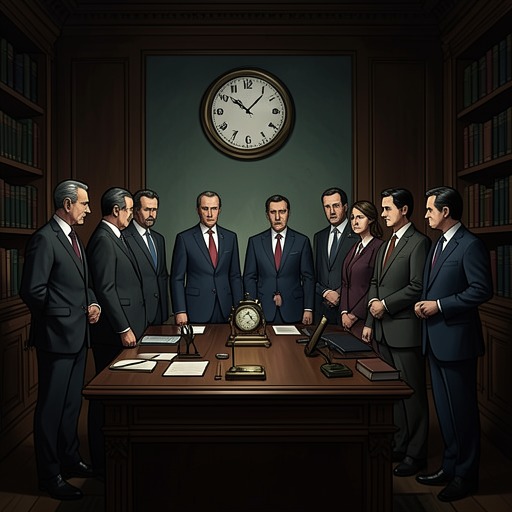
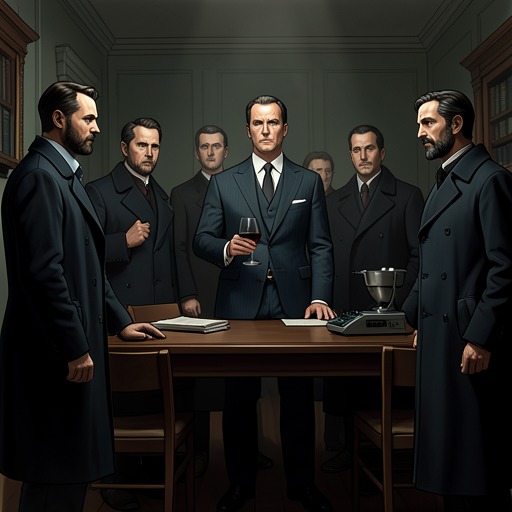
Neville Chamberlain’s private secretary, Hugh Legat, brings the officers to the Cabinet Room. The Prime Minister is meeting with Lord Halifax, the Chancellor of the Exchequer, and the Home Secretary. After Hugh Legat announces that the Chiefs of Staff are waiting, Neville Chamberlain initially remains turned away, his fingers tapping the polished table. He then agrees to receive them. The officers leave their caps by the door, take the seats vacated by the ministers, and spread their papers across the table; Lord Gort occupies the central position.
The Military Assessment
At 2:05 p.m., Hugh Legat marks the meeting on a foolscap sheet as a meeting of the Prime Minister and Chiefs of Staff. Neville Chamberlain introduces the deteriorating situation: the proposed orderly transfer of the Sudeten territory to Germany, subject to a plebiscite, has given way to Adolf Hitler’s declaration that he will invade on Saturday. The Prime Minister also recounts the warning conveyed by Sir Horace Wilson and Hitler’s reported defiance of the possibility that Britain and France might act together.
Lord Gort presents the Chiefs’ memorandum and asks permission to read its conclusion. The assessment is categorical: pressure from Britain and France, whether by sea, land, or air, cannot prevent Germany from overrunning Bohemia and inflicting a decisive defeat on Czechoslovakia. In the Chiefs’ view, restoring Czechoslovakia’s lost integrity would be possible only through Germany’s defeat, as the outcome of a prolonged struggle that would from the outset amount to unlimited war. The memorandum therefore makes the scale and character of a possible conflict explicit, rather than suggesting that military pressure could quickly reverse Germany’s advance.
Advice and the Government’s Dilemma
The Chiefs’ assessment is presented within a Cabinet discussion already shaped by the prospect of war. Neville Chamberlain says that he will continue seeking a peaceful solution if one exists, while warning that the government must prepare for the worst. The military conclusion sharpens the choice facing ministers: resisting Germany could not be treated as a limited intervention with a readily achievable military objective, but as a commitment to a prolonged and potentially unlimited struggle.
The novel also places the Chiefs’ warning alongside later arguments over what Britain should ask of Czechoslovakia. Lord Halifax objects to sending Sir Horace Wilson’s proposed telegram urging the Czechs to accept Hitler’s terms, calling such a demand a capitulation and stressing that Britain cannot guarantee Germany would stop at the Sudetenland. Separately, Neville Chamberlain weighs whether the British public could be persuaded to continue a winter war if Czechoslovakia collapsed, while Lord Halifax points to the Dominions’ opposition to fighting over so narrow an issue. These political arguments are not presented as the Chiefs’ own statements; they show the severe military and domestic constraints within which the government considers the memorandum’s implications.
Record and Narrative Significance
The Chiefs’ contribution is formal and documentary: they bring a collective memorandum, and Lord Gort reads its conclusion aloud to ministers. Hugh Legat records the meeting’s time and participants, but later, when Osmund Somers Cleverly asks what happened to his minute of the meeting with the Chiefs, Legat says that Neville Chamberlain decided he did not want the meeting recorded. The contrast between a written military assessment and the disputed status of the meeting’s record gives the scene a second institutional significance: the officers’ warning enters the government’s deliberations, while the account of those deliberations is itself subject to control.
The British Chiefs of Staff do not decide the policy that follows. Their role is to define its military cost with unusual severity. By placing the prospect of Czechoslovakia’s defeat beside the scale of the war required to restore it, their memorandum makes clear why the government’s search for a diplomatic alternative is not simply a matter of preference: it is being pursued against a military assessment that leaves no easy route to rescue.