early in the story
Departure from Aleppo
On a freezing winter morning at five o'clock, Hercule Poirot boards the Taurus Express in Aleppo, Syria, after successfully completing a delicate mission for the French Army. Lieutenant Dubosc sees him off with elaborate politeness, and Poirot settles into his sleeping compartment as the train departs. This opening establishes Poirot's reputation as a master detective and sets the stage for his journey toward Constantinople.
later the same day
Meeting Mary Debenham and Colonel Arbuthnot
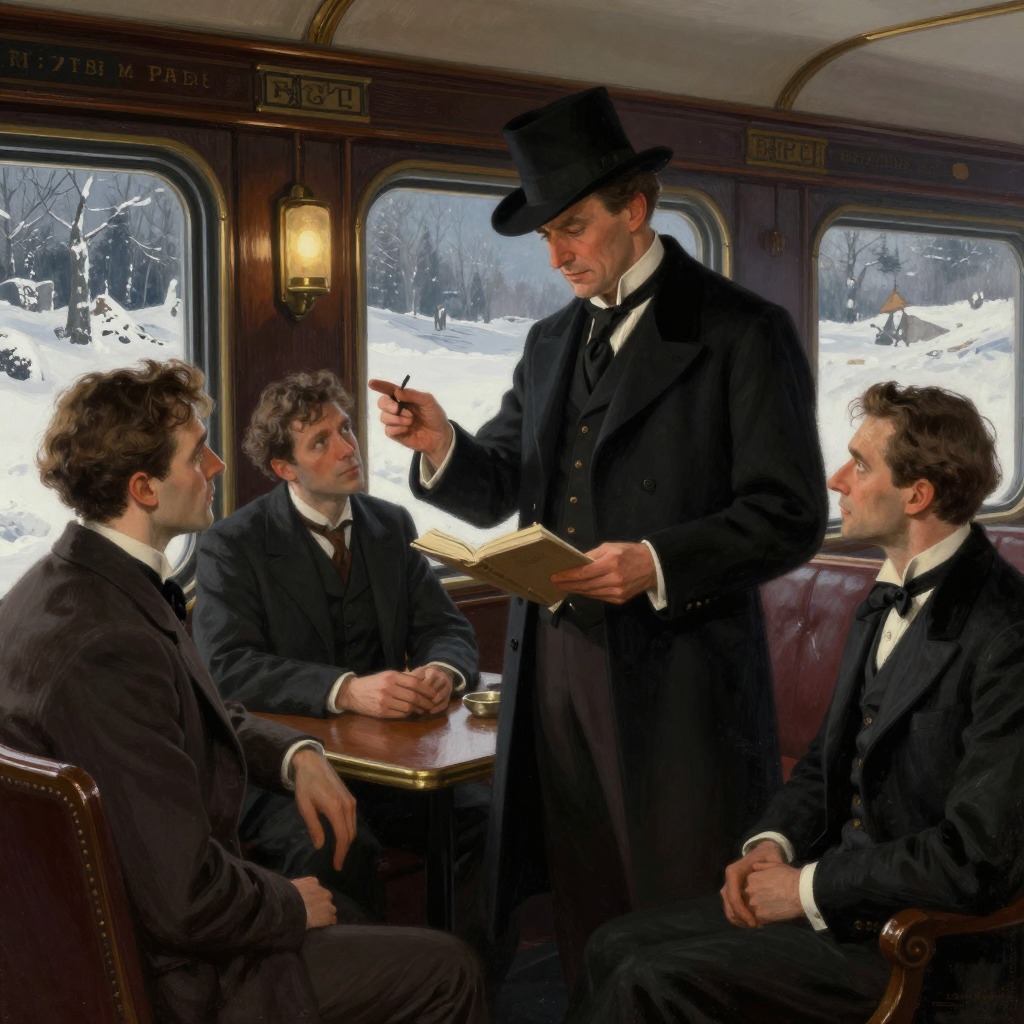
In the restaurant car, Poirot observes the two other passengers: Mary Debenham, a coolly efficient young Englishwoman returning from Baghdad, and Colonel Arbuthnot, a lean, brown-skinned army officer from India. They exchange brief, polite conversation, revealing a mutual acquaintance and a growing but restrained intimacy. Poirot notes their reserved English manner and senses an undercurrent of tension between them.
night of the first day
Overheard Words at Konya
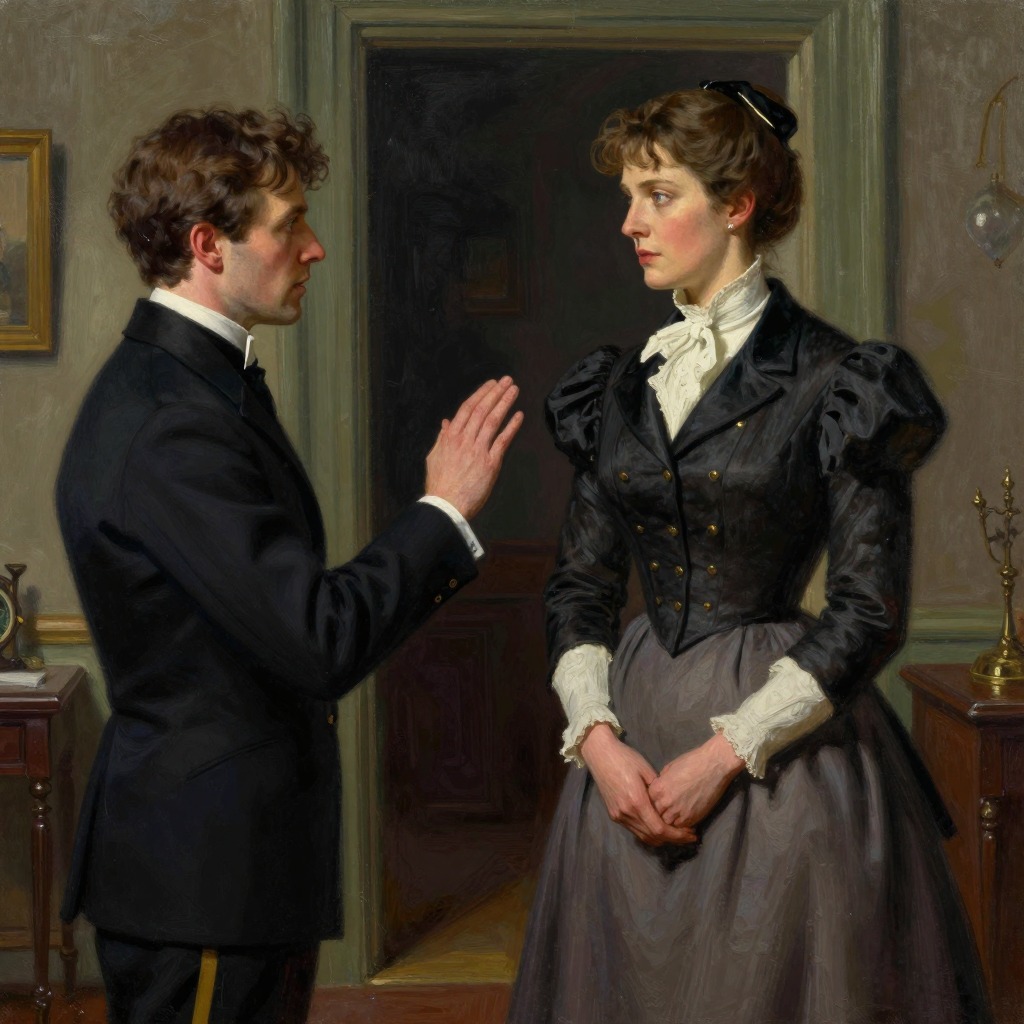
During a stop at Konya, Poirot steps onto the snowy platform and overhears Mary Debenham and Colonel Arbuthnot speaking in the shadows. She says, 'Not now. Not now. When it's all over. When it's behind us—then—' The words are charged with emotion and secrecy, puzzling Poirot and planting a seed of suspicion. He later recalls this moment as a key clue.
Monday evening
Arrival in Constantinople
The Taurus Express arrives at Hayda-Passar only five minutes late. Poirot crosses the rough Bosphorus and drives to the Tokatlian Hotel. There he finds a telegram recalling him to London on urgent business, forcing him to abandon his planned sightseeing and book a berth on the Simplon Orient Express that very night.
evening at the Tokatlian Hotel
Encounter with M. Bouc
While dining at the hotel, Poirot is greeted by his old friend M. Bouc, a director of the Compagnie Internationale des Wagons Lits. They agree to travel together on the Orient Express. Poirot also notices a sinister American, Mr. Ratchett, and his secretary, Hector MacQueen, in the restaurant. Poirot feels a distinct impression of evil emanating from Ratchett, comparing him to a wild animal behind a respectable facade.
9:00 PM, Monday
Boarding the Orient Express
At the station, M. Bouc learns the train is unexpectedly full. Using his authority, he arranges for Poirot to take berth No. 7 in a second-class compartment already occupied by Hector MacQueen. The young American initially objects but graciously offers Poirot the lower berth. The train departs, beginning its three-day journey across Europe.
lunchtime, Tuesday
Poirot Refuses Ratchett's Case
In the dining car, Poirot observes the other passengers: Princess Dragomiroff, the Hungarian couple, Mrs. Hubbard, Greta Ohlsson, and others. After lunch, Ratchett approaches Poirot and offers him a large sum of money to protect him from an enemy who has threatened his life. Poirot refuses bluntly, stating he does not like Ratchett's face. This refusal establishes Ratchett's vulnerability and Poirot's moral stance.
8:45 PM, Tuesday
Evening at Belgrade
The train arrives at Belgrade. Poirot descends briefly but returns quickly due to the bitter cold. M. Bouc has moved to the Athens coach, giving Poirot his original compartment. Poirot walks through the corridor, noting the passengers settling in for the night. Mrs. Hubbard expresses her fear of Ratchett, and Poirot sees Ratchett's valet, Masterman, attending to him.
12:37 AM, Wednesday
A Cry in the Night
Poirot is awakened by a loud groan or cry from Ratchett's compartment. He hears the conductor knock, and a voice from inside says in French, 'Ce n'est rien. Je me suis trompé.' Poirot notes the time—23 minutes to one—and returns to sleep, assuming the incident is trivial. This moment later becomes crucial evidence.
about 1:17 AM, Wednesday
Mrs. Hubbard's Alarm
Poirot hears Mrs. Hubbard repeatedly ringing for the conductor, insisting a man was in her compartment. The conductor, Pierre Michel, tries to calm her, but she is adamant. Poirot orders mineral water and learns from Michel that the train has stopped in a snowdrift between Vincovci and Brod. The snowbound situation traps everyone on board.
morning, Wednesday
Discovery of the Body
The train remains stuck in snow. At about 11:00 AM, the conductor and chef de train break into Ratchett's locked and chained compartment, finding him dead, stabbed multiple times. Dr. Constantine examines the body and estimates death occurred between midnight and 2:00 AM. The window is open, but no footprints in the snow suggest an escape that way.
later that morning
Poirot Takes Charge
M. Bouc asks Poirot to investigate the murder, fearing the complications of involving local police. Poirot agrees, intrigued by the puzzle. He requests a plan of the coach, passengers' passports and tickets, and begins his inquiry. The doctor notes the wounds are inconsistent—some feeble, some powerful—suggesting either two attackers or a staged crime.
morning, Wednesday
Interview with Hector MacQueen
Poirot questions Ratchett's secretary, Hector MacQueen. MacQueen reveals Ratchett had received threatening letters and feared an enemy. He admits he disliked Ratchett but denies any involvement. Poirot learns MacQueen's father was the district attorney in the Armstrong case, giving MacQueen a personal motive. MacQueen provides an alibi: he was talking with Colonel Arbuthnot until nearly 2:00 AM.
morning, Wednesday
Examination of the Body
Poirot and Dr. Constantine examine Ratchett's compartment and body. They find twelve stab wounds, some superficial, others deep and forceful. The doctor notes that some wounds appear to have been inflicted after death, and that both left-handed and right-handed blows were used. Poirot discovers a woman's handkerchief with an initial H, a pipe-cleaner, and a charred note fragment mentioning 'little Daisy Armstrong.'
afternoon, Wednesday
Revelation of Ratchett's Identity
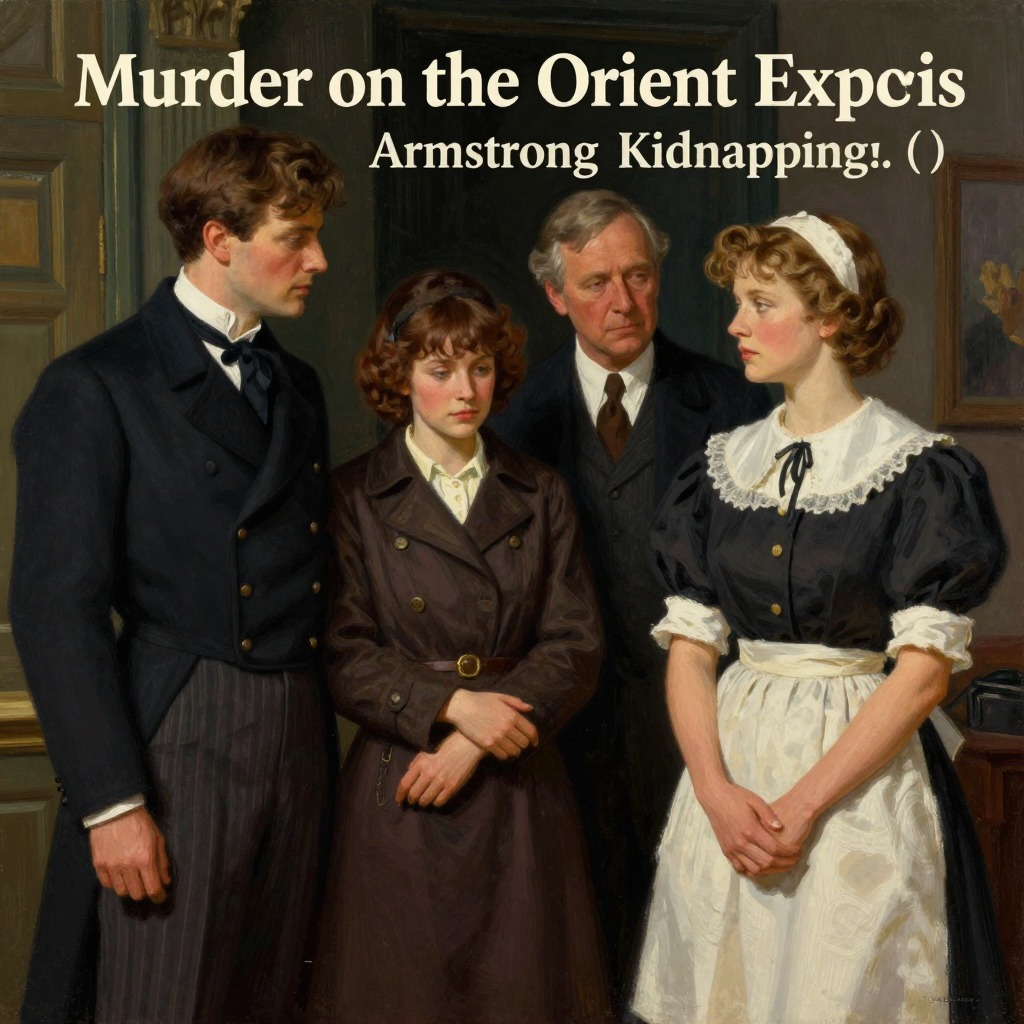
Using a spirit stove and curling-tongs, Poirot reconstructs the charred note, revealing the words 'member little Daisy Armstrong.' He realizes Ratchett is actually Cassetti, the mastermind behind the Armstrong kidnapping case. Poirot explains the tragedy to M. Bouc and Dr. Constantine: the kidnapping, the ransom, the child's murder, the mother's death in childbirth, the father's suicide, and the nursemaid's suicide. This establishes the motive for multiple passengers.
afternoon, Wednesday
Evidence of the Wagon Lit Conductor
Pierre Michel testifies that he last saw Ratchett alive at 12:37 AM, when he answered the bell. He confirms he was in the Athens coach for about ten minutes after 1:00 AM, then answered Mrs. Hubbard's bell. He saw a woman in a scarlet kimono in the corridor. Poirot notes that Michel's account matches the timeline but leaves gaps.
afternoon, Wednesday
Evidence of the Valet
Edward Masterman, Ratchett's valet, states he last saw his master at about 9:00 PM, preparing for bed. He confirms Ratchett took a sleeping draught. Masterman claims he had toothache and stayed awake reading in his compartment, sharing it with Antonio Foscarelli, who never left. He denies any knowledge of the crime.
afternoon, Wednesday
Evidence of Mrs. Hubbard
Mrs. Hubbard insists a man was in her compartment during the night. She found a Wagon Lit uniform button on her magazine, which she presents as proof. She also admits hearing a woman's voice from Ratchett's compartment earlier. Poirot notes her story but questions the bolt's position, given her sponge-bag's placement.
afternoon, Wednesday
Evidence of Greta Ohlsson
Greta Ohlsson, a Swedish missionary, testifies she mistakenly opened Ratchett's door around 10:40 PM, seeing him alive and reading. She then visited Mrs. Hubbard for aspirin. She confirms the communicating door was bolted. She provides an alibi for Mary Debenham, saying the girl never left their compartment.
afternoon, Wednesday
Evidence of Princess Dragomiroff
Princess Dragomiroff states she retired early, suffered from rheumatism, and summoned her maid, Hildegarde Schmidt, at about 12:45 AM for massage and reading. She claims she heard nothing unusual. She admits knowing the Armstrong family—she was godmother to Sonia Armstrong—and expresses satisfaction at Ratchett's death. Poirot notes her strong will and frail physique.
afternoon, Wednesday
Evidence of Count and Countess Andrenyi
Count Andrenyi states he and his wife played piquet until 11:00 PM, then retired. He claims his wife took a sleeping draught and heard nothing. Poirot insists on questioning the Countess alone. She confirms her husband's account but seems nervous. Poirot notices a grease spot on her passport, obscuring her Christian name.
afternoon, Wednesday
Evidence of Colonel Arbuthnot
Colonel Arbuthnot testifies he was talking with MacQueen until about 1:45 AM, then returned to his compartment. He smokes a pipe, and Poirot notes the pipe-cleaner found at the crime scene. Arbuthnot denies knowing Ratchett but admits he knew of Colonel Armstrong. He provides a character reference for Mary Debenham, calling her 'a pukka sahib.'
afternoon, Wednesday
Evidence of Cyrus Hardman
Cyrus Hardman reveals he is a private detective from the McNeil Agency, hired by Ratchett to protect him from a 'small dark man with a womanish voice.' He claims he watched the corridor all night and saw no one enter or leave Ratchett's compartment. Poirot accepts his identity but questions his story's completeness.
afternoon, Wednesday
Evidence of Antonio Foscarelli
Antonio Foscarelli, an Italian-American car salesman, gives a voluble account of his movements. He claims he never left his compartment, supported by Masterman's testimony. Poirot notes his Italian temperament and possible use of a knife, but finds no direct evidence against him.
afternoon, Wednesday
Evidence of Mary Debenham
Mary Debenham answers questions calmly but reveals little. She denies knowing Ratchett and claims she slept through the night. Poirot presses her about the overheard conversation at Konya, but she refuses to explain, saying it was a private matter. She mentions seeing a woman in a scarlet kimono in the corridor at 5:00 AM.
afternoon, Wednesday
Evidence of Hildegarde Schmidt
Hildegarde Schmidt, Princess Dragomiroff's maid, testifies she was summoned at about 12:45 AM, attended to her mistress, and returned to her compartment. She describes encountering a small, dark man in Wagon Lit uniform in the corridor—a man who is not any of the three conductors. This corroborates Hardman's description of the supposed assassin.
afternoon, Wednesday
Summary of Evidence
Poirot reviews the evidence with M. Bouc and Dr. Constantine. He notes the conflicting clues: the handkerchief, pipe-cleaner, scarlet kimono, and the mysterious Wagon Lit attendant. He points out that the watch stopped at 1:15 may be faked. The doctor reiterates the impossibility of a single attacker given the wounds' variety. Poirot begins to suspect a conspiracy.
afternoon, Wednesday
Discovery of the Weapon
Mrs. Hubbard bursts into the dining car, hysterical, claiming she found a blood-stained dagger in her sponge-bag. Poirot and the others examine the weapon—a cheap Oriental dagger—and confirm it matches the wounds. Poirot notes the sponge-bag was hanging on the communicating door handle, suggesting the murderer placed it there while escaping through her compartment.
afternoon, Wednesday
Search of Passengers' Luggage
Poirot, M. Bouc, and Dr. Constantine search the luggage of all passengers in the Stamboul-Calais coach. In Hildegarde Schmidt's suitcase, they find a Wagon Lit uniform with a missing button, matching the one Mrs. Hubbard found. Later, in Poirot's own valise, they discover a scarlet silk kimono embroidered with dragons. These discoveries deepen the mystery.
evening, Wednesday
Poirot's Ten Questions
Poirot presents a list of ten unresolved questions to M. Bouc and Dr. Constantine, covering the handkerchief, pipe-cleaner, kimono, uniform, watch, and the nature of the wounds. He challenges them to think. M. Bouc theorizes two murderers, but Poirot remains unsatisfied, sensing a deeper pattern.
evening, Wednesday
The Grease Spot Revelation
Poirot confronts Countess Andrenyi, revealing that her passport's grease spot conceals the initial H—Helena, not Elena. She admits she is Helena Goldenberg, the younger sister of Sonia Armstrong. She and her husband altered the passport to avoid suspicion. She swears she did not kill Ratchett, and her husband confirms her alibi. Poirot begins to see the conspiracy taking shape.
evening, Wednesday
Princess Dragomiroff Claims the Handkerchief
Princess Dragomiroff enters the dining car and claims the handkerchief with the initial H is hers, explaining that H is the Russian letter for N. She admits she lied about Helena Andrenyi's identity to protect her friend's daughter. Poirot notes her loyalty but remains suspicious of her role.
evening, Wednesday
Second Interview with Colonel Arbuthnot
Poirot questions Colonel Arbuthnot again about the pipe-cleaner and the overheard conversation. Arbuthnot refuses to explain the words, citing loyalty to Miss Debenham. Poirot then reveals that Mary Debenham was a governess in the Armstrong household. Arbuthnot is shocked but maintains her innocence.
evening, Wednesday
Mary Debenham's Confession
Mary Debenham admits she lied about never being in America; she was indeed the governess in the Armstrong house. She explains she concealed this to protect her career from scandal. She breaks down in tears, and Colonel Arbuthnot comforts her, revealing their deep bond. Poirot now sees her as part of the conspiracy.
evening, Wednesday
Further Revelations
One by one, the remaining passengers confess their connections to the Armstrong case: Antonio Foscarelli was the chauffeur, Greta Ohlsson was the nurse, Masterman was Colonel Armstrong's batman, and Pierre Michel is the father of Susanne, the nursemaid who committed suicide. Hardman admits he loved Susanne. The conspiracy becomes undeniable.
evening, Wednesday
Poirot Propounds Two Solutions
Poirot assembles all passengers in the dining car. He presents two solutions: first, an outside assassin who escaped before the snow; second, the true solution—a conspiracy of twelve people, each connected to the Armstrong tragedy, who jointly executed Ratchett. He reveals that Mrs. Hubbard is actually Linda Arden, the actress and grandmother of the murdered child, who orchestrated the plot.
evening, Wednesday
Confession of Linda Arden
Mrs. Hubbard, now revealed as Linda Arden, confirms Poirot's solution. She describes the grief and rage that drove the group to plan Ratchett's execution. Each of the twelve stabbed him once, ensuring collective responsibility. She asks Poirot to spare the others and take the blame herself. Her voice, rich with theatrical emotion, moves the room.
evening, Wednesday
Poirot's Decision
M. Bouc and Dr. Constantine agree to accept Poirot's first, false solution for the official report, protecting the conspirators. Poirot formally retires from the case, allowing the 'outside assassin' theory to stand. The novel ends with the implication that justice, in a higher sense, has been served, and the passengers are free to continue their journeys.