Elder isolation and care insecurity
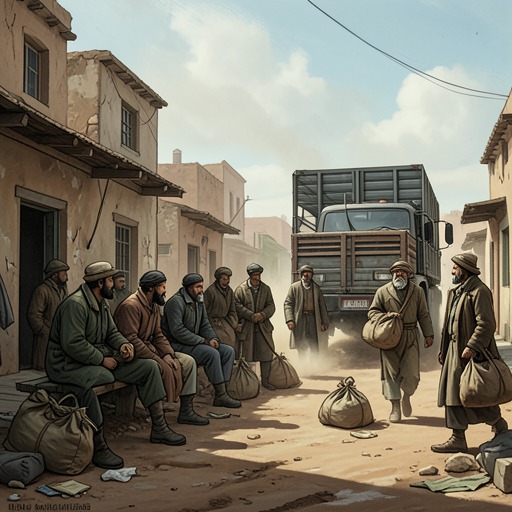
NomadlandElder isolation and care insecurity are among the least visible costs of nomadic life in the book: the people who share food, skills, and companionship can help one another through an immediate crisis, but they cannot guarantee affordable medical care, a secure place to live, or support in old age. The contrast is stark. A travelling community may arrive with food when someone is ill, while an older person can die undiscovered in a parked vehicle. Informal kinship matters, but it is not a substitute for dependable care.
The long road to insecurity
The book situates older nomads’ vulnerability within a wider reversal in retirement security. Many workers in the Amazon camps, it observes, were downwardly mobile older Americans whose circumstances would once have seemed remote from the expectations associated with a stable middle-class life. Economist Monique Morrissey describes a first-ever reversal in modern American retirement security: beginning with younger baby boomers, successive generations are less able than their predecessors to retire without a drop in living standards.
The pressures show up in both the number of older people still working and the uncertainty surrounding retirement. In 2016, nearly nine million Americans aged sixty-five and older remained employed, a 60 percent increase over the previous decade. The book reports that economists expected the numbers and the proportion of seniors in the labor force to keep rising. Although most older Americans still regarded retirement as a time of leisure, only 17 percent expected not to work at all in later life. Continued work, in this account, is not reliably a matter of preference; for many, it is part of making an insecure future financially possible.
The retirement system’s weakened supports help explain that insecurity. The Three-legged stool model of retirement security joined Social Security, private pensions, and individual savings and investments. The book argues that two legs have been eroded: the Great Recession destroyed many people’s assets, while employers had increasingly replaced defined-benefit pensions with 401(k) plans that rely more heavily on workers’ contributions and can be exhausted before death. The shift moved more economic risk onto families. For people reaching old age without adequate savings or a pension, seasonal jobs and vehicle dwelling can become less a chosen alternative than a response to the failure of other supports.
Work in place of retirement
The work available to older nomads can be physically demanding even when employers praise their reliability. David Roderick, a seventy-seven-year-old workamper, recalled selling Christmas trees with his wife, who was also in her seventies. For eight to ten hours a day, six days a week, he carried trees as tall as nine feet and helped lift them onto customers’ vehicles. He liked selling, but described the cutting and hauling as work for a much younger person; several members of the crew were retired. His blunt assessment was that employers valued retirees as dependable workers while effectively getting very cheap labor.
David’s own history shows how retirement insecurity can accumulate over a lifetime rather than begin in old age. He had taught chemistry and oceanography at California community colleges, but during an earlier divorce he had to cash out a pension built over sixteen years. It amounted to $22,000 to divide with his first wife; had it remained invested with the state’s match, it might have grown to at least $500,000. His later wife had also lost substantial security when a $650,000 annuity from her first marriage disappeared in the 1991 collapse of Executive Life. A long working life, in other words, did not ensure a dependable retirement income.
Older workers appear in other settings as well. At Adventureland, a seventy-seven-year-old former recruiter spoke proudly of coworkers whose ages or disabilities had not kept them from working: one employee was eighty, another had been eighty-six, a wheelchair user counted visitors at the water park, and a one-armed employee supervised rides. An operator at the Tornado rollercoaster was eighty-one. These details show older people present and capable in the workforce, but presence at work does not resolve what happens when a person can no longer work, drive, or live independently.
Care beyond the reach of the road
One formal option for aging RVers who can no longer drive is Escapees CARE, an assisted-living center annexed to Rainbow’s End RV park in Livingston, Texas. Residents stay in their own motorhomes, a provision that accommodates life on wheels but does not make the service affordable. A site costs more than $850 a month, and optional adult daycare adds another $200 each week. Those prices put the facility beyond the reach of most of the people the narrator had met. The arrangement offers a destination for some, but its existence does not amount to accessible care for the wider nomadic population.
The consequences of having no reliable support emerge in accounts of isolated deaths. Iris Goldenberg, a nomad who lived with a talking parrot, said an acquaintance named Ron drank himself to death while boondocking in a Walmart parking lot, thirty-six miles from Quartzsite. His body was not found for a month. A volunteer with the Church of the Isaiah 58 Project had also spoken of an eighty-year-old man who had taken shelter at the church for three months, then was found dead in his RV in the desert near Ehrenberg. In both accounts, vehicle dwelling provided shelter without ensuring that anyone would be present to notice when help was needed.
Patti DiPino’s story adds the vulnerability of illness to the insecurity of work and housing. After losing her bookkeeping job and her house, she moved into her RV and sent out thousands of applications, but her decades of office experience did not return her to full-time employment. She later died at sixty while receiving radiation treatment for cancer. A friend’s memorial described the freezing conditions, cramped spaces, and debt that had marked her life on the road. The book does not present her death as a simple consequence of nomadism; instead, her story makes visible how illness can arrive within a life already shaped by lost work and housing.
Mutual aid and chosen kin
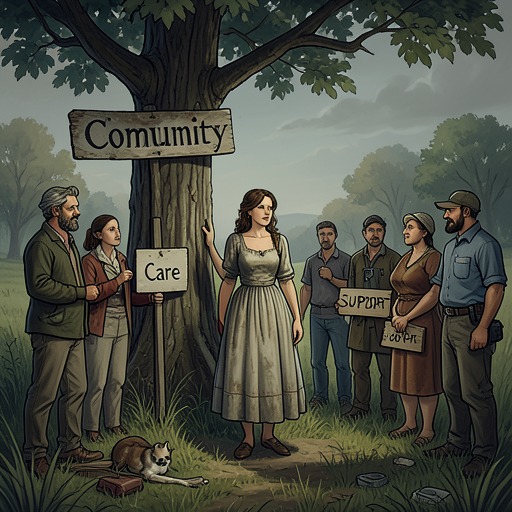
Against these failures, the book records practical acts of care among nomads. At the Rubber Tramp Rendezvous, people shared skills and resources: mechanics taught basic repairs, carpenters made furniture for vans, and people with large solar panels offered surplus power. Lesa NeSmith kept an older habit of hospitality alive by starting the morning campfire and making cowboy coffee for anyone who came by. Shared meals drew on whatever each person could contribute. Such exchanges did not solve long-term care needs, but they made community materially useful as well as sociable.
Food moved through the group when money or warmth ran short. After Kat and Mike Valentino ran out of gas trying to keep their van warm during a cold spell near Quartzsite, Vincent Mosemann drove them into town to fill a fuel jug. They returned with apples, sausages, and a large bag of salad from the food bank. Earlier, the narrator had left groceries for Linda May and Silvianne Delmars; Linda said she had only ten dollars left until payday. In both instances, assistance met a precise and immediate need rather than an abstract wish for solidarity.
The same reciprocal care could extend to sickness and injury. When Linda fell ill with severe bronchitis in Ehrenberg and was too weak to cook, off-grid neighbors brought her boiled eggs, tomatoes, and sausage. The book also recalls a nomad whose broken arm left her unable to manage ordinary tasks: friends formed what they called Camp Recovery, helping with things from tying shoes to fastening a bra until she could move on. During a visit to nearby petroglyphs, Charlene Swankie led a caravan of vans and later hauled a stranded vehicle from a ditch with her own van and a nylon strap. These gestures created a form of chosen kinship built from repeated, practical acts. They could ease an illness or help someone through recovery, but they remained dependent on who happened to be nearby and able to help.
Plans for an uncertain old age
When asked about the future, some nomads described endurance rather than a care plan. Silvianne Delmars imagined continuing on the road indefinitely, even if that meant a final drive over a cliff. Iris Goldenberg asked to be left in the desert after death, covered with rocks. Bob Wells proposed a more engineered refuge: burying one side and the roof of a cheap, durable school bus, with windows on the south-facing side. If that plan failed, he imagined walking into the wilderness and taking his own life. These were statements of anticipated contingencies, not events that the book reports as having occurred. Their starkness nevertheless shows how little security some people expected from institutions in old age.
Peter Fox answered the same uncertainty by imagining collective provision. After a registered nurse at the gathering lanced an infected finger, he wondered where people would go when they were too old to camp or live in a van. He proposed roving medical teams or way stations at state parks and other places where nomads gathered, and imagined a nonprofit for aging vandwellers called the Hello in There Foundation. He had no settled personal solution; a niece and nephew had offered to take him in if things became desperate. His idea turns isolation into a question of infrastructure: care should not have to depend entirely on a relative’s offer or a chance encounter with a nurse.
Together, these accounts hold two truths in view. Nomadic communities can build real systems of exchange and affection, bringing food, practical help, and companionship to people in immediate need. Yet friendship cannot guarantee regular medical care, affordable assisted living, or someone’s presence at the moment of a crisis. The distance between a camp’s informal family and the support required in frailty is where elder isolation and care insecurity become most consequential.