Vehicle dwelling
NomadlandVehicle dwelling turns a van, trailer, or other vehicle into both shelter and transportation, allowing people to leave conventional housing when its costs become untenable. In the book, it is not simply a travel preference: it is an adaptive way to survive economic pressure, a bid for greater choice, and an indicator of strains reaching far beyond those who live on the road.
Definition and Conditions
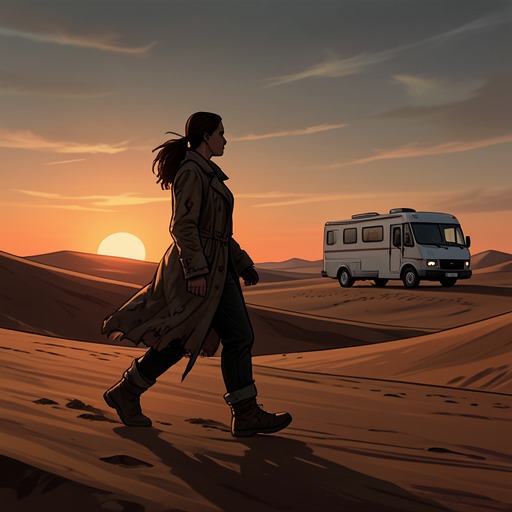
The vehicles range from vans and secondhand recreational vehicles to school buses, pickup campers, travel trailers, and ordinary sedans. The book calls this mobile housing wheel estate, in contrast to a conventional stick-and-brick home. Its residents may be called homeless by outsiders, but many describe themselves as houseless: they lack a traditional house while retaining shelter and transportation. That distinction matters to their self-understanding, although it does not remove the insecurity or practical difficulties of their lives.
For many, moving into a vehicle follows a narrowing series of financial choices: whether to pay rent or student loans, buy medicine or make a car payment, or cover utilities and food. Giving up a conventional home can cut a major expense, but it does not create income or eliminate the costs of travel. People still need to keep their vehicles fueled and themselves fed, and many take demanding seasonal jobs to do so. The resulting life is mobile, but not cost-free or unconstrained.
The residents can look much like retired recreational-vehicle travelers. Some do laundry at laundromats and use fitness clubs for showers; when they go to a movie or restaurant, they may blend into the surrounding crowd. Yet many are working long hours at physical jobs and living this way after savings were depleted in the Great Recession. The book therefore presents vehicle dwelling not as an easy escape from hardship, but as one way people respond when flat wages and rising housing costs make conventional arrangements difficult to sustain.
A Mobile Life, and What Makes It Possible
Movement offers its own form of hope. Seasonal workers leave camps as jobs end and travel toward another job, warmer weather, or people they know. The road crosses ordinary commercial and residential landscapes, and overnight stops may be Walmart parking lots, quiet suburban streets, or truck stops. Rest is temporary: travelers pull off, sleep, and return to the highway before their presence attracts attention. The parking spot becomes a brief refuge within a journey that must continue.
That mobility relies on an infrastructure that is easy to overlook. A vehicle must be registered, inspected, insured, and associated with an official place of residence, even when its owner has no fixed home in the ordinary sense. Because nomads must maintain a domicile for taxes, voting, licenses, and other obligations, some use mail-forwarding services and choose states with relatively few administrative burdens. South Dakota, for example, allows a person to establish residency after spending one night at a local motel and registering with a mail-forwarding service, then presenting both receipts to the state department of public safety. The arrangement makes a life without a settled home legible to government systems by assigning it a fixed address on paper.
Parking and communication also shape where a mobile life can take place. Walmart has allowed overnight stays in many of its lots, but the practice is not universal: local restrictions and store decisions can close off particular locations, and some stores have withdrawn permission after visitors overstayed or established encampments. An overnight-parking locator app marks stores in the United States and Canada, distinguishing locations where travelers may be rousted or towed from those where users report having stayed. Such tools make access to a place to sleep partly dependent on current information and other travelers’ accounts.
Public land offers another, regulated form of refuge. Near Quartzsite, the Bureau of Land Management permits free camping for up to two weeks in designated desert areas. Campers must then move at least twenty-five miles to another patch of federal desert or stay at the La Posa Long Term Visitor Area, where permits cost $40 for two weeks or $180 for as long as seven months. A roadrunner-and-snowflake sticker on a windshield marks a permit holder. Here, the vehicle and its visible markings connect personal mobility to a managed landscape, where a right to stay comes with a time limit and a requirement to move.
Informal Community and Practical Knowledge
Mobility does not necessarily mean isolation. When travelers meet online, at jobs, or at dispersed campsites, they exchange information and sometimes help one another. The book describes a shared sense of kinship, including people passing a hat when someone’s van breaks down. Online forums and practical guides address the everyday work of this life, from mail and loneliness to showers and places to park.
Bob Wells’s CheapRVLiving.com, launched in 2005, began with budget-oriented how-to articles. It explained boondocking—camping away from paid recreational-vehicle hookups—as well as stealth parking or stealth camping in more urban settings. After the 2008 financial crisis, traffic to the site surged as people who had lost jobs, exhausted savings, or faced foreclosure searched for ways to live in vehicles. Wells offered both practical guidance and an interpretation of the change: people could regard vehicle living not only as a response to a failed economic promise, but as a possible route to freedom and adventure.
The community’s practical knowledge ranges beyond any one website. Travelers share advice about bathing, mail, and campsites; online maps and directories identify free camping areas and businesses that permit overnight parking. In Quartzsite, thousands of recreational-vehicle dwellers gather seasonally on public land, where neighbors in tents and expensive custom motorhomes share access to the desert. The book presents this temporary community as a place where differences in means may become less visible in the shared purpose of staying on public land. Such moments of mutual welcome coexist with the need to follow rules, conserve resources, and keep moving.
Regulation, Visibility, and the Right to Stay
The places that shelter vehicle dwellers can also become places of surveillance and exclusion. The book describes laws in cities that restrict sitting or sleeping in public and a rise, between 2011 and 2014, in the number of surveyed cities that prohibited sleeping in cars: from 37 to 81. In this account, the distinction between a vehicle being allowed to remain and its occupant being allowed to sleep inside it exposes a conflict over who may use public space for shelter.
Regulation extends beyond cities. In Coconino National Forest, rangers have questioned van and recreational-vehicle campers about their home addresses. A vehicle bearing a Quartzsite boondocking sticker could be treated as evidence that its occupant was a permanent nomad, and campers could be ticketed or evicted for making residential use of the forest. The book also reports that the Forest Service was developing an app for citizens to report suspected long-term campsites. Together, these examples show that movement is not simply a matter of possessing a vehicle: the right to stop, sleep, and remain is contested and may depend on how authorities interpret a person’s presence.
Urban vehicle homes can be difficult to recognize precisely because their occupants work to remain inconspicuous. In Brooklyn, New York, the narrator encounters camper vans, motorhomes, trailers, and a converted shuttle among ordinary work vehicles. Some have covered windows or drawn curtains; a yellow school bus has metal over its windows and four aligned solar panels on its roof. The vehicles form an invisible city in plain sight, visible as objects but concealing the people and domestic routines within them. Remembering the vulnerability of stealth parking, the reporter chooses not to knock on a vehicle’s door. That decision makes the privacy sought by discreet parking part of the scene rather than merely a logistical detail.
Wider Significance
The book frames vehicle dwellers as an indicator species: a comparatively visible group whose adaptation signals wider economic pressures. Most people facing impossible household budgets will not move into vehicles, but the underlying arithmetic recurs in homes across the country—wages set against groceries, medical bills, utilities, debt, and rent. Vehicle dwelling makes one possible response unusually legible: instead of accepting the full cost of conventional housing, some people surrender the stability associated with it and reorganize their lives around a vehicle, work, and movement.
The practice therefore holds two meanings at once. It can represent a measure of choice and a search for freedom, especially for people who have concluded that conventional middle-class security is out of reach. It also depends on arrangements that can be withdrawn or restricted: parking permission, public-land access, fuel, seasonal employment, communication, and a required legal domicile. The road is not outside society’s systems; it is a way of navigating them, with movement offering possibilities while rules and costs continually determine where a person can stop.
The book’s closing return to the city widens the subject beyond the people already identified as nomads. The reporter notices concealed mobile shelters in ordinary Brooklyn streets and connects them to the recurring household calculations behind housing insecurity. Vehicle dwellers are not presented as an isolated curiosity or a universal solution. Their lives make visible a larger question about what people must give up to keep living, and about how much room a society leaves for those who can no longer afford a conventional place to stay.