Inadequate retirement security
NomadlandInadequate retirement security shapes Linda May’s search for a livable future and exposes a broader change in American working life: reaching old age no longer guarantees an end to paid labor. Linda had no pension, little savings, and a projected Social Security benefit of roughly $500 a month. Her attempt to imagine retirement therefore depended not on leaving work behind, but on finding a cheaper way to live while continuing to earn. Around her, older workers filled seasonal and physically demanding jobs, while family members increasingly absorbed the costs of economic and health insecurity.
Linda May and the missing safety net
Linda’s working life had not produced lasting financial stability. In her sixties, she was working as a Home Depot cashier in Lake Elsinore for $10.50 an hour, sometimes receiving only twenty to twenty-five hours a week. She had two degrees in construction and prior experience as an expeditor at another Home Depot, but the cashier position paid less and made little use of her expertise. She suspected age prejudice played a part in the limited opportunities available to her. Her experience suggested that years of work and accumulated skill did not necessarily translate into secure employment or a better-paid role.
The prospect of retirement made that instability immediate. Linda had never managed to obtain a pension and had no meaningful savings to draw on. When she read her Social Security statement, she learned that her expected monthly benefit would be about $500—not enough to cover the rent on its own. She began collecting benefits at sixty-two, in 2012, later reflecting that she might have waited until sixty-five but had doubted a larger percentage would make much difference to so small a payment. The decision registered the narrowness of her choices: even a benefit claimed early offered little protection from the need to keep working.
Her situation was compounded by responsibilities within the family. While staying with her daughter Audra, son-in-law Collin, and grandchildren in Mission Viejo, Linda slept on a couch by the front door and felt stranded without her Jeep. She loved her family but missed having autonomy and worried that her presence made their household arrangements more difficult. The family was already under pressure: one grandchild had been ill for years, another managed type 1 diabetes, Audra had arthritis, and Collin’s migraines and vertigo had forced him out of his office job. In this setting, Linda’s wish not to become a burden was not an abstract concern; the family’s own resources and health were already stretched.
A retirement system with fewer supports
The book sets Linda’s experience against the weakening of what economists called the three-legged stool of retirement: Social Security, private pensions, and personal savings or investments. The Great Recession destroyed assets for many households, while savings had already declined for many people. Since the 1980s, employers had increasingly replaced defined-benefit pensions, which promised a continuing monthly payment, with 401(k) plans dependent on employee contributions and investment outcomes. The shift transferred more of the risk of growing old from employers and public systems to individual families.
Social Security consequently became the largest single source of income for most Americans aged sixty-five and older, yet the benefit could remain insufficient for basic needs. Economist Teresa Ghilarducci warned that some middle-class workers might face a food budget as low as five dollars a day in retirement, while many older people could not manage without a paycheck. The stigma attached to retirement also shaped the debate: continued paid work was often treated as personal virtue, while not working could be cast as dependence. The result was a widening gap between the cultural image of retirement as leisure and the material reality of older people needing income.
The book emphasizes that these risks accumulate across a lifetime rather than appearing only at retirement age. In 2015, more than one in six older women living alone were below the poverty line. There were 2.71 million elderly women in poverty, compared with 1.49 million elderly men. Women received, on average, $341 less per month in Social Security benefits, reflecting lower lifetime payroll contributions. Lower pay, more unpaid caregiving, and less opportunity to build savings compounded one another; women also lived longer on average, so limited resources had to last further into old age. Linda’s history of raising two daughters as a single parent and later helping her mother during a serious illness belongs to this larger pattern of family care alongside paid work.
Older workers on the job
The need to keep earning was visible among the older workampers the narrator encountered. At a Christmas-tree job in California, seventy-seven-year-old David Roderick and his wife worked six days a week, for eight to ten hours a day, carrying trees as tall as nine feet and lifting them onto customers’ vehicles. Roderick described retirees as dependable workers but also recognized that cutting and hauling trees was work better suited to younger bodies. His own financial cushion had been reduced when, during an earlier divorce, he cashed out a teaching pension earned over sixteen years. A later wife had also lost a substantial annuity in the collapse of Executive Life.
Other examples make clear that continued employment could involve both physical demands and unstable terms. At Hanna Flat, camp hosts Linda and Silvianne were responsible for cleaning eighteen toilets and eighty-eight campsites, checking in campers, collecting fees, and responding to needs outside ordinary hours. They had been hired for full forty-hour weeks, but their supervisor cut their schedule when reservations fell, reducing Linda’s weekly pay below $290. At Amazon, Linda worked overnight as a stower, walking the warehouse aisles, lifting and shelving goods, and scanning barcodes. The work required sustained movement and repetitive tasks; she took the higher-paying overnight shift because she wanted to earn as much as possible. These jobs offered income, but not the reliable hours, lighter duties, or long-term protections that would make them a secure substitute for a pension.
Older workers were not simply exceptions in workplaces designed for the young. At Adventureland, a seventy-seven-year-old former recruiter described coworkers aged eighty and eighty-six, including workers with disabilities assigned to tasks they could perform. Yet the park’s openness to older employees did not erase the risks of the work: a sixty-eight-year-old workamper, Steve Booher, later died in an on-the-job accident. The contrast underscores the book’s distinction between being welcomed into employment and being protected from the demands and hazards that employment can bring.
Building a different kind of future
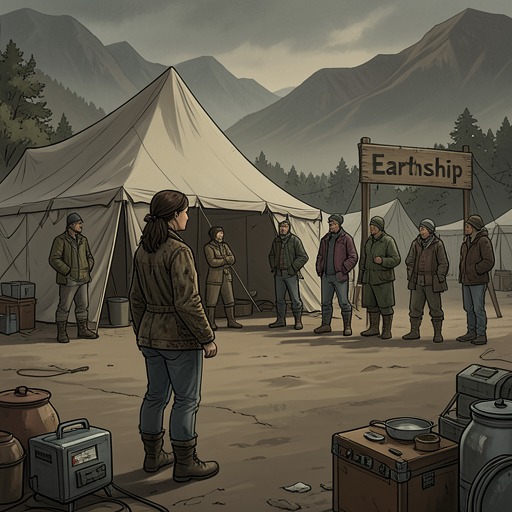
Linda’s answer was not to expect conventional retirement, but to seek a lower-cost life that might let her continue working without remaining trapped by rent. She hoped to find inexpensive land with permissive building rules and create an Earthship: a home with independent systems for food, electricity, climate control, and water. She imagined it as a source of self-sufficiency and stability, as well as a lasting project she could leave to her children and grandchildren. It was a practical response to inadequate retirement income, but also a long-term ambition requiring time, resources, and physical capacity—things that become harder to secure when paid work consumes both money and energy.
The family’s later eviction crisis showed how quickly insecurity could cross generations. When Collin lost the short-term disability benefits he had received after illness forced him from his job, the family could no longer pay rent. Linda gave them her stored, twenty-eight-foot El Dorado motorhome, which had once been her own home on the road. Two adults, three teenagers, and four dogs would have to fit inside. Later, her grandchildren were living in a tent beside an RV; a storm lifted the rain fly and water seeped in, while small holes in the floor were patched with duct tape. Linda’s support helped the family respond to immediate housing loss, but it also showed how a thin safety net shifts responsibility onto relatives and their already limited assets.
In this account, inadequate retirement security is not merely the absence of leisure after a lifetime of work. It is a condition in which low-paid jobs, unpredictable schedules, limited benefits, health needs, and family obligations continue into old age and spill across generations. Linda’s projected $500 monthly benefit gives that structural problem a precise personal measure. Her planned Earthship represents an effort to make stability for herself where employment and formal retirement protections had failed to provide it.