Precarious seasonal work
NomadlandPrecarious seasonal work is both an engine and a constraint of nomadic life in the book: temporary jobs let people keep moving, but layoffs, low pay, physical strain, and the need to find a place to stay make that mobility difficult to secure. The work is not simply a chosen interval between journeys. For Linda May, it is the means of trying to build a permanent home, even as the jobs she depends on expose how uncertain that future remains.
A seasonal economy on the road
Each autumn, routine layoffs at seasonal jobs send nomads back toward the road. They travel in search of another job, warmer weather, or people they know, sometimes crossing the continent. The cycle joins employment to movement: the end of one job is not necessarily a return to settled life, but the start of a search for the next opportunity. Winter’s arrival makes that pattern visible as a recurring feature of the nomadic calendar.
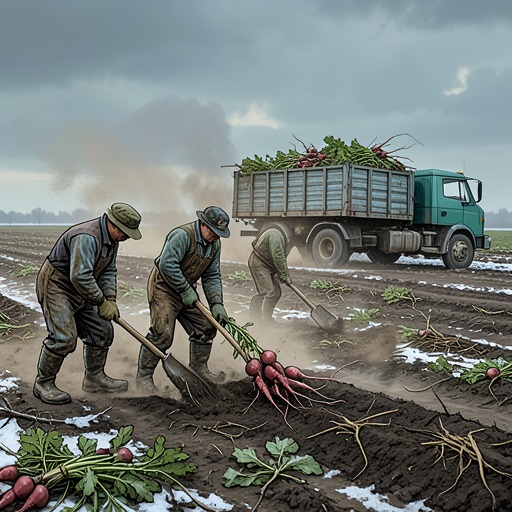
The book describes a wide range of arrangements under the workamping umbrella. Some employers offer hourly wages; others exchange an RV site and hookups for labor, sometimes without pay. At the annual sugar beet harvest, the American Crystal Sugar Company draws hundreds of RV dwellers to Montana, North Dakota, and Minnesota. Weather permitting, they work twelve-hour shifts, day and night, for a starting wage of $12 an hour plus overtime and a parking space. These terms make the trade-off concrete: a seasonal worker may receive both cash and a place to park, but the work is intense and tied to a short-lived agricultural season.
The population that depends on such jobs is difficult to count because itinerants must maintain official domiciles. A fixed address is needed for vehicle registration and inspection, driver’s licenses, taxes, voting, jury service, and other obligations, even when a person’s actual life is mobile. Some choose states with fewer administrative burdens; becoming a South Dakota resident can require only one night at a local motel and registration with a mail-forwarding service. This paperwork allows movement, but it also shows that mobility rests on stationary arrangements that workers must maintain.
Temporary jobs, uncertain prospects
The scale of competition for seasonal work grew after the housing collapse. Warren Meyer, whose company manages 110 campgrounds and hires about 300 workampers, reported a capped list of 25,000 people interested in hearing about jobs. He estimated that, because many applicants were couples, roughly 50,000 people were competing for 50 positions. In 2008, by contrast, he had needed to recruit retirees at conventions. The account presents seasonal employment not as a dependable safety net but as a crowded market in which interest in work can far exceed the openings available.
Linda May’s work history makes that uncertainty personal. She had previously joined Amazon CamperForce at the Fernley, Nevada, warehouse, where using a handheld barcode scanner caused a repetitive-motion injury. Her wrist developed a visible lump, and pain extending through her arm made even lifting a coffee cup or cooking pan difficult. Her wrist took three years to heal. The Fernley facility, which had offered better wages than some other CamperForce locations, closed in 2015. When Linda later considered another warehouse season, the same temporary job that might help finance her plans was also work her body had reason to resist.
The financial calculation became less favorable on her next tour. Linda’s previous base wage had been $11.50 an hour, before night-work and overtime additions; at the later job it was $10.75. She was initially assigned to stowing merchandise, but managers considered transferring CamperForce workers to picking, a more strenuous task. One picker’s Fitbit had recorded eighteen miles of walking and forty-four flights of stairs in a single day. The possibility of reassignment made the job’s physical demands uncertain as well as substantial: Linda could not know that the less strenuous assignment would last through the season.
Work as a bridge to a home
Linda’s goal was to save toward an Earthship, a self-sufficient home with systems for food, electricity, climate control, and water. She hoped it would reduce living costs and offer greater stability as she aged. The project also carried a longer horizon: she wanted to leave something lasting to her children and grandchildren. But the bridge to that future was low-wage work, and the money needed to build accumulated slowly while time and physical capacity mattered to her. Her first Social Security check arrived the month after she turned sixty-two; she later reflected that she had claimed it early because the benefit was so small she doubted waiting would increase it enough.
The wider figures in the book clarify why that calculation weighed heavily. Census figures from 2015 showed that more than one in six older women living alone were below the poverty line. Elderly women were nearly twice as likely as elderly men to be poor, and women receiving Social Security got an average of $341 less per month. Lower lifetime earnings, unpaid caregiving, and longer average lives all affected how far savings and benefits had to stretch. Linda had raised two children and later helped care for her mother, who developed aggressive brain cancer. Her ambition to finance a home through work therefore sits alongside a history of family care and a retirement income system that offered limited relief.
Her seasonal warehouse job also produced a moral conflict. In a message sent after she began working in Kentucky, Linda described the warehouse as a million-square-foot storehouse of goods she believed would not last and would become landfill. She connected the consumption she saw at work to debt and to the low-paid labor involved in making goods elsewhere. At the same time, she needed the wages to complete her plan and questioned how else she could raise the money in the time available to her. She likened the contradiction to a bank robber doing one last job before retirement: earning from a system she criticized in order to try to leave it.
Mobility, shelter, and family risk
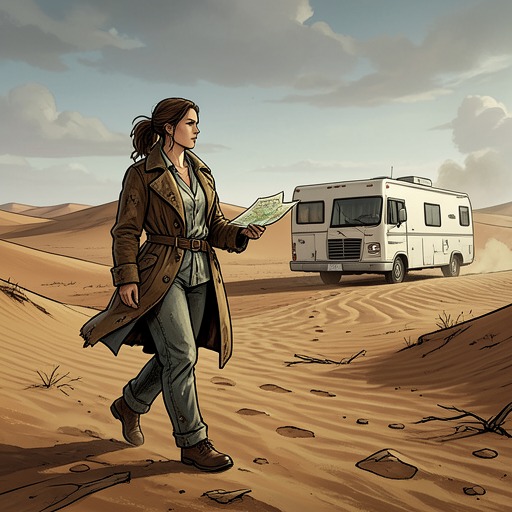
Seasonal employment does not supply housing by itself, and the places nomads can occupy between jobs are also governed by cost and regulation. Near Quartzsite, Arizona, campers may stay on some free federal land for up to two weeks; after that, they must move at least twenty-five miles or pay to stay in the La Posa Long Term Visitor Area. In Coconino National Forest, rangers questioned some campers about their addresses, and people judged to be making residential use of the forest could be ticketed and evicted. The need to keep moving is thus not only an effect of seasonal layoffs. It is reinforced by rules that restrict how long a vehicle can remain in a place.
Linda’s family circumstances further show how employment insecurity intersects with care and housing. While her Jeep was being repaired, she stayed with her daughter, Audra, and son-in-law, Collin, in Mission Viejo. The crowded house had too few bedrooms, and Linda slept on a couch near the front door. She loved her family but missed her autonomy and worried that her presence made ordinary household outings awkward. The family was already stretched by health problems: her granddaughter Gabbi had been weak and intermittently bedridden, her grandson Julian managed type 1 diabetes, Audra had arthritis, and Collin’s migraines and vertigo had driven him from his office job.
Later, the family’s rented house became unaffordable after Collin lost short-term disability benefits. Facing eviction, Audra and Collin and their three teenagers prepared to live in Linda’s stored, twenty-eight-foot motorhome. Linda gave them the vehicle, although she worried about fitting two adults, three teenagers, and four dogs inside. The family sold possessions in two weekends of yard sales, raising $1,000; Linda helped, but eventually said she was exhausted and had pulled back from helping as much. Her own housing and work plans were entangled with relatives’ needs, so the vehicle that had once carried her from job to job became emergency shelter for the family.
The account does not resolve precarious seasonal work into either freedom or failure. Winter brings layoffs and sends workers back into motion; new jobs can offer wages and a place to park, but openings are scarce, terms vary, and bodies may not withstand the work. Linda’s later journey toward a Kentucky warehouse, where she hoped to earn money for her Earthship, kept the project alive without making its completion certain. Seasonal labor functions as a bridge, but the repeated need to find work, maintain an address, secure somewhere to stay, and manage family and health pressures makes that bridge itself unstable.