Retirement insecurity
NomadlandRetirement insecurity describes a late-life condition in which work cannot reliably be left behind: pensions and savings have weakened, Social Security often provides too little, and health or family circumstances can make continued earning difficult. The book traces that insecurity from changes in the American retirement system into the everyday lives of older workers and vehicle-dwelling nomads, where the promise of independence collides with the need for income, care, and somewhere to live.
From a retirement promise to private risk
The book places contemporary retirement insecurity against the history of retirement as a social institution. The Great Depression helped make retirement a practical public concern: by 1934, more than half of older Americans lacked the means to support themselves. The Social Security Act of 1935 established a shared contribution system, and the first check, issued to retired legal secretary Ida Mae Fuller in 1940, was $22.54. This system helped make retirement imaginable as a period of life beyond work, rather than a brief interval between employment and death.
After the New Deal, the familiar model of retirement security was described as a three-legged stool: Social Security, private pensions, and personal savings and investments. The book argues that two of those supports have become less dependable. The Great Recession destroyed many households’ assets, while the long shift from employer-funded pensions, which guaranteed a continuing monthly benefit, to 401(k) plans transferred more risk to workers and their families. A 401(k) account depends on contributions and market performance and may be exhausted during a person’s lifetime. What was marketed as personal control over investments thus also meant that employers could shed the cost and responsibility of providing pensions.
The consequences appear in the labor force as well as in household finances. Nearly nine million Americans aged sixty-five and older were employed in 2016, 60 percent more than a decade earlier. Although most older Americans still regarded retirement as a time of leisure, only 17 percent expected to stop working altogether in later life. The book describes a generational reversal: younger baby boomers and succeeding generations face worse prospects for retiring without a decline in living standards than those who came before them. Continued work in old age is therefore not presented simply as a preference for activity; it is increasingly a response to inadequate resources.
Work after the expected endpoint
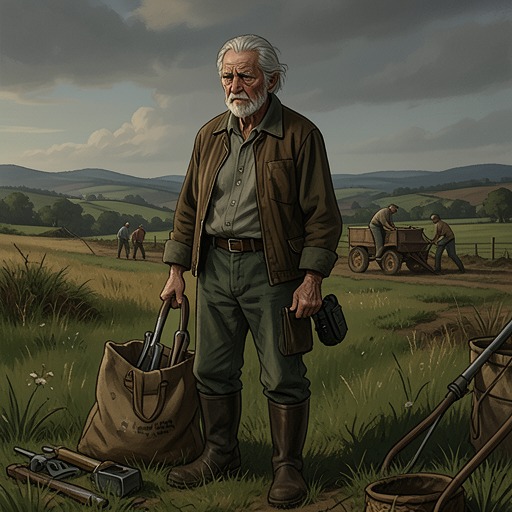
Seasonal and itinerant jobs offer one way to keep earning, but the work can be physically demanding and poorly matched to older bodies. David Roderick, a seventy-seven-year-old workamper, recalled selling Christmas trees with his wife, who was also in her seventies. Living in a fifteen-year-old Lazy Daze RV, he carried trees as long as nine feet and lifted them onto customers’ vehicles for eight to ten hours a day, six days a week. He enjoyed selling, but described cutting and hauling the trees as work better suited to a much younger person. His account captures the mismatch at the heart of retirement insecurity: older workers may be valued for reliability, yet still be expected to perform strenuous jobs because their finances require them to remain employed.
Roderick’s own history shows how retirement resources can be lost well before old age. During an earlier divorce, he had to cash out a pension built over sixteen years of teaching at California community colleges. The account, which might have grown to at least $500,000 with the state’s match, amounted to $22,000 to be divided between him and his first wife. His second wife had also suffered a major loss: an annuity worth $650,000 from her first marriage disappeared in the 1991 collapse of Executive Life. Their later workamping was set against those earlier financial shocks, not merely against a choice to travel.
Other older workers encountered age barriers alongside the need for income. Roderick had once received offers to teach in Saudi Arabia and Kuwait, but both were withdrawn when administrators learned that he was over seventy. At Adventureland, by contrast, older employees were conspicuous throughout the workforce: one clerk described coworkers aged eighty and eighty-six, a man in a wheelchair assigned to count with a clicker, and a one-armed ride supervisor; an operator on the Tornado rollercoaster was eighty-one. Such examples show older people continuing to work in varied roles, but they do not erase the hazards of employment. Sixty-eight-year-old retired postal carrier and pastor Steve Booher died after a raft conveyor started prematurely at the Raging River ride. He fell from the loading platform and fractured his skull. Adventureland reopened the ride the next day; regulators later cited safety violations and required upgrades and a $4,500 fine. The episode makes the cost of working late in life concrete: employment may be necessary, while workplace danger remains real.
Family as a safety net—and another source of strain
Retirement insecurity also reaches into family life, where housing and care needs are often managed through informal support. Linda May stayed with her daughter, Audra, and son-in-law, Collin, in Mission Viejo, sharing a crowded home with three teenage grandchildren. With too few bedrooms, one grandson slept in a doorless dining area, while Linda occupied a couch near the front door. She loved her family but felt stranded and missed her autonomy; even ordinary outings became awkward when everyone had to pass her couch on their way out.
The household was already under pressure from serious health problems. Linda’s granddaughter Gabbi had been weak and intermittently bedridden for more than three years before testing positive for Sjogren’s syndrome. Her grandson Julian managed type 1 diabetes, Audra had severe arthritis, and Collin’s migraines and vertigo had forced him out of his office job. These illnesses stretched the family emotionally and financially, making Linda reluctant to depend further on them. Her situation illustrates how the loss of stable income and independent housing can turn relatives into a necessary safety net even when those relatives are struggling themselves.
That support later became material and immediate. When Collin lost his short-term disability benefits and the family faced eviction, Linda gave them her old twenty-eight-foot El Dorado motorhome, which had been in storage. The plan was for Audra and Collin to sleep in the bedroom, Julian in the cab-over loft, and Gabbi and Jordan on the fold-out dinette; the family’s four dogs would have to fit wherever they could. As the family emptied its two-thousand-square-foot house and garage, each teenager was given one Rubbermaid tub for belongings. Two weekends of yard sales raised $1,000, while Linda helped sort and sell possessions. She was glad the motorhome could help, but the arrangement did not remove the strain: the number of people, animals, and cramped sleeping spaces made clear how little room an emergency leaves when housing security fails.
The grandchildren’s next circumstances extended that precariousness. They were staying in a tent beside the RV; during a storm, rain lifted the fly and water came in beneath the tent. A granddaughter had vacuumed the sandy floor, unintentionally pulling grit through the fabric and making tiny holes, which the family patched with duct tape. The episode is small in scale but revealing in its particulars: shelter depended on improvised repairs, and a household’s displacement became a shared family problem rather than a single person’s difficulty.
Aging on the road and the limits of independence
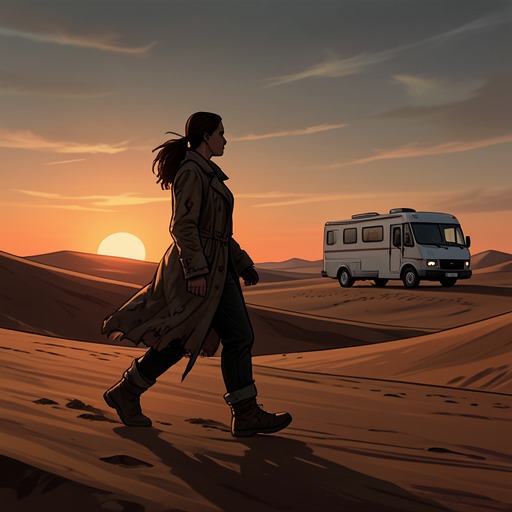
For nomads, retirement insecurity is intensified by the question of what happens when driving, camping, or working becomes impossible. The book describes Escapees CARE, an assisted-living center in Texas where RVers who can no longer drive may remain in their own motorhomes. A site cost more than $850 a month, with optional adult day care adding another $200 each week—prices beyond the reach of many people the narrator had met. Remaining in one’s vehicle could preserve a measure of familiarity, but it did not make care affordable.
The less formal outcomes in the account are stark. Iris Goldenberg told of an acquaintance who died while boondocking in a Walmart parking lot, where his body went undiscovered for a month. A volunteer with the Church of the Isaiah 58 Project described an eighty-year-old man who had spent three months at the church before being found dead in his RV in the desert near Ehrenberg, Arizona. Patti DiPino, a former Amazon warehouse worker, died at sixty while receiving radiation treatment for cancer. A friend’s memorial described her as finally debt-free and in a permanent home, no longer freezing in the desert or Kansas or living in cramped spaces. These accounts show that the absence of a dependable care system can make isolation, illness, and death part of the landscape of late-life poverty.
Some nomads spoke about the future in terms that made abandonment sound almost like a plan. Silvianne Delmars imagined continuing on the road indefinitely, even if it ended in a fatal drive over a cliff. Bob Wells described a more practical but still bleak fallback: burying a cheap school bus under earth, with windows on the south side, and, when that arrangement no longer worked, wandering into the wilderness to die. His proposed long-term health-care plan was to become bleached bones in the desert. These statements are not evidence of a viable retirement strategy; they expose how little confidence some people had in institutions or family support to care for them in old age.
Peter Fox responded to the same uncertainty by imagining collective provision. After a registered nurse at the Rubber Tramp Rendezvous lanced an infected finger, he proposed roving medical teams or way stations at state parks and other places where nomads gathered. He also imagined a nonprofit for aging vehicle dwellers, the Hello in There Foundation, named after a John Prine song about loneliness in old age. When asked about his own future, however, he had no settled plan: a niece and nephew might take him in if matters became desperate. The contrast between the proposed network and the uncertain personal fallback shows both the appeal and the absence of dependable support.
Linda May’s hoped-for exit from insecurity
Linda May’s plan to build an Earthship represents an effort to answer retirement insecurity through self-sufficiency. She envisioned a dwelling with independent systems for food, electricity, climate control, and water, hoping that it would reduce her costs and care for her as she aged. But she first needed a bridge: a way to earn money while keeping expenses low enough to acquire land and begin construction. She worried about becoming a burden to her children, even as family circumstances repeatedly made their lives and hers interdependent.
The plan remained vulnerable to the conditions it was meant to overcome. Linda’s earlier Amazon warehouse work had left her with a repetitive-motion injury from using a barcode scanner; her wrist took three years to heal. When she considered another season, she faced the possibility of more strenuous picking work, which could involve extensive walking and stair climbing: one picker’s Fitbit had recorded eighteen miles and forty-four flights of stairs in a single day. Linda’s previous warehouse wage had been $11.50 an hour before night-work and overtime additions; later, the base rate was $10.75. The work was a means to finance a future home, but it could also damage the body on which that future depended.
The book therefore presents retirement insecurity not as one person’s failed preparation, but as a pressure distributed across time: pension losses, lower lifetime earnings, age barriers, bodily limits, family caregiving, and expensive or absent support accumulate before and during old age. Linda’s hoped-for Earthship offers a vivid alternative to dependence, but the path toward it runs through low-wage work, uncertain health, and family emergencies. The central tension is that independence must be built with resources that insecurity itself makes difficult to accumulate.