Poverty
NomadlandPoverty in the book is a material condition and a social stigma: it determines where people can sleep, what they can eat, whether they can afford to move, and how much help they can ask of family. The stories of older people living in vehicles, the seasonal relief offered in Quartzsite, and Linda May’s financial strain show both the ingenuity people use to get by and the limits of treating self-reliance as a substitute for security.
Income, Housing, and the Work of Getting By
For Chere, living in a van followed the loss of a house that had served as both home and income. She had bought the Minnesota property in 1989 and spent twenty-three years renting out spare bedrooms. After she was forced to stop because she lacked a required permit, she lost that arrangement. The house, appraised at $300,000 in 2002, sold for $140,000 after the housing crash; mortgage payments and broker’s fees consumed much of the proceeds. A plan to live on the equity became, instead, a life organized around limited monthly income and small expenses.
Chere received $600 a month in Social Security after a $100 Medicare deduction. She kept her clothes in three plastic bins and rented a storage unit for $600 a year. In Quartzsite she paid $300 a month for a swap-meet space and $50 for a town vending permit; when she sold jewelry in Santa Barbara, a $100 seasonal beach pass excluded the hours from 2 a.m. to 6 a.m., when the beach was closed. She hid during those hours, relying on unobtrusive parking. Her plain white van drew less attention than an older van covered in stickers. Mobility gave her places to go, but did not erase the need to manage where she could legally or inconspicuously stay.
Her choices were calibrated to scarcity. Chere said her Social Security usually covered gas; if it did not, she stayed put. At dinner at the Quartzsite Yacht Club, she ate one hamburger patty and wrapped the other for Skittles, a dog she was watching. She poured the remaining ice water into a takeout cup to bring back with her: ice was a luxury because she could not make it in the van. Such details make poverty visible not as a single dramatic crisis, but as continuous calculation over fuel, food, storage, and a place to park.
Poverty in a Retirement Destination
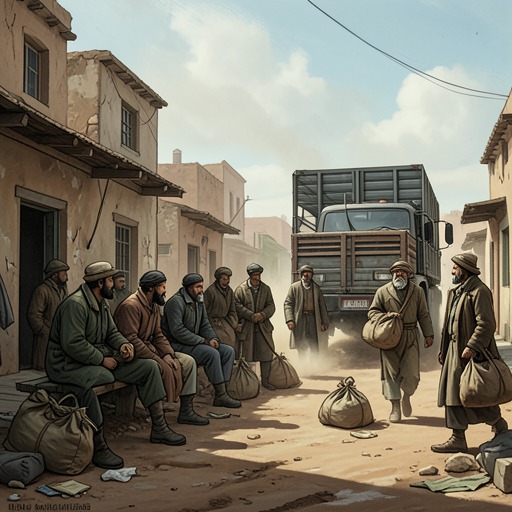
Quartzsite draws people who need a low-cost place to spend the winter, including older visitors with little money and few alternatives. Mike Hobby, a pastor who had experienced homelessness with his wife after uninsured medical bills overwhelmed them, helped establish the Church of the Isaiah 58 Project in 2003. Its seasonal soup kitchen serves thousands of meals to elderly and homeless people from November through March. Guests do not have to sit through a sermon to eat. That distinction matters in a town where, as Mike explained, people come to escape shame, poverty, and cold, and may tell their children they are doing fine.
The church’s meal line gathered retirees, freight-train hoppers, and bicycle tramps in the same warehouse dining room. Poverty did not erase the differences among them, but the meal offered a place where those differences did not determine who was served. The local food pantry faced a wider version of the same pressure. Carol Kelley, an eighty-year-old widow who ran it, gave away vegetables from an overturned semitrailer to a van-dwelling couple whose coffee-shop business had failed and who hoped to sell the woman’s dog paintings at a flea market. Carol worried that the town was feeding not only its year-round residents but also the winter visitors. A volunteer answered that they fed everyone and treated everyone alike. The exchange registers both the strain on local resources and the decision to make assistance broadly available.
The book also sets individual hardship against structural inequalities in later life. Census figures for 2015 showed that more than one in six older women living alone were below the poverty line; 2.71 million elderly women were poor, compared with 1.49 million men. Women’s average Social Security benefits were $341 a month lower, reflecting lower lifetime payroll contributions. The account connects that gap to women’s lower earnings, the gender wage gap, and unpaid caregiving, including Linda’s work raising two daughters and later helping her mother during an aggressive brain cancer. Longer average lifespans mean that women’s smaller savings and benefits must also last longer. These figures place the characters’ day-to-day shortages within a broader pattern, rather than presenting them as isolated failures of planning.
Family Hardship and the Cost of Asking for Help
Linda’s own insecurity was sharpened by her dependence on family. While marooned in Mission Viejo, she slept on a couch near the front door of her daughter Audra and son-in-law Collin’s crowded rental home. She loved her family, but felt stranded and missed her autonomy; the household’s outings repeatedly carried everyone past her couch. She worried that her presence made them feel guilty, and disliked living under another person’s roof. The arrangement provided shelter, yet made the loss of independence part of daily life.
The family was already under pressure from illness. Audra had severe arthritis; Collin, the household’s breadwinner, had developed migraines and vertigo that forced him out of his office job. Their son Julian was managing type 1 diabetes, and their granddaughter Gabbi had spent years weak and intermittently bedridden before testing positive for Sjogren’s syndrome. Linda’s ability to rely on them was limited not only by the cramped home but by the family’s own emotional and financial burdens. At one point she had only $10 left until payday. Groceries the narrator left behind—cold cuts, vegetables, eggs, bacon, cheese, soup, and tortillas—went largely to Linda because another member of the household had a restricted diet.
When Collin lost his short-term disability benefits and the family faced eviction, Linda gave Audra and Collin her stored twenty-eight-foot El Dorado motorhome. She was glad they could use it, but worried about how two adults, three teenagers, and four dogs would fit. The family sold possessions from their two-thousand-square-foot house and attached garage; the teenagers were each given one storage tub for belongings they wanted to keep. Two weekends of yard sales brought in $1,000. Linda helped organize the sale, even as the crisis exhausted her and she began to pull back. Her old motorhome thus became emergency housing for the family, while the sacrifice also marked the limits of what she could continue to do for them.
The family’s precarious housing continued after the move. Linda later heard that her grandchildren were sleeping in a tent beside the RV. Rain lifted the tent’s fly and came through the bottom; an attempt to vacuum sand from the floor had made small holes in the fabric, which the family patched with duct tape. The details show how quickly a move into a vehicle can produce further improvised living arrangements, and how little protection such arrangements provide from weather or household disruption.
Mutual Aid and the Meaning of Scarcity
The nomadic community’s exchanges of food, labor, and knowledge help people endure shortages, though they do not make poverty disappear. At the Rubber Tramp Rendezvous, Bob Wells’s free pile accumulated items that people could use or pass on, while participants shared practical skills. Mechanics taught basic repairs; carpenters built beds and shelves for vans; people with large solar panels offered excess power; and a cosmetologist gave haircuts for optional donations. Charlene Swankie baked for the gathering in a solar oven. These acts made resources circulate beyond individual budgets and helped turn a gathering into a working support network.
Other forms of sharing were smaller and more routine. Lesa NeSmith rose at sunrise to make cowboy coffee for anyone who came by with a cup, continuing a habit she had begun when she lived in a Richmond high-rise and invited neighbors in for Sunday coffee. Group dinners—baked potatoes, chili, and soup—combined contributions in communal pots. After the Valentinos ran out of fuel on a cold night, Vincent drove them to town for a fuel jug, and they returned with apples, sausages, and a large bag of salad from the Quartzsite food bank. At another gathering, Charlene Swankie led a caravan to see nearby petroglyphs and later used her van and a nylon strap to pull a stranded vehicle out of a ditch. Food and assistance moved through the group alongside knowledge and practical labor.
That network could also provide care when illness made ordinary tasks impossible. When Linda developed bronchitis and was too weak to cook, neighbors brought boiled eggs, tomatoes, and sausage to the Squeeze Inn. The narrator recalls a similar response when a nomad named Beth broke her arm: members of her van community organized help with tasks as basic as tying her shoes and fastening her bra. The care was concrete and immediate, filling gaps that money, formal services, or a nearby family member might otherwise have addressed. Its importance is clear precisely because illness and poverty make independence fragile.
The support did not remove the shame attached to being poor. LaVonne Ellis confessed that she had taken payday loans of $255 each, with $45 interest due on each within a week. She felt guilty and ashamed. Sameer Ali replied with a message of solidarity rooted in his own experience of being nearly out of gas, with only days of food and water before payday. He acknowledged that the nomadic life could be presented as exciting and inventive while also recognizing that many people were living it because of financial circumstances. His response offered LaVonne companionship and a place among people who understood her situation; it also named the distance between the romantic image of freedom and the pressures that brought people to the road.
Stigma, Choice, and Unfinished Security
The book treats the word homeless as more than a description of lacking conventional housing. LaVonne reflected on its force as a label associated with exclusion and failure. Sameer knew the legal classification could apply to people living in vans, but resisted allowing it to define his identity. His family had once rejected him as a homeless bum when he visited his sister for Ramadan. He described himself instead as a traveler. This distinction helps explain how mobile residents defend dignity, but it does not cancel the material facts of low income, insecure shelter, or dependence on food assistance and informal care.
A passage from Kurt Vonnegut’s Slaughterhouse Five that Linda and LaVonne shared on Facebook challenged the tendency of poor Americans to blame themselves and glorify wealth. Their act of sharing the passage connects private shame to a broader account of how poverty is judged. The social meaning of scarcity can thus compound scarcity itself: people must manage not only insufficient money, but also the pressure to interpret that insufficiency as personal failure.
The book’s strongest counterweight to that pressure is not a claim that poverty is liberating. It is the practical solidarity people build without mistaking it for a permanent solution. A meal, a bag of vegetables, a borrowed skill, help with a stranded vehicle, or shelter during illness can change what someone is able to get through that day. Yet Chere still had to hide during beach-closure hours, Linda’s family still lived through eviction and a leaking tent, and LaVonne still faced payday-loan debt. Poverty remains the condition that makes these acts necessary; mutual aid makes it more bearable without turning insecurity into security.