Income inequality
NomadlandIncome inequality is presented as a widening chasm that reshapes ordinary choices and pushes financial risk onto people least able to absorb it. The book connects national disparities in earnings to the precarious work of older Americans, the erosion of retirement security, and the unpaid support families provide when wages and public benefits do not cover basic needs. People living in vehicles become an especially visible signal of pressures affecting many more households.
Household arithmetic and the widening divide
The account makes inequality tangible through the calculations that recur at kitchen tables: wages reduced by groceries, medical bills, credit-card debt, utilities, student loans, car payments, and, above all, rent. When the numbers fail to balance, survival becomes a series of sacrifices rather than a stable plan. The question is not simply how much a household earns, but which necessity it can postpone or give up to keep going.
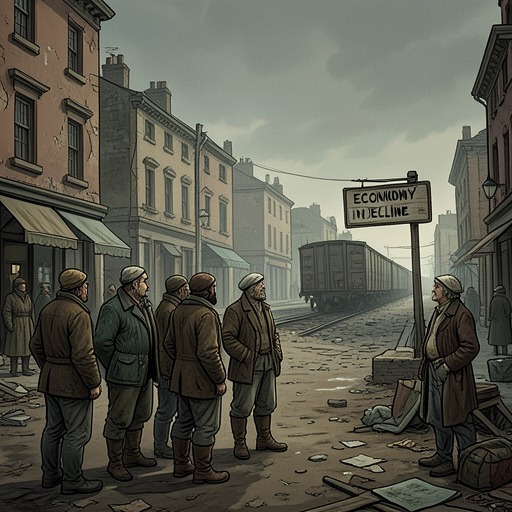
The book locates this arithmetic in a stark national distribution of income. The top one percent earns, on average, eighty-one times as much as people in the bottom half of the income ladder. For roughly 117 million adults in that lower half, earnings have not changed since the 1970s. The disparity is therefore described as a chasm, not a modest wage gap: growth and opportunity have been distributed so unevenly that the people doing the calculations face costs that cannot be solved through thrift alone.
The social consequences extend beyond individual hardship. A deepening class divide makes upward mobility increasingly difficult and risks turning economic position into a de facto caste system. The argument is both ethical and practical: when large parts of the population are denied access to opportunity, their abilities are wasted, and economic growth is weakened. The book notes that the Gini coefficient, a widely used measure of income inequality, places the United States among the most unequal developed societies, at levels comparable to Russia, China, Argentina, and the Democratic Republic of the Congo. The measure gives statistical form to the wider divide, while household bills show how that divide is lived.
Retirement risk and work in old age
The insecurity of older workers is one of the clearest expressions of this changing distribution of risk. In 2016, nearly nine million Americans aged sixty-five and older were still employed, a 60 percent increase over the preceding decade. The book reports expectations that both the number and share of older people in the labor force would continue to rise. Although retirement remained associated with leisure in public understanding, only 17 percent of older Americans surveyed expected not to work at all in later life. Continued employment appears less as a simple preference than as an increasingly necessary response to inadequate resources.
The retirement model once described as a three-legged stool relied on Social Security, private pensions, and investments or savings. The Great Recession destroyed assets for many households, while savings had already been declining. Since the 1980s, employers increasingly replaced defined-benefit pensions, which promised a continuing monthly payment, with 401(k) plans dependent on employee contributions and market performance. These accounts transferred responsibility and risk from employers to individual families; unlike a pension, they could be depleted while a retiree was still alive. The language of individual investment choice thus accompanied a less secure reality: families were left to manage risks once carried by broader institutions.
The change is visible in David Roderick’s working life. At seventy-seven, he described older workampers as dependable workers but also as, in effect, cheap labor. During the winter of 2012, he and his wife sold Christmas trees while living in their fifteen-year-old Lazy Daze RV. His shifts lasted eight to ten hours, six days a week, and included carrying trees as long as nine feet and lifting them onto customers’ vehicles. The work behind the sales, he observed, was better suited to a much younger person. His own retirement cushion had been diminished years earlier when divorce required him to cash out a teaching pension accumulated over sixteen years; the amount available to divide was far below what the pension might have grown to with the state’s contribution. His later career and his physically demanding seasonal work make the loss of secure retirement income concrete.
Gender, care, and family resources
Income inequality is also shaped by gender and the uneven distribution of care. The book reports that, in 2015, older women living alone were especially exposed to poverty: more than one in six lived below the poverty line, and the number of poor elderly women was nearly twice that of poor elderly men. Women received, on average, $341 less per month in Social Security benefits, reflecting lower lifetime payroll contributions. Lower earnings, less accumulated savings, and longer life expectancy meant that women often had fewer resources to stretch across more years. Unpaid caregiving further constricted the time and income available for paid work. Linda May had raised two children and later helped care for her mother after she developed aggressive brain cancer.
Linda’s circumstances show how structural insecurity passes into family life. While staying in the crowded Mission Viejo home rented by her daughter Audra and son-in-law Collin, she slept on a couch near the front door and felt stranded without her Jeep. She loved her family but missed her autonomy and worried about depending on a household already under strain. Gabbi had been weak and intermittently bedridden for years before testing positive for Sjogren’s syndrome; Julian managed type 1 diabetes, Audra had severe arthritis, and Collin’s migraines and vertigo had forced him out of his office job. Health needs and lost earnings narrowed the family’s capacity to support one another even as they made mutual support more necessary.
That vulnerability became an immediate housing crisis when the family lost Collin’s short-term disability benefits and could no longer pay rent. Facing eviction, Linda gave them her stored twenty-eight-foot El Dorado motorhome. It was meant to shelter two adults, three teenagers, and four dogs, with the family improvising sleeping arrangements throughout the vehicle. The gift demonstrates both the force of economic insecurity and the family’s role as a fallback when income and benefits fail. It also shows the cost of that fallback: a relative’s limited asset becomes the substitute for stable housing.
Workampers as indicators of broader change
The book frames nomads who live in vehicles as an indicator species: a group whose sensitivity to economic pressure makes larger social changes visible early. Not everyone pushed to alter a middle-class life will move into a vehicle, but many face versions of the same deficit between income and expenses. Their choices may involve delaying bills, postponing medical care, or going without necessities rather than changing their housing as visibly as the nomads do.
Older employees at Adventureland offer another view of the contradiction. A seventy-seven-year-old former recruiter took pride in colleagues who continued working despite advanced age or disability, including an eighty-six-year-old former employee, a wheelchair user assigned to count admissions at a water park, and a one-armed ride supervisor. An eighty-one-year-old operated the Tornado roller coaster. Such examples show determination and capacity, but they also sit alongside a labor market in which people may need to keep working when their bodies are less suited to the job. Elsewhere, Linda faced health problems that made returning to warehouse work difficult, while her family’s housing troubles continued. Ability to work, access to work, and security from work are not the same thing.
The book’s final emphasis is that these pressures are systemic, not an assortment of unrelated personal failures. Income inequality concentrates earnings and opportunity while leaving households to absorb medical, housing, employment, and retirement risks. The nomads’ vehicles make that transfer unusually visible, but the underlying calculations belong to a much larger population. Their lives register a society in which traditional stability is increasingly difficult to attain and in which the consequences of the widening divide are borne across generations.