Precarious conditions of temporary labor
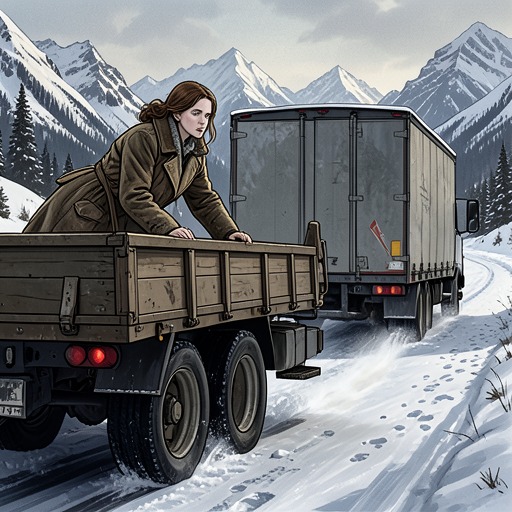
NomadlandPrecarious conditions of temporary labor shape workamping as more than a flexible way to travel: for people living in vehicles, seasonal jobs can also supply income and a place to stay, while leaving workers exposed to unpredictable hours, strenuous routines, and limited recourse when employers fail to pay for all the labor performed. The book traces that insecurity from public campgrounds to Amazon warehouses and harvest sites, showing how the promise of mobility rests on employment that may be temporary, tightly managed, or only partly compensated.
Seasonal Jobs and the Terms of Mobility
The workampers’ calendar follows the seasons. As autumn gives way to winter, seasonal jobs lay off workers, and many nomads move on in search of another job, warmer weather, or a place to reunite with friends and family. Their mobility is not separate from employment: the next town may mean the next opportunity to earn money, while the end of a season can send workers back onto the road without a continuing wage. In this account, movement is both a chosen pattern of life and a response to an economy organized around short-term labor.
Workamping jobs do not come with a single standard form of compensation. Some employers pay an hourly wage; others exchange an RV site and hookups for labor, sometimes asking for many hours without wages. The annual sugar beet harvest offers a more clearly defined cash arrangement: workers recruited by the American Crystal Sugar Company are brought to Montana, North Dakota, and Minnesota from late September, and, weather permitting, work twelve-hour shifts for a starting wage of $12 an hour plus overtime. That paid seasonal work stands in contrast to positions where a parking space and utilities are the principal return, and it makes clear that the value of a job to a vehicle-dwelling worker may include shelter as well as cash.
The need for a stable official address adds another constraint. Full-time travelers must maintain a fixed domicile for tasks such as registering vehicles, renewing licenses, paying taxes, voting, and obtaining health insurance. Many rely on mail-forwarding services and choose states with fewer administrative or tax burdens. South Dakota, for example, allows a new resident to establish residency after spending a night at a local motel and registering with a mail-forwarding service, then presenting both receipts to the state. Such arrangements make an itinerant life administratively possible, but they also show that mobility depends on fixed paperwork even when a worker’s actual home is elsewhere.
Campground Hosting: Work Without Clear Boundaries
At Hanna Flat, Linda May and Silvianne Delmars were responsible for all of the campground two days a week; on the other three, they divided the area with another host. The routine joined guest services to extensive maintenance. They cleaned eighteen toilets and eighty-eight campsites, checked in campers, collected fees, posted reservation tags, offered hiking advice, settled disputes, cleared fire pits, and completed paperwork. Campers could buy firewood stored in a locked cage at the hosts’ site, but Linda and Silvianne also suggested gathering forest wood that was already dead, down, and detached. After rounds, Linda could be so winded that she needed to nap.
The campground’s sign identifying a camp host also meant that the workers were treated as available whenever they were present. When two trucks arrived at 11:30 p.m., the campers woke Silvianne in the Queen María Esmeralda to check them in. Hosts were also expected to enforce quiet hours and respond to complaints. Linda tried to prevent conflicts through a friendly approach: she asked arriving groups to keep their fun quiet after ten and offered trash bags to campers whose sites were strewn with beer bottles. These interactions illustrate how guest-facing duties could stretch beyond a neat division between scheduled work and personal time.
The schedule was unstable as well. Although Linda and Silvianne had been hired for forty-hour weeks, their supervisor cut them to three-quarter time for two weeks after saying reservations were down and costs needed to be reduced. Linda’s weekly pay fell below $290; Silvianne earned even less because she had not received Linda’s returning-worker raises. The reduction came only half a month into the job, turning an apparently full-time position into a less dependable source of income with little warning.
Other camp hosts described a wider mismatch between the hours they were allowed to bill and the work they were expected to do. A California Land Management employee in his sixties said he was assigned a thirty-hour site but sometimes worked more than forty-five hours; after he objected, the company reduced the demands, but did not pay for the extra hours already worked. Greg and Cathy Villalobos, campground hosts in their mid-sixties, likewise said they were expected to work more than they could record on their time cards. A former employee said she and her husband sometimes worked twelve hours or longer in a day but could submit no more than eight hours. These accounts make the problem more specific than low wages alone: the employer’s control over recorded hours could separate the work performed from the work compensated.
Warehouse Labor and the Managed Body
Amazon’s CamperForce recruited nomads as seasonal warehouse employees during the three to four months of peak season before Christmas. The company did not disclose exact staffing numbers, but a manager estimated the program had about two thousand workers in 2014. By the 2016 season, Amazon had stopped recruiting CamperForce workers earlier than usual, attributing the change to a record number of applications. When the holiday rush ended, the company no longer needed the seasonal workforce, and workers departed in what managers called a taillight parade.
The warehouse job was physically demanding and closely organized. Linda May trained as a stower, placing incoming goods on library-style shelves. She pushed carts of yellow tubs through aisles, searched for open bins, and scanned both each bin and each product. Identical items from the same shipment had to be distributed among separate bins, a method designed to make it easier for pickers to collect goods for orders. The assigned motions were repetitive, but the assortment of goods could be striking: Linda recalled bins containing everything from brake fluid and baby formula to books and tape.
After orientation and a week of half-day work-hardening shifts, Linda took the overnight schedule because it paid 75 cents more, bringing her wage to $12.25 an hour plus overtime. Her regular shift ran from 6 p.m. to 4:30 a.m. She slept through much of the day, then had about three hours to do chores, prepare lunch, and walk her dogs at Sage Valley RV Park before making the twenty-five-minute commute. The job’s higher hourly rate thus came with a schedule that reorganized daily life around overnight work.
At the start of a shift, Linda put on an orange reflective vest and security badge, collected a charged scanner battery, and joined workers for stretches while supervisors announced productivity goals. She then scanned barcodes and stocked products across a warehouse roughly the size of thirteen football fields; workers used state names, including Nevada and Utah, to navigate its vast interior. She found the work tiring and was troubled by the volume of inexpensive goods she believed would end up in landfills. The physical effort and that unease coexisted: her work moved merchandise through the system, while she questioned the waste embedded in what she was handling.
The book places Linda’s experience alongside reports of broader warehouse pressures. An investigation of an Amazon facility in Pennsylvania found that summer temperatures could exceed 100 degrees indoors and that paramedics waited outside for workers who became ill from heat. Workers also described rising production targets and real-time monitoring through scanner data. At the Coffeyville, Kansas, warehouse, Laura Graham said her scanner displayed a countdown between items and tracked progress toward hourly goals; after she took a wrong aisle and fell behind, a supervisor reprimanded her. She said the walking and foot pain became severe enough that she used pain medication during her overnight shift and spent days off largely resting. These accounts show how the scanner functioned not just as a tool for finding and recording goods but as a mechanism for setting pace and measuring output.
Complaints, Oversight, and Limited Recourse
Complaints about campground work reached the United States Forest Service, which hires private concessionaires to run public campgrounds. In documents obtained through a Freedom of Information Act request, employee names and contact details were redacted. One long-serving California Land Management employee reported that workers lacked water in hot conditions and described a host assigned alone to two campgrounds on 109-degree days who had been taken by ambulance twice for heat exhaustion. The same letter alleged that he had worked overtime but was told not to record it. Another former host described being paid $8.50 an hour for a stated forty-hour week while routinely working fifty to sixty hours without overtime or straight-time pay. The reported duties included intensive cleanup, repeated toilet cleaning, clearing fire pits, and late registration work.
California Land Management’s president, Eric Mart, told the author that the company’s policies and training contradicted the workers’ claims. He said the company investigated at least three complaints and found them without merit, while one worker received reimbursement for unpaid hours. He also said the complaint concerning a manager accused of shortchanging and insulting an employee prompted a separate Forest Service investigation. The agency, however, told the author that it did not investigate such grievances directly; its policy was to forward complaints to the concessionaire involved, even though the Forest Service issued and renewed operating permits for those contractors. This arrangement left the employer as the immediate recipient of complaints about its own labor practices.
Warehouse workers also challenged the way time was counted. At Amazon’s Fernley facility, Nevada Occupational Safety and Health Administration received a complaint about back injuries and sent two inspectors to review injury records and tour the plant with managers. The visit lasted less than four hours, and the case was closed that day; the report acknowledged strain injuries, including back strain, but concluded there was nothing outside the norm for that kind of workplace. Separately, temporary workers argued that time spent in security lines—up to thirty minutes a day—should be paid. After a federal appeals court ruled for the workers, the U.S. Supreme Court overturned that decision the following year. The dispute made the end of a shift another point at which the boundary between paid labor and uncompensated time could be contested.
Precarity as a Condition of Nomadic Work
The accounts connect insecurity to the practical conditions that enable life on the road. A job may provide a place to park, but its hours can be cut; a higher wage may require overnight shifts; and a season’s end can terminate employment as abruptly as it frees a worker to travel. Even public-land camping depends on rules and movement: in the desert near Quartzsite, free sites are generally limited to two weeks, after which campers must move at least twenty-five miles or pay to stay in the La Posa Long Term Visitor Area. In Coconino National Forest, rangers questioned some campers about home addresses, and people appearing to use the forest as a residence could be ticketed and evicted. A worker’s ability to remain mobile therefore depends on both temporary employment and access to places where a vehicle can legally stay.
The book does not reduce workampers to either victims or carefree travelers. Its account of fieldwork emphasizes that the two realities can coexist: people seek camaraderie and opportunity while facing low or uncertain pay, demanding schedules, and institutions that may offer little direct oversight. The recurring bargain is concrete: work in exchange for wages, a parking place, or both, under conditions that can change with reservations, production targets, or the end of a season. Precarity is not simply the absence of a job; it is the instability built into the work and into the arrangements that allow workers to keep moving.