before the main action
The Heavenly Invocation
The poem opens by invoking the Heavenly Muse to sing of mankind’s first disobedience, the forbidden fruit, death, and the loss of Eden. The stated purpose is to explain divine providence and justify the ways of [God](entity:character-recall-character-833766c1de3f) to men.
The narrator asks for inward illumination so that a vast theological history can be rendered intelligible, establishing the epic’s governing movement from rebellion and fall toward judgment, mercy, and restoration.
before Creation
The Heavenly Rebellion
[Satan](entity:character-recall-character-3dc6adee9264) leads a revolt against [God](entity:character-recall-character-833766c1de3f), seeking equality with the supreme throne. The rebellion is defeated, and the insurgent host is hurled from [Heaven](entity:location-recall-location-heaven-0167f964ad61) into the abyss
after the heavenly defeat
Satan Awakens in Hell
[Satan](entity:character-recall-character-3dc6adee9264) and [Belial](entity:character-recall-character-a6660e725e4e) awaken on the fire lake, surrounded by burning darkness, pain, and despair. Rather than submit, Satan declares that the mind can transform its surroundings and insists that they will continue their resistance
soon after the fall
The Infernal Host Rallies
[Satan](entity:character-recall-character-3dc6adee9264) calls the fallen angels from their stupor, and the host gathers on the shores of [Hell](entity:location-recall-location-hell-e163fca35b4f). He raises the imperial standard, and the spirits reform themselves into organized ranks, recovering military discipline and collective purpose
after the host regroups
The Building of Pandemonium
[Mammon](entity:character-recall-character-d31fdbc63e4e) leads the excavation of [Hell](entity:location-recall-location-hell-e163fca35b4f)'s mineral wealth, and the fallen spirits construct [Pandemonium](entity:location-recall-location-pandemonium-d32b085a206d), a vast palace and council hall. The architecture exceeds the monuments of earthly kingdoms in splendor and speed
immediately after Pandemonium is built
The Pandemonium Council
The [Infernal Council](entity:organization-recall-organization-infernal-council-58abd3d27751) convenes to decide how the fallen angels should continue the war. Molech demands open battle, while [Belial](entity:character-recall-character-a6660e725e4e) recommends passive endurance, and [Mammon](entity:character-recall-character-d31fdbc63e4e) advocates building an independent kingdom in [Hell](entity:location-recall-location-hell-e163fca35b4f). Belial proposes seeking the newly created world of Man, where the demons might corrupt [God](entity:character-recall-character-833766c1de3f)'s
at the conclusion of the infernal council
Satan Volunteers for the Quest
When the demons hesitate before the perilous journey through [Hell](entity:location-recall-location-hell-e163fca35b4f)'s gates and the abyss of Chuan Dun, Sathan volunteers to search for the new world alone. He presents the decision as a ruler's duty, accepting danger in exchange for honor and authority
during Satan’s departure from Hell
Sin Guards the Gates
At the Gate of [Hell](entity:location-recall-location-hell-e163fca35b4f), [Satan](entity:character-recall-character-3dc6adee9264) encounters Sin and Death, who block the way. Sin explains that she emerged from Satan's head during the heavenly rebellion, while Death was born from their incestuous union and now guards the passage. Satan persuades Sin to unlock the gates with the [Key of Hell](entity:object-recall-object-key-of-hell-ae5daf34bf6d)
immediately after leaving Hell
Satan Crosses Chaos
[Satan](entity:character-recall-character-3dc6adee9264) travels through the unformed abyss, navigating tumultuous elements and the dominion of Chuan Dun. After great difficulty he reaches the border of [Heaven](entity:location-recall-location-heaven-0167f964ad61) and sees the newly created world hanging below it
after Creation and before the temptation
The Divine Debate on Humanity
[God](entity:character-recall-character-833766c1de3f) sees [Satan](entity:character-recall-character-3dc6adee9264) approaching [Earth](entity:location-recall-location-earth-a6b883af9147) and tells the Son that the adversary will corrupt humanity through deceit. He insists that [Adam](entity:character-recall-character-f2c33a925377) was created upright and free, and that foreknowledge did not cause his fall. The Son asks how humanity can be saved without compromising justice. He offers himself as a voluntary ransom, establishing the
after crossing Chaos
Satan Reaches Earth
[Satan](entity:character-recall-character-3dc6adee9264) lands on the outer sphere of [Earth](entity:location-recall-location-earth-a6b883af9147) and surveys its beauty. He disguises himself as a lesser angel and approaches [Uriel](entity:character-recall-character-e5228fd31a51), asking where the dwelling place of Man lies. Uriel, deceived by the apparent piety of the stranger, directs him toward Eden. The episode establishes deception as Satan
before the first human temptation
Satan Enters Eden
[Satan](entity:character-recall-character-3dc6adee9264) reaches the borders of Eden, leaps over its enclosing wall, and surveys the garden. He sees [Adam and Eve](entity:relation-recall-relation-adam-and-eve-0bf195c59d41) living in unfallen happiness, surrounded by fertile nature and obedient animals
the first night in Eden
The Night Watch Finds Satan
At night, [Satan](entity:character-recall-character-3dc6adee9264) crouches near [Eve](entity:character-recall-character-89fe44e03989) in the shape of a toad and attempts to influence her imagination. Itsuru and Seifuku discover him and reveal his true form by touching him with a heavenly spear
the next morning
The First Human Morning
[Adam and Eve](entity:relation-recall-relation-adam-and-eve-0bf195c59d41) awaken in the garden and perform their morning worship. Their life is presented as a harmony of labor, love, reason, and gratitude within the [State of Innocence](entity:state-recall-state-state-of-innocence-40157a1dfd2b)
the same day before the Fall
Raphael Warns Adam
[God](entity:character-recall-character-833766c1de3f) sends [Raphael](entity:character-recall-character-ebd1c73d546a) to warn [Adam](entity:character-recall-character-f2c33a925377) about the fallen enemy and the danger of deceit. During a meal, Raphael explains that angels, like humans, remain free and can stand or fall according to their obedience. Adam learns the history of the heavenly rebellion and the principle that free service is meaningful only when disobedience
during Raphael’s instruction
The War in Heaven Recounted
[Raphael](entity:character-recall-character-ebd1c73d546a) tells of how [Satan](entity:character-recall-character-3dc6adee9264) secretly incited the northern angels to rebel against the command that the Son should rule. Only Abaddon resisted the rebellion and left the rebellious angels. Initially, the rebellious angels fought with weapons, later inventing hell artillery. Then the Son rode out to battle
before Adam’s conscious memory
The Creation of the World
[Raphael](entity:character-recall-character-ebd1c73d546a) describes how the [Son of God](entity:character-recall-character-9243f7e9aff2) ordered the abyss, established the boundaries of the universe, separated light from darkness, raised the earth from the waters, and filled the creation with plants, stars, birds, fish, beasts, and the four seasons. This account places humanity within a vast hierarchy of
the sixth day of Creation
The Creation of Adam and Eve
[God](entity:character-recall-character-833766c1de3f) formed [Adam](entity:character-recall-character-f2c33a925377) from dust and gave him a rational soul, the authority to rule over creation, and the command to manage the earth. [Eve](entity:character-recall-character-89fe44e03989) was formed from Adam's rib, becoming his fellow and equal in humanity, though their roles were different. Their union established the principle of the unity of marriage and
immediately after Adam’s creation
The Forbidden Tree Command
[God](entity:character-recall-character-833766c1de3f) allowed [Adam and Eve](entity:relation-recall-relation-adam-and-eve-0bf195c59d41) to eat the fruit from every tree, except the tree of the knowledge of good and evil, and warned that eating it would bring death. This command was presented as the only visible test of their obedience and freedom
during the first human day
Adam’s First Consciousness
[Adam](entity:character-recall-character-f2c33a925377) awoke in the natural world without memories of his origin. He observed the landscape and creatures, discovered language, and questioned how he existed and whom he should worship
after Adam’s first awakening
The Creation of Eve
When [Adam](entity:character-recall-character-f2c33a925377) was asleep, [God](entity:character-recall-character-833766c1de3f) took a rib and formed [Eve](entity:character-recall-character-89fe44e03989). Adam recognized her as his bone of his bone, his flesh of his flesh, and their mutual attraction established the emotional and physical bond of marriage
the evening before the temptation
The Heavenly Farewell
[Raphael](entity:character-recall-character-ebd1c73d546a) told [Adam](entity:character-recall-character-f2c33a925377) that angels experience happiness through obedience, and both angels and humans stand or fall by free choice. He advised Adam to remain alert and resist passions that might overwhelm his judgment
the night before the Fall
Eve’s Troubling Dream
[Eve](entity:character-recall-character-89fe44e03989) dreamed of a serpent-like spirit leading her to the tree of knowledge of good and evil, claiming that the fruit on the tree could grant divine knowledge. In her dream, she ate the fruit and rose above the ground, but upon waking, she was glad that the experience was not real
the morning of the Fall
Eve Requests Separation
[Eve](entity:character-recall-character-89fe44e03989) suggested that she and [Adam](entity:character-recall-character-f2c33a925377) separate their work in the garden so that they could work more efficiently. Adam was concerned that the separation would expose her to enemies, but Eve believed that virtue must accept trials and should not be protected by continuous supervision. Adam finally allowed her to leave, though he warned
the same morning
Satan Possesses the Serpent
[Satan](entity:character-recall-character-3dc6adee9264) searched for the [Garden of Eden](entity:location-recall-location-garden-of-eden-e10e6bb4e22f), choosing the snake as the most cunning animal. He entered the sleeping body of the snake, granting it the wisdom to speak. He used the snake's innate cunning to conceal his supernatural actions
late morning on the day of the Fall
The Serpent Flatters Eve
The possessed snake praises [Eve](entity:character-recall-character-89fe44e03989), calling her the goddess among all things, and claims her beauty is worthy of universal worship. When Eve asks the beast how it learned human language, the snake fabricates a story saying that it gained reason after eating a strange fruit. This narrative prepares Eve to believe in experience
at noon on the day of the Fall
The Prohibition Is Questioned
The serpent led [Eve](entity:character-recall-character-89fe44e03989) to the tree of the knowledge of good and evil. Eve repeated the command, saying she should not eat, nor even touch the fruit on the tree. The serpent replied that [God](entity:character-recall-character-833766c1de3f)'s threat was false, and this restriction was only meant to keep humans in ignorance. [Temptation](entity:concept-recall-concept-temptation-280ae66f1d55)
noon on the day of the Fall
Eve Eats the Fruit
After [Eve](entity:character-recall-character-89fe44e03989) considered the serpent's words, she reached out and took the fruit, eating it. She felt an enhancement of her senses and imagined herself becoming wiser and closer to the divine. Her actions harmed the created order, and the fall began through free will rather than coercion. Eve then thought about
shortly after Eve eats
Adam Chooses Eve
[Adam](entity:character-recall-character-f2c33a925377) found [Eve](entity:character-recall-character-89fe44e03989) returning from the tree and learned that she had already eaten the fruit. He understood the danger, knew that this act violated [God](entity:character-recall-character-833766c1de3f)'s command, yet decided to share her fate rather than live without her
immediately after Adam eats
The First Shame
After [Adam](entity:character-recall-character-f2c33a925377) ate the fruit, the two experienced disorder of desire, shame, and the loss of their original state of innocence. They covered their bodies with fig leaves and realized that there was a rupture between body, mind, and moral law
the afternoon of the Fall
Mutual Accusation
[Adam](entity:character-recall-character-f2c33a925377) rebuked [Eve](entity:character-recall-character-89fe44e03989) for leaving him and believing the serpent, while Eve argued that Adam allowed this separation and could have prevented it. Both tried to shift blame rather than bear the full moral responsibility
the evening of the Fall
God Judges the Serpent
[God](entity:character-recall-character-833766c1de3f) judged the serpent that had been used by [Satan](entity:character-recall-character-3dc6adee9264) first, and the serpent was condemned to crawl and be an enemy to the woman and her offspring. This judgment included the first promise of redemption, that the offspring of the woman would wound the head of the serpent, and the serpent would wound his heel
immediately after the serpent’s judgment
The Sentence on Eve
[God](entity:character-recall-character-833766c1de3f) increased the pain of [Eve](entity:character-recall-character-89fe44e03989) during childbirth and established a new relationship in which she would be subject to her husband's authority. This judgment touched upon the physical aspect of reproduction and family authority, the two conditions most closely related to the continuation of humanity. This judgment did not erase Eve's dignity, but
immediately after Eve’s judgment
The Sentence on Adam
Because [Adam](entity:character-recall-character-f2c33a925377) obeyed his wife and ate the forbidden fruit from the tree of knowledge, [God](entity:character-recall-character-833766c1de3f) cursed the earth for his sake. Adam must labor in thorns and sweat to obtain food, until he returns to the dust from which he was taken
immediately after judgment
The Son Clothes the Fallen
Jesus interceded for these fallen beings and lessened the sentence of immediate death. He clothed [Adam and Eve](entity:relation-recall-relation-adam-and-eve-0bf195c59d41) with skin, symbolically covering their physical shame as well as their deeper spiritual nakedness
after the Fall
Sin and Death Build Their Bridge
Sin and death cross the abyss, gathering materials from chaos to build a bridge of sin and death. This structure follows the path of [Satan](entity:character-recall-character-3dc6adee9264) from hell to earth, making travel between different realms easier
after the bridge is completed
Satan Returns to Pandemonium
[Satan](entity:character-recall-character-3dc6adee9264) returns to [Pandemonium](entity:location-recall-location-pandemonium-d32b085a206d), reporting that he has corrupted humanity and has achieved the world without needing to fight again. He expects praise from the [Hell](entity:location-recall-location-hell-e163fca35b4f) Assembly and describes his fall as a complete victory over [God](entity:character-recall-character-833766c1de3f)'s new creation
immediately after Satan’s transformation
The Serpents’ False Fruit
After transformation, the demons saw a forest similar to the tree that deceived [Eve](entity:character-recall-character-89fe44e03989). Driven by hunger and thirst, they ate the fruit, but found only ashes and bitterness. Every time their forms restored and changed again, this punishment repeated
immediately after the human Fall
Nature Suffers the Fall
Sins and death are widespread throughout the world, yet [God](entity:character-recall-character-833766c1de3f) has changed the movement and influence of the celestial bodies. Seasons, storms, diseases, predation, and intense hostility enter the created world, and animals begin to devour each other. These changes make the fall cosmic, not merely personal. Human
the first night after the Fall
Adam Despairs
[Adam](entity:character-recall-character-f2c33a925377) lamented that his sin brought a curse upon himself, his descendants, and the world. He imagined death as a release from sin and feared that after his body's destruction, he would still retain consciousness
the same night
Eve Pleads for Reconciliation
[Eve](entity:character-recall-character-89fe44e03989) knelt before [Adam](entity:character-recall-character-f2c33a925377), asking him not to abandon her. She admitted she bore greater responsibility and proposed either not to bear children or to commit suicide together to prevent future generations from inheriting suffering
after the first night of despair
The Prayer for Mercy
[Adam and Eve](entity:relation-recall-relation-adam-and-eve-0bf195c59d41) returned to the place of judgment, kneeling before [God](entity:character-recall-character-833766c1de3f), weeping and confessing their sins, praying. Their repentance was brought about by the prior grace of God. This grace softened their hearts and restored the possibility of prayer
after Adam and Eve repent
The Son Intercedes
Suzuki presented the prayers of the penitent before the Father, and used her future merits as the basis for their acceptance. She requested that they be allowed to live temporarily, delaying death, and that they ultimately enter a better life through redemption. [God](entity:character-recall-character-833766c1de3f) accepted the intercession, yet remained firm
the next day after repentance
The Banishment Decreed
[God](entity:character-recall-character-833766c1de3f) commanded [Michael](entity:character-recall-character-756662928179) to expel the guilty pair from the [Garden of Eden](entity:location-recall-location-garden-of-eden-e10e6bb4e22f) and to prevent them from approaching the [Tree of Life](entity:object-recall-object-tree-of-life-e793fb826e15). [Seraphim](entity:organization-recall-organization-seraphim-3734cd719759) guards and the sword of fire were placed at the gate on the east side
during Michael’s vision of the future
Michael Reveals Cain and Abel
[Michael](entity:character-recall-character-756662928179) revealed the first murder to [Adam](entity:character-recall-character-f2c33a925377). Cain refused to offer his own sacrifice because [God](entity:character-recall-character-833766c1de3f) accepted Abel's faithful offering, and thus killed his brother Abel. Abel died innocently, and Cain became the first murderer and the origin of the human lineage of violence
after the vision of Cain and Abel
Michael Shows Human Mortality
[Michael](entity:character-recall-character-756662928179) showed [Adam](entity:character-recall-character-f2c33a925377) the diseases and physical torments that fallen humanity would suffer, including fever, paralysis, swelling, and aging that consumes the body. Death is not a single blow, but a series of painful stages throughout a life that is inevitably destined to die. He also explained that self-restraint can
early generations after the Fall
The Rise of Cainite Civilization
[Michael](entity:character-recall-character-756662928179) showed [Adam](entity:character-recall-character-f2c33a925377) how the descendants of Cain developed agriculture, animal husbandry, music, metallurgy, and other skills. Their intelligence improved life, yet they remained distant from the reverence for the Creator
before the Flood
The Corruption of Marriage
A man of sincere piety was drawn by women who were addicted to beauty, pleasure, music, and display into marriage. Their moral seriousness collapsed into sensuality, and violence spread through their offspring. [Michael](entity:character-recall-character-756662928179) presents this event as the result of failed judgment and incompatible spiritual attachment. The corruption of family life
late antediluvian age
The Rise of Tyranny
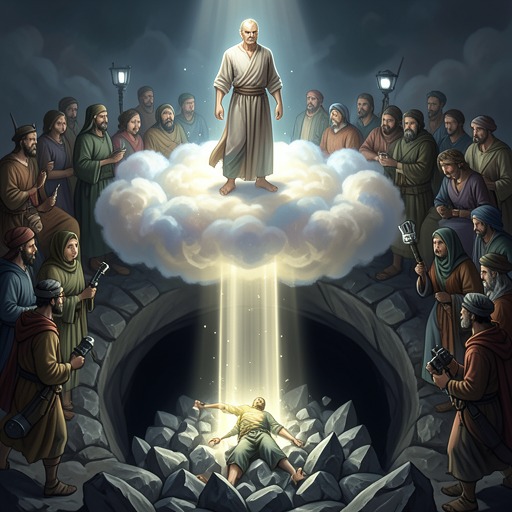
[Michael](entity:character-recall-character-756662928179) showed [Adam](entity:character-recall-character-f2c33a925377) that the city was filled with armies, robbers, giants, and rulers who considered conquering as the highest glory of humanity. A righteous person who protested against violence and oppression was almost caught by the crowd, but was saved by heaven
immediately before the Flood
Noah Builds the Ark
[Michael](entity:character-recall-character-756662928179) showed [Adam](entity:character-recall-character-f2c33a925377) that [Noah](entity:character-recall-character-92b6364c0ebc) proclaimed repentance to a corrupt world. After his warnings were rejected, he built the ark, gathered supplies, and took his family and the chosen animals aboard the ark. Noah's obedience opposed the general violence and licentiousness. The ark became both a tool of judgment and
the next generation after Noah’s warning
The Great Flood
Rain falls, the source of the deep is split open, and the flood waters cover the earth. All human societies and their achievements are swallowed up, only [Noah](entity:character-recall-character-92b6364c0ebc) and his family survive on the ark
after the Flood waters recede
The Rainbow Covenant
The ark came to rest on a mountain. [Noah](entity:character-recall-character-92b6364c0ebc) first released a raven, then a dove, to determine if the flood had receded. The returning dove brought back a branch of olive, and the dry land was revealed. Noah offered thanks and saw a rainbow in the clouds. [God](entity:character-recall-character-833766c1de3f)'s covenant
after the repopulation of the earth
The Tower of Babel
A proud ruler led people from the [Garden of Eden](entity:location-recall-location-garden-of-eden-e10e6bb4e22f) to the plain of Shinar, where they built cities and a tower to make their name known to heaven. They attempted to achieve political unity through the ambition of self-exaltation, rather than submission. [God](entity:character-recall-character-833766c1de3f) confused their language, and the builders could
after Babel
The Call of Abraham
[God](entity:character-recall-character-833766c1de3f) called [Abraham](entity:character-recall-character-727d149fb3ed) to leave Ur of the Chaldees, leaving his family, homeland, and idols, and promised to lead him to a new land. Abraham, without knowing his destination, obeyed by faith, taking his family and possessions to [Canaan](entity:location-recall-location-canaan-45b9c48b1e4c). His faith opened the history of the
generations after Abraham
The Exodus from Egypt
The descendants of [Abraham](entity:character-recall-character-727d149fb3ed) increased in [Egypt](entity:location-recall-location-egypt-831f7ba4f646) and were enslaved by a fearful king; this king ordered the killing of their male infants. [Moses](entity:character-recall-character-6e87fcb4db51) and [Aaron](entity:character-recall-character-792c3adb48fa) were sent by [God](entity:character-recall-character-833766c1de3f) to demand their release, and a series of plagues forced the rulers to yield. The Israelites left Egypt with the goods they had taken
during the wilderness journey after the Exodus
The Sinai Covenant
[God](entity:character-recall-character-833766c1de3f) led [Israel](entity:organization-recall-organization-israel-ed8198589963) through the wilderness, and in the sound of thunder, lightning, and trumpets, gave the law from [Mount Sinai](entity:location-recall-location-mount-sinai-29b4392355f7). The law established civil justice and religious sacrifices, while the tabernacle and the ark established the presence of God among the people. [Michael](entity:character-recall-character-756662928179) explained that the law of [Moses](entity:character-recall-character-6e87fcb4db51)
after Israel settles in Canaan
The Promise to David
After [Israel](entity:organization-recall-organization-israel-ed8198589963) settled in [Canaan](entity:location-recall-location-canaan-45b9c48b1e4c), they repeatedly fell into sin and were saved through judges before the coming of a king. The second king, [David](entity:character-recall-character-34e273e61eff), was known for his piety and ability, and was promised an eternal throne. This promise established a royal lineage from which a future Messiah would come
later in Israel’s monarchy
The Babylonian Captivity
The idolatry and corruption of [Israel](entity:organization-recall-organization-israel-ed8198589963) brought about judgment. [Babylon](entity:location-recall-location-babylon-5ceb3b8b683f) destroyed [Jerusalem](entity:location-recall-location-jerusalem-8e4409a0f555), the temple, and its holy things, carried the people away into exile, and imprisoned them for seventy years. Later, [God](entity:character-recall-character-833766c1de3f) restored them through the decree of foreign kings, preserving the covenant made with [David](entity:character-recall-character-34e273e61eff). This event shows
near the beginning of the Common Era
The Birth of the Messiah
After being taken back, [Israel](entity:organization-recall-organization-israel-ed8198589963) fell into factional strife and lost the rightful line of kingship. A star announced the birth of the Messiah, and the wise men from the east brought frankincense, myrrh, and gold. An angel told the shepherds where the child was born
during the Messiah’s earthly ministry
The Passion and Resurrection
The incarnate [Son of God](entity:character-recall-character-9243f7e9aff2) fulfills the law through obedience and love, but is subsequently hated, accused, and crucified by his own people. His death bears the punishment of [Adam](entity:character-recall-character-f2c33a925377)'s rebellion and defeats the law, sin, and the enemy of humanity. On the third day he rises again
after the Resurrection
The Ascension and Great Commission
The risen Son appears to his disciples, commands them to teach all nations, and leaves baptism as the sign of cleansing from sin. He then ascends through the air in triumph, overcoming [Satan](entity:character-recall-character-3dc6adee9264)'s realm and taking his seat at [God](entity:character-recall-character-833766c1de3f)'s right hand. The mission extends the promise beyond [Abraham](entity:character-recall-character-727d149fb3ed)'s physical descendants
after the Ascension
The Church’s Future Corruption
The [Apostles](entity:organization-recall-organization-apostles-0f45108934d8) receive the promised Spirit, preach throughout the nations, perform signs, and eventually die after completing their ministry. Later teachers become like wolves, turning sacred mysteries toward wealth and ambition.
Outward ritual and political power replace inward faith for many, while persecution falls on those who worship in spirit and truth. Nevertheless, written records preserve the doctrine until the final return of Christ.
at the end of the world
The Last Judgment
When the world is ripe for dissolution, the returning Santo comes in glory to judge the living and the dead. He destroys [Satan](entity:character-recall-character-3dc6adee9264) and his perverted world, separates the faithful from the wicked, and brings divine justice to its final expression. The judgment completes the promises made after the Fall. Death, sin
after the Last Judgment
The New Heaven and Earth
The conflagration purges creation, and [God](entity:character-recall-character-833766c1de3f) raises new heavens and a new earth founded on righteousness, peace, and love. The redeemed inherit a world more blessed than Eden, where divine presence and human joy are no longer threatened by corruption.
The final renewal shows that the story does not end in simple restoration of the original garden. The redeemed state surpasses the [State of Innocence](entity:state-recall-state-state-of-innocence-40157a1dfd2b) because it is secured through tested faith, suffering, obedience, and grace.
the closing scene after Michael’s revelation
The Expulsion from Eden
[Michael](entity:character-recall-character-756662928179) leads [Adam and Eve](entity:relation-recall-relation-adam-and-eve-0bf195c59d41) from the eastern gate of Eden. They look back at the flaming sword and the guarded paradise, shed natural tears, and then turn toward the world outside