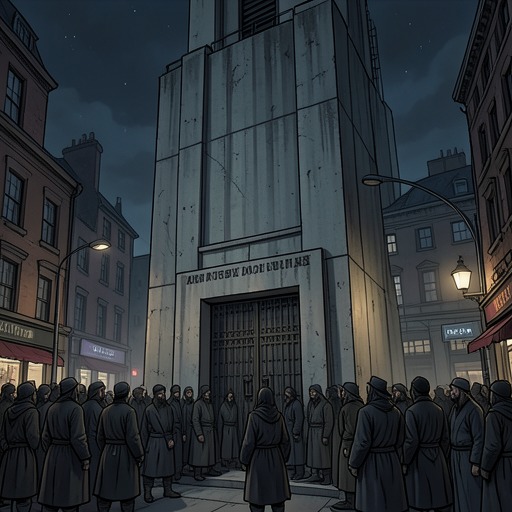
Asien’dalun
PeacemakerAsien’dalun is the Kadagidi estate and manor house where an armed confrontation brings the Shadow Guild’s operations into the open. Once the residence of Lord Aseida and a refuge for Guild operatives, it becomes a contested stronghold: after gunfire from its grounds and an upper window, Bren Cameron’s party takes tactical positions inside, prevents records from being destroyed, and transfers the estate into the hands of the Taibeni clan and Lord Tatiseigi’s allies.
Estate and political setting
Asien’dalun stands on Kadagidi lands beside Lord Tatiseigi’s estate, in the green midlands. Its importance is therefore both residential and political: it is the seat from which the Kadagidi household’s authority is exercised, and the place where that authority is compromised by the people Lord Aseida has sheltered. The confrontation does not remain a private dispute within a manor. Reports of an invasion of Kadagidi lands unsettle the township, while the estate itself is occupied by forces aligned with Lord Tatiseigi.
The events at Asien’dalun also belong to a wider struggle against the Shadow Guild. In the preceding month, Shadow Guild members in a mountainous province had used an order presented as legitimate Guild business to disarm capable local Guild units and send them to defend rural areas without their equipment. After Ilisidi learned of this mistreatment and acted to rescue countryfolk, information from captured southern leaders gave her the legal grounds to move against the Kadagidi in the north. Asien’dalun is where the northern operation becomes visible: Lord Aseida’s chief bodyguard, Haikuti, is identified as the Shadow Guild’s leading tactician and as the man who had exercised power behind Murini.
Gunfire and seizure
Bren Cameron and Jase Graham go to Asien’dalun to explain whom the Kadagidi household had inadvertently endangered and to seek an apology. Rather than bringing Lord Aseida out to confer, his bodyguard fires on them. Banichi and Jase Graham’s guard return fire. A second attack comes from an upper story, where a shooter fires at Bren Cameron and Jase Graham; the guard responds, damaging a window. Bren Cameron later emphasizes to Tabini that his party did not fire first.
The confrontation ends in deaths rather than arrests among the armed attackers. Haikuti, two Guild units, and the person who fired from the upper window are dead. Bren Cameron’s group and Ilisidi’s bodyguard then take tactical positions in the house and grounds. They prevent servants from destroying records, arrest people they believe to be plain-clothes Guild members, and send the remaining domestic staff to the township under Guild regulations. The operation thus secures both the property and potential evidence, while the staff’s removal leaves them outside the immediate exchange of fire.
Lord Aseida is found hiding inside the house and brought out under escort. He is taken to Tirnamardi, where he asks Lord Tatiseigi for protection and is refused. The estate is left in the possession of Lord Tatiseigi’s allies. The Taibeni clan, itself offended by an operation launched from Kadagidi soil, holds Asien’dalun in alliance with Lord Tatiseigi. The transfer is a striking realignment: groups with a history of hostility now cooperate against the Kadagidi household and the threat associated with it.
Evidence, custody, and public attention
Asien’dalun’s records matter because the official account of the shooting is not yet complete. Bren Cameron tells Tabini that Jase Graham can process a recording for their machines, but cautions that he has not seen it. His recollection, shared by Banichi, is that Lord Aseida’s senior Guild man fired first. Tabini recognizes Haikuti’s name; Bren reports that Haikuti is dead and describes how the operation was carried out, including the prevention of record destruction and the detention of suspected Guild members.
Lord Aseida’s detention and the seizure of his estate are connected but distinct outcomes. Aseida is removed from the property and denied refuge by Lord Tatiseigi; the house, meanwhile, is controlled by his opponents. Tabini also learns that Jase Graham’s guard fired the shot that ruined the window, a detail that makes the physical damage part of the accounting of responsibility rather than evidence that the whole house was destroyed. The distinction matters in an operation whose legitimacy rests on who initiated the violence and how the response was conducted.
The estate’s occupation quickly becomes a matter of public knowledge. News services, initially diverted by preparations for Cajeiri’s birthday, are expected to seek answers from aggrieved household staff sent down to the township after being ejected from the manor. The reports are likely to overshadow not only the birthday preparations but also the assassination of the heir’s grandfather and the impending birth of another child to the aiji in Shejidan. What began as a military action at a secluded residence is therefore poised to become a larger public and political crisis.
Narrative significance
Asien’dalun concentrates the change from suspicion to actionable evidence. The attack on Bren Cameron and Jase Graham gives the response an immediate defensive cause; the discovery of Haikuti’s role and the estate’s threatened records connects that violence to the Shadow Guild’s broader operations. Control of the manor changes hands, Lord Aseida is taken into custody, and news of the invasion threatens to overwhelm the story that had been arranged around Cajeiri’s birthday.
The estate also exposes the limits of appearances and of controlled publicity. Ilisidi’s elaborate diversion around the birthday preparations had seemed designed to keep the news services away from politics, but Bren Cameron comes to suspect that he himself had been misled about its primary purpose. The maneuver may instead have separated the Shadow Guild’s two principal targets, Ilisidi and Tabini, while allowing her to gather intelligence on the Kadagidi. Asien’dalun is consequently more than the site of a firefight: it is the point where covert planning, armed resistance, evidence gathering, and public disclosure converge.