Bujavid
PeacemakerBujavid is the fortress on the hill above Shejidan: at once a residence, a political center, a venue for public ceremony, and a place whose layered security can determine what action is possible. Its elevated position above the capital’s red roofs and maze-like streets gives it a conspicuous physical presence, but its importance rests just as much on controlled access, internal systems, and its links to the institutions and infrastructure of the city.
Setting, arrival, and residence
Bujavid rises above the roofs and intricate streets of Shejidan, a landmark Bren Cameron first encountered on arriving at the mainland. He had landed at the airport on a sunny afternoon and was met by two of Tabini-aiji’s black-uniformed bodyguards, who escorted him up to the fortress. His assigned accommodation was not a grand reception suite but a modest set of rooms in the servants’ wing. The arrangement placed the newly arrived human within the ruler’s household while marking the limits of his initial standing and access.
Bren’s first formal act from that accommodation was to send Tabini-aiji a letter bearing his ring of office. It reported his presence and satisfaction with the arrangements and expressed hope for good relations between Atevi and humans. He sealed the rolled letter in a small message cylinder, choosing the finest one, then found himself unsure how to get it delivered. The moment makes the complex more than a backdrop: even a newcomer’s attempt to establish diplomatic contact depended on navigating its household and channels of communication. Bren was the sole human permitted to set foot on the mainland, and the place from which he tried to make that first impression was also the seat from which the political relationship would be conducted.
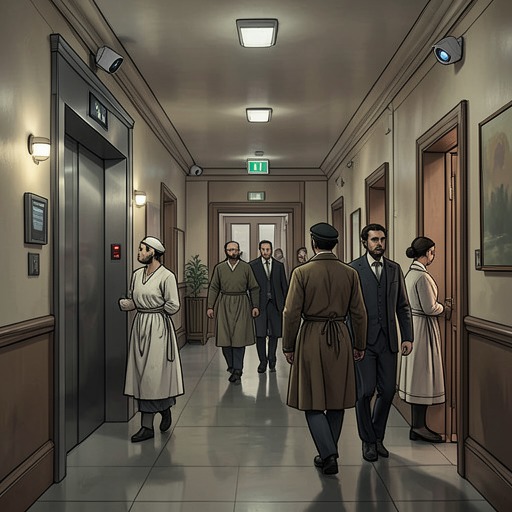
The Bujavid accommodates sharply different kinds of space. Its public and ceremonial interiors can be lavish, while residential floors can be made to function as protected enclaves. One described hall has antique patterned runners, porcelain on plinths, tapestries, rococo moldings, and decorative niches. Cameras are integrated into this display, but their images go only to security stations serving the residents of four apartments. Ornament and surveillance occupy the same environment: the interior presents refinement while quietly enforcing the privacy and protection of its inhabitants.
Security, access, and the coup
The building’s lifts and corridors are part of its security architecture. During the coup, the entire floor associated with Ilisidi’s household operated on a separate system and was effectively cut off from the rest of Bujavid. Ilisidi’s people had maintained surveillance in her absence, and ordinary lift cars could not stop on the floor without a key. The separation converted a residential level into a controlled zone, one whose security depended not simply on walls but on regulating movement and information.
A security-locked lift could pass the public ground level and continue to the third floor, stopping there despite the ordinary limits on access. The arriving party included Ilisidi, Jase, Cajeiri, and younger members of the household, surrounded by Guild uniforms, with Cenedi beside the control panel. Once the doors opened, Tano and Algini stepped out with Bren into the richly furnished hall. Its cameras answered to the residents’ security rather than to the building at large. Luxury and protection were thus not separate functions: the same corridor offered a domestic setting and a defensible boundary.
That boundary mattered because the coup had originated inside the Assassins’ Guild, not in a general revolt by the lords or the people. A body of the institution charged with law enforcement had fractured, and one part had seized the government for a ruler who should not have held office. In this crisis, confidence in the building depended on knowing which people and systems could be trusted. The isolated floor, its surveillance, and controlled lifts offered Ilisidi’s household a measure of security while the larger political order remained compromised.
The protection was real but not absolute. Bren explained that Jase could contact the station without using the Messengers’ Guild, and that Geigi had strengthened the spaceport and could respond if the people or the spaceport were threatened. Jase’s bodyguard could defend those on their floor, but no one could guarantee the safety of the entire building. Bujavid’s security was therefore understood in layers: a guarded apartment level, connections to allies beyond the fortress, and the continuing vulnerability of the wider complex.
Movement through the city and its infrastructure
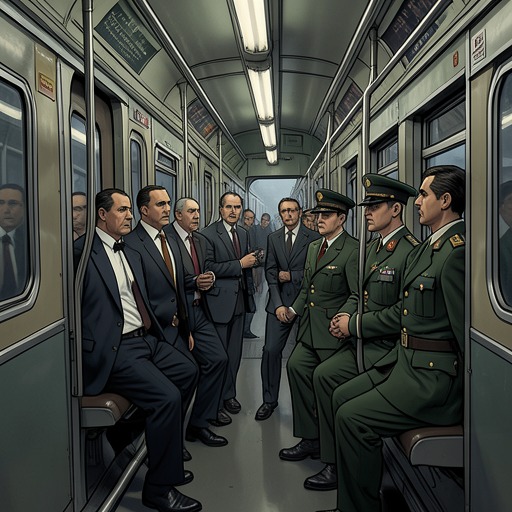
Bujavid’s authority is connected to the systems that move people, goods, and information through Shejidan. A rail spur passed through a cobbled plaza around which guild premises were clustered. The area served six regular trains from the old station, four freight runs for uptown shops, and a local train twice daily for office workers. Although traffic included vans and small buses, there were few pedestrians beyond Guild members visiting nearby restaurants or the sheltered stops. The rail line was not merely a route: it linked the district’s daily routines to the larger city network.
The Transportation Guild’s office in Bujavid could direct the Red Train onto an old mid-city spur for a pickup at a freight yard. The stated purpose was to collect artworks from Lord Tatiseigi’s estate for a special exhibit at the Bujavid Museum during the Festivity. The crates were indeed in the system for a regular freight pickup after midnight, but they also contained spare clothing left behind when the party departed Tirnamardi. The official freight movement gave cover to a private need, showing how Bujavid’s institutions and railway connections could carry both public business and discreet arrangements.
Rail access could also be used to interrupt movement. Once a train was stopped, the city rail network was expected to come to a prolonged halt. Reports would be made for safety, while Ilisidi’s people had to ensure that the Transportation office in Bujavid did not send crews to reach the train and instead allowed traffic to stop. The sequence makes the office a consequential point of control: the response to a disruption depended not only on the track but on who could shape the instructions issued from the administrative center.
This infrastructure has a wider political history. Eleven regional associations eventually agreed to build a railroad west from Shejidan without going to war over it. In the immediate political landscape, the association representatives’ lodging also placed them within reach of the capital’s institutions: minor lords stayed in town during legislative sessions, and the Cismontane Association kept rooms for its representatives in a moderately priced hotel near the esplanade below Bujavid. The fortress stood above a city in which political representation, guild administration, and transport were physically connected, though not all housed within the same building.
Ceremony, publicity, and the public face of power
Bujavid is also a stage on which political authority becomes visible. Its lower hall, encountered by the younger visitors, is more ornate than the secured residential corridor: plinths and pedestals, vases and statues, carved and gilded doors, sculpted arches, jade screens, and live-fire lamps frame a gathering of guests in court finery. The contrast between this crowded ceremonial interior and the guarded upper floor makes the building’s multiple roles legible. One space receives a public-facing assembly; another is arranged to restrict access and protect its residents.
The Audience Hall’s opening is marked by a horn, after which guests and members of the public are assigned places behind red satin ropes in the main hall. At one event, there are no public visitors, but the procedure still defines the boundary between participants and observers. The Bujavid printing office prepares cards for distribution, including a special run for attendees. The first issue is ordinarily limited to thirty thousand cards, kept under tight security until official release in the Audience Hall and on the steps. Their distribution requires a substantial Guild presence to keep the lines orderly. Ceremonial authority thus extends outward from the hall through printed objects, public access, and managed crowds.
The building is the setting for a decisive private and public transition when Tabini-aiji formally names Cajeiri as his heir. Tabini explains that the news will reach the whole aishidi’tat at once rather than traveling by rail to the outer provinces. The formal declaration is also to travel by a traditional route: a runner descends the Bujavid steps by torchlight carrying the proclamation on parchment with its seals, then proceeds to the Guilds and finally the Archives, where the declaration of Investiture is filed. The complex is both the point of issue and the first landmark in a carefully staged passage from a father’s announcement to a public, recorded fact.
Political continuity and narrative significance
Bujavid’s importance continues beyond individual ceremonies and crises. Ilisidi maintained control of the complex while making herself aiji-regent, even though she failed to secure acceptance as aiji in fact. She refused to leave Shejidan and retained strong control of Malguri; her own agenda and large bodyguard remained influential well into her son’s majority. That force extended her authority across the East and preserved her safety, while also irritating some of the political powers in the capital. Control of Bujavid was therefore not equivalent to uncontested rule, but it was a durable base from which authority could be exercised and defended.
Across these episodes, the fortress repeatedly joins domestic life to state power. It houses newcomers and rulers, separates secure households from compromised institutions, receives freight and political representatives, and turns declarations into public ritual. Its doors, lifts, corridors, offices, and steps are not neutral scenery: they regulate who can enter, what can move, where news originates, and how authority becomes visible. Bujavid’s defining significance lies in this double character—an imposing residence above Shejidan and a working political infrastructure woven into the city below.