Southern Island
PeacemakerThe Southern Island is both a lost place and a continuing presence in atevi life: a forested region destroyed in an ancient cataclysm, a source of prized cultural artifacts, and the focus of contested accounts of ancestry. Its history survives not as a settled record but through landscapes transformed, objects that can no longer be made, and political arguments over who may claim descent from its people.
Landscape and Catastrophe
In Cajeiri’s account of the distant past, forests once covered much of the Southern Island, except for its coast. Forest also stretched across the Atageini ridge and onward to the mountains, while parid’ji once lived as far north as Shejidan. The account makes the island part of a much broader lost ecology: woodland connected regions that are now separated by a changed landscape.
That world ended when three islands blew up. The catastrophe is also recalled as the Great Wave, which wiped out the Southern Island culture. The evidence gives no detailed account of the destruction, but its consequences remain tangible: forests vanished, the old culture collapsed, and travel to the southern region remains hazardous. The possibility that an island was reappearing above the waves and smoking briefly raised hopes of reaching the Southern Island; those hopes were checked by the dangerous weather and open seas of the Southern Ocean.
Cultural Remains and Competing Histories
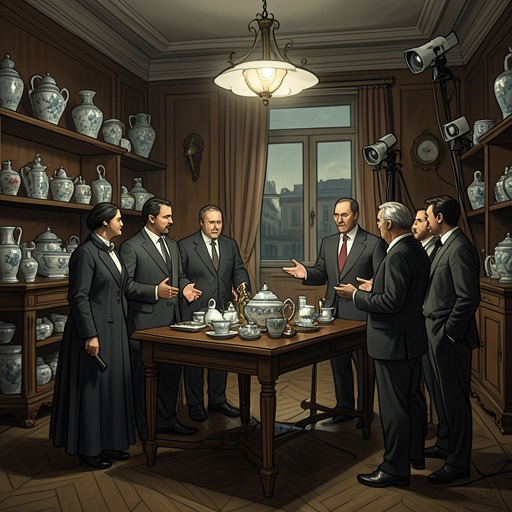
The island’s cultural legacy survives in objects as well as stories. Bren recognizes the legendary Southern blues in a porcelain exhibition: a beautiful, glassy aqua glaze that can no longer be made in the old way because the Great Wave destroyed the culture that produced it. Lord Tatiseigi’s collection rivals the collection in Lord Machigi’s district, giving the lost tradition a material presence in the present even as its original methods and context are gone.
The island also lies at the center of competing claims about the tribal peoples. One account connects elaborate northern figured porcelain to the pillar-like Reverence Statues of the north and to techniques brought by survivors of the Southern Island culture. Another proposed connection links those forms to the Grandmother Stones known on Mospheira and found on the mainland among the Edi and the Gan. The guide’s account makes clear that these are theories, not an agreed history.
The tribal peoples reject the idea that they descend from northern culture. They maintain instead that they came from former lords of the Southern Island, and that the island’s Grandmother Stones were swept away in the flood. Their claim is supported, in part, by the contrast between their matriarchal society and the patriarchal north. The question carries political weight: during the exhibition, the Director moves away from it and turns to acknowledging the assembled notables rather than continuing the discussion.
A Dangerous Route into the Present
The southern seas make the island’s past a practical concern. The open Southern Ocean is exposed to winds that travel around the world without land to break them; by comparison, the seas between Mospheira and the mainland are calmer. The former chain of islands had also served as a barrier along the Southern Island’s eastern coast. Even after the island’s possible reappearance, reaching it is described as dangerous, not simply a matter of setting a course south.
Plans for Lord Machigi’s large metal ships to sail around the teeth of the southern shore and onward to Ilisidi’s territory in the East place this difficult geography within current political arrangements. The voyage is part of the new agreement between Ilisidi and Lord Machigi, and Bren reports that its planners think it can be done with help from the space folk. The route shows the Southern Island’s continuing significance: the same southern waters that preserve the hazards left by catastrophe now figure in proposed connections between regions.
Significance
The Southern Island is remembered through sharply different kinds of evidence: Cajeiri’s map and account of vanished forests, Bren’s recognition of an unrepeatable ceramic color, and the tribal peoples’ assertion of an ancestry the northern account disputes. None restores the island as it was. Together, these recollections make its loss an active historical question, linking environmental change to cultural survival, political identity, and the risks of present-day travel.