Assassins’ Guild Headquarters
PeacemakerAssassins’ Guild Headquarters embodies the contradiction at the heart of the Guild: an institution presented to the public as a place of law and orderly service, yet vulnerable to a quiet concentration of power behind its offices and records. Its severe exterior and deliberately archaic interior frame a larger political struggle, in which the building’s control, the Guild’s assignment machinery, and the authority of its Council all become inseparable.
Exterior and Public Face
The headquarters stands out for its unwelcoming modern block of black stone. Narrow slits serve as windows, and recessed ironwood doors sit at the end of a relatively narrow approach. Unlike the more ornamented Merchants’ Guild or the Scholars’ Guild, it offers no lively frieze or statuary to soften its façade. The building appears inaccessible by design; even its substantial wooden doors suggest that entry is meant to be controlled rather than inviting.
That severity does not mean the outer entrance is meant to remain closed. The doors are not routinely supposed to be locked, although they can be, while the inner door is expected to be secured. The distinction captures the headquarters’ two faces: an accessible public threshold and a protected interior whose openness depends on Guild procedure and permission.
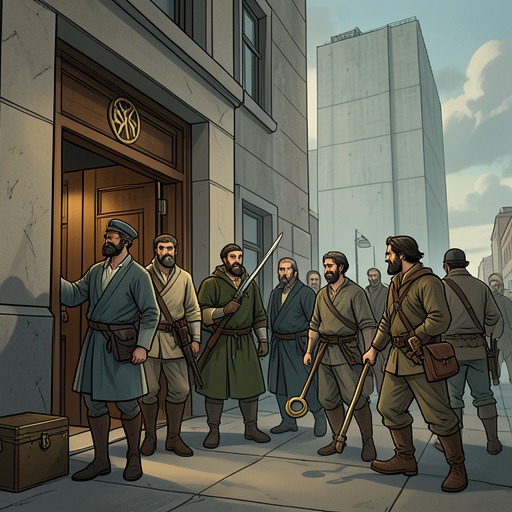
The arrival of Bren, Banichi, Jago, Tano, and Algini makes the exterior part of a carefully managed approach. Their car stops near a lamp post in front of the building. They descend by steps released from the vehicle, then continue toward the entrance at a deliberate pace: speed matters, but haste could attract attention. At the doors, Guild personnel maintain official form and step aside without discussion. The party is admitted, but the controlled passage into the building does not yet amount to access to its inner power.
Public Offices and Controlled Interior
Inside, the headquarters reverses the impression of its modern exterior. The foyer opens into shadow and cool air, with three steps leading up to a black-stone hallway. Electric lamps converted from gas fittings cast an inadequate gold light beside office doors. Dark-varnished doors contain hammered-glass windows, and the motif is one of deliberate antiquity: shadow and tradition set against the building’s stark, contemporary shell.
The fifteen outer offices handle work that connects the Guild with the public. Their business includes requests for guards, legal filings, neighborhood complaints, and applications for certificates or seals. In this capacity the Guild also serves the national judicial system in inter-clan disputes. The glass in the doors suggests a measure of openness, but that openness is bounded by the offices’ function: these public-facing rooms are not the same thing as access to the Guild’s governing or administrative spaces.
The route inward makes those limits physical. Each office has a rear service entry opening onto a hidden corridor, and the offices are staffed by lightly armed clerical personnel. Regular Guild members may also visit on business, creating a more serious security concern. The public-access hall ends at a guarded door separating the outer area from the Guild Council, the other Guild section ordinarily available to outsiders.
Beyond that door, a wider area turns left toward a short continuation of the main hall and the double doors of the Council chamber. When the Council is in session, those doors are guarded. A bench stands to the right of the entrance; to the left is a locked wooden door leading to the administrative corridor, a space even high-ranking visitors do not enter. The arrangement divides the headquarters into graduated zones of access: public service, the Council’s formal meeting space, and an administrative interior held apart from visitors.
Records, Assignments, and Hidden Authority
The headquarters’ political importance lies not only in its rooms but in the work carried out through them. For forty-two years, Shishogi held the Office of Assignments, recommending personnel for both short-term and long-term duties. These included units hired for a citizen’s Filing, units assigned to the defensive side of a dispute, replacements for a unit that had lost a member, and senior guards assigned to a lord, a house, or an institution such as Bujavid, where the legislature met.
His authority extended to plain-clothes Assassins placed as servants—valets, cooks, and doorkeepers—on assignments intended to be strictly defensive. He also appointed the investigators serving the Guild Council, the body that approved other assignments and examined whether a Filing was truthful. In combination, personnel recommendations and the appointment of investigators gave the Office of Assignments influence over both who carried out Guild work and who assessed the basis for it.
Shishogi was only the tenth person to hold the office in the modern Guild’s history. He outlived his clerks and secretaries without replacing them, leaving a cramped, untidy room crowded with towering stacks of files and records. Its pre-computer system became a Guild joke, but Shishogi himself remained so senior and so knowledgeable about personnel that the Council had no pressing reason to replace him. The disorder of the office should not be mistaken for a lack of reach: the records could send the right person into the right position years later, undermine a province, or put units in the field at risk. A year before the events surrounding the headquarters, the elderly official in Assignments had, in effect, held the atevi world in his hands.
That accumulated influence helps explain how the Guild’s institutional crisis could reach beyond a single leader. Tabini, Ilisidi, and their allies gradually learned that the coup had not originated in a conspiracy of lords or popular dissent. The Assassins’ Guild itself had fractured, and part of it had seized the government for Murini. Later, when forces opposing Tabini were defeated, many combatants proved to have been misled by forged orders. The Guild’s records and procedures were therefore not neutral background machinery: they were part of the means by which authority could be assigned, obscured, and abused.
Re-entry and Restoration
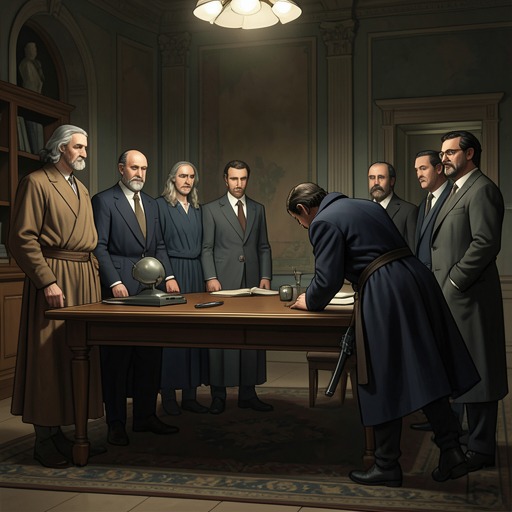
The return to the headquarters is framed as a legal operation as much as a security action. Bren carries no weapon; he brings the aiji’s ring and a briefcase containing legitimate demands from Tabini and Ilisidi for an investigation. The distinction is consequential: an attack on him or his guards would be an attack on Tabini’s authority. When Nawari opens the doors and gives orders to the guards, Bren and his party enter the Council chamber and walk down its descending aisle, past tiers of desks toward the speaker’s well.
The chamber is already occupied by Guild members, some wounded and all heavily armed, gathered around the long desk of the Guildmaster and his aides. The recording secretary’s smaller desk is partly obscured by the crowd. The party’s descent draws every eye. The scene brings the headquarters’ institutional divisions into the open: a public route has led to the Council’s formal chamber, where armed Guild personnel confront a demand grounded in the aiji’s authority and the Guild’s own procedures.
The operation has limited casualties. Only three people die across the action: the target and two others who die firing at a senior Guild officer after he identifies himself. Banichi’s plan secures entry into the heart of the building for the returning Guild, while Cenedi directs the action in the administrative wing during the initial distraction. The two plans succeed as well as could have been hoped, and the separation between Council chamber and administrative corridor becomes operationally significant rather than merely architectural.
Afterward, the headquarters stands as a place where the Guild must rejoin written rules with rules actually enforced. Algini observes that juniors who have advanced during the preceding three years will discover that the rules on the books and those in operation are now the same. The remark gives the restoration a generational dimension: reclaiming the building is not enough if its procedures remain selectively applied. The headquarters’ decisive significance lies in that conjunction of space and system. Its guarded doors, public offices, Council chamber, and accumulated files make visible how the Guild can serve law—and how control of its internal machinery can turn that same institution into an instrument of political seizure.