Shejidan Old City
PeacemakerShejidan Old City is the walled, maze-like heart of Shejidan, shaped by narrow cobbled streets and an urban railway built to fit the contours of an older city. Its tracks and open spaces preserve more than a record of past transport: they connect everyday circulation with the political history of the Aishidi’tat and, in a later crisis, provide a route for a carefully staged operation.
Setting and Urban Form
The Old City is defined by walled neighborhoods and narrow streets, a dense layout that distinguishes it from the more open routes served by modern long-distance trains. The city’s oldest railway track runs through this historic center. Its curves and tunnels set practical limits on the trains that can use it: sleek, longer transcontinental cars cannot manage the Bujavid tunnels or the bends of the cross-city route, even though they share the same gauge as the local railway.
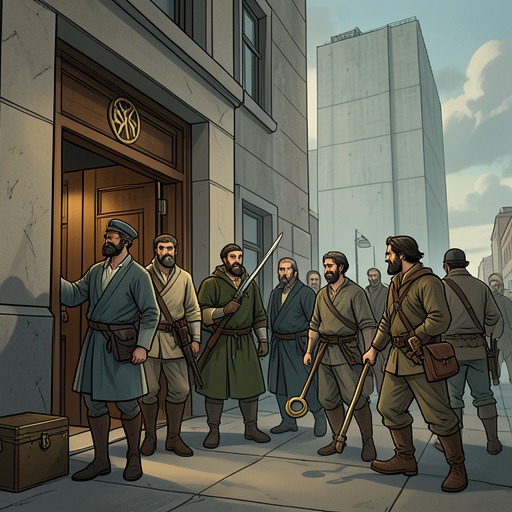
A broad cobbled plaza forms another landmark within the old urban fabric. The Guilds claimed this as the last available land in the heart of old Shejidan when the Aishidi’tat was taking shape and the Guilds were becoming durable institutions. Once a muster ground, the plaza became a point where the spatial history of the city and the institutional history of its Guilds meet.
The City Railway
The older city trains continue to serve districts and tasks that the modern transcontinental cars cannot. Smaller engines and shorter cars operate through Bujavid and along warehouse-to-market routes, using equipment that has remained much as it was a century earlier. Their line loops around the ancient center, linking the city’s local circulation to its wider transport system.
The railway carries mail and ordinary goods as well as passengers. Its trains move produce, flour, oil, and wine to warehouses or onward to the express line, and they can make practical adjustments to the demands of city life: a stack of crates may be offloaded for a shop, a passenger may board at an unscheduled stop, or traffic may pause for a stalled vehicle or pedestrians. This flexible, local service contrasts with the fixed demands of fast intercontinental travel.
Shejidan also marks the starting point of the railroad built westward toward the coast. Eleven regional associations agreed to construct it without going to war with one another. During construction, the Transportation Guild and the Builders began to cross boundaries not only between clans but between regions. The project helped turn cooperation over a shared undertaking into a broader political force.
Railways, Guilds, and Political Change
The railroad’s progress continued amid anxiety about an omen associated with the Foreign Star, which occupied the attention of lords and clans for a year but produced no disruption to the project. The aijiin who had once been elected as war leaders were instead elected to manage the work: coordinating Guilds, clans, and sub-clans, securing passage through districts, and upholding agreements sealed by individual clan lords. The emerging Assassins’ Guild protected these leaders against attacks by assassins serving particular lords.
The first railroad’s success encouraged further projects and larger associations. When a dispute threatened to dissolve those new alliances, the Assassins’ Guild supported the aiji against three powerful clan lords who wanted to replace the existing agreement with separate administrative districts. The railway thus became more than a route for goods and passengers: the agreements needed to build it tested whether cooperation across local boundaries could endure political pressure. The Old City, with its Guild-held plaza and rail connection to the west, stands at the center of that history.
A Strategic Route Through the Old Center
The local railway’s limitations could also make it useful in a crisis. The Red Train, an older engine suited to the city tracks, was ordered onto an unaccustomed route and brought to a planned halt in front of Assassins’ Guild Headquarters. Its crew were to report a mechanical breakdown and hold their position, while the dowager’s people worked to keep the Transportation office from sending repair crews and to stop other rail traffic.
The train’s slow progress carried it past the edge of the Old City and onto the track crossing the broad former muster ground. There it stopped. Bren, accompanied by Banichi and Jago, moved toward the end of the car, where Tano and Algini were waiting. The scene turns the Old City’s inherited infrastructure into an immediate political instrument: the same narrow route shaped by old tunnels, curves, and local engines becomes the means to position people directly before the Guild’s headquarters.