Earth
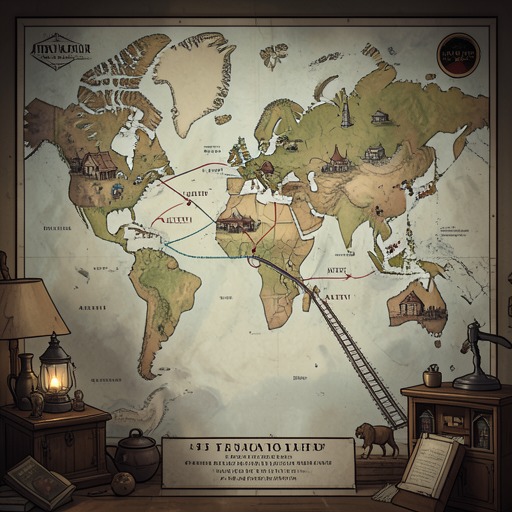
PeacemakerEarth is the atevi home world that became the destination of the human starship Phoenix after an unexplained navigational disaster. The humans’ arrival transformed an unfamiliar planet into a shared political world: first as a place where refugees came down from the sky, then as the ground on which humans and atevi negotiated peace, and eventually as the focus of renewed journeys into space. The two names carried by its history—Earth and the Foreign Star—mark the distance between the people who had always lived there and those who arrived from beyond it.
Planetary setting and names
The planet is described from two connected perspectives. For the atevi, it is Earth, their inhabited world; for the humans aboard Phoenix, it appears as a blue world resembling their own ancestral Earth. The resemblance is consequential but not identity: the ship’s people have reached a different planet, one with its own societies and history. Their eventual orbit around Earth brings these two accounts into contact, though the humans at first have only distant observations of the communities below.
The ship that atevi observers would come to know as the Foreign Star was Phoenix, a human starship whose original mission had been to establish a station at a distant star. The shift between those names reflects a divided history of knowledge. The atevi see a strange object in their heavens and, later, remember the people who descended from it; the humans know the vessel as a ship displaced from its intended course. Earth is therefore not merely the setting of first contact: it is the unexpected destination around which both versions of the encounter gather.
The arrival from the heavens
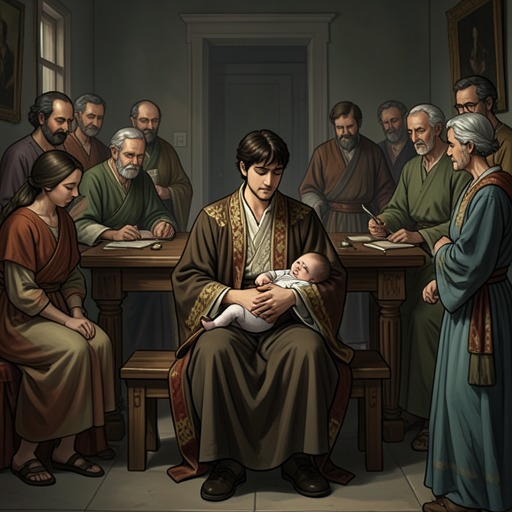
In an account framed as a village lord’s recollection, the first arrivals appear as petal sails falling from the heavens. They came down over a period of three years, sometimes in whole clouds, and landed in different places: most on Mospheira among the Edi and Gan peoples, some on the mainland near Dur, and some in the sea, where they were lost. The account emphasizes how strange their descent looked to those on the ground. Their small stature, fragile bones, and manner of reaching Earth drew curiosity and, in time, admiration for their bravery.
The newcomers seemed poor and ill-equipped. They wore plain, scant clothing and dismantled the containers that had sheltered them, reusing the pieces and spreading their petal sails between trees for protection from the elements. Their attempts to eat local food sometimes ended in death; it became clear that they could tolerate only the plainest foods. The account preserves both the human vulnerability of these arrivals and the atevi response to it: districts wanted to find them and see them, while some observers believed they had fallen from the moon. The humans’ own explanation—that they came from inside the Foreign Star and were glad to reach Earth because of the poverty where they had been—offered a different account of the same descent.
Phoenix’s displacement and settlement in orbit
The human history of the arrival begins with a planned expedition, not a voyage to Earth. Phoenix was to establish an orbital station that could house four thousand colonists. Its people carried the knowledge, machines, seeds, and plans needed to build a station core and outer structure; a second ship was expected to bring equipment for eventually landing people and constructing a habitat on a less hospitable world. The mission’s intended destination lay far from Earth, and the atevi planet was not part of the original plan.
Something went wrong. The ship-folk believed an accident had shifted Phoenix far off course. When the reference stars were absent from where they should have been, the crew understood that the disruption was drastic, but they could not identify their position. Phoenix gathered what resources it could and selected the nearest promising star system. Among the possibilities was a blue, life-bearing world much like the humans’ ancestral Earth. The lack of artificial satellites and detectable transmissions suggested that no spacefaring civilization lived there. Phoenix entered orbit around the atevi world.
The crew could see towns and villages and recognize a degree of technology below their own. Their law forbade disturbing the world, even if landing and asking for help had been easy; it was not. Prepared to construct an orbital station, the colonists instead began building one where they had arrived. They gathered asteroid resources, manufactured panels, parts, and framework, and enclosed the growing structure from within. Tethers and the beginnings of a station ring provided a place to stand; barracks moved into it, the first children were born, and the settlement’s prospects improved. Earth thus became the home of a human population whose survival depended on building in orbit rather than approaching the societies visible below.
Treaty and continuing significance
The first contact history is not the end of Earth’s role in human affairs. The Treaty of the Landing established the basis for dealings between humans and atevi, and the Foreign Star continued to orbit the planet, empty. Humans, vastly outnumbered, set about transforming Mospheira to suit themselves. The agreement brought sufficient peace, but the account also records matters left unsaid on both sides: atevi scientists were discovering uses for captured foreign machines, while the humans had not disclosed that another starship might someday return. The treaty’s stability therefore coexisted with incomplete knowledge and unresolved possibilities.
Earth later became the point of departure for a human–atevi journey into deep space. Tabini sent Bren Cameron, the heir, and the aiji-dowager on a two-year voyage, one year outward and one year back, to investigate whether the human account of their refugee situation was true. Their return brought thousands of colonists forcibly removed from their station, to be relocated on the space station above Earth. Their absence had coincided with a crisis at home: the government had fallen into the hands of Tabini’s enemies, although the people soon restored him to power. These events make Earth a center of political consequence as well as a place of settlement. The planet’s sky, once the source of the arrivals and the object of atevi curiosity, became an arena in which atevi authority and human survival were negotiated anew.