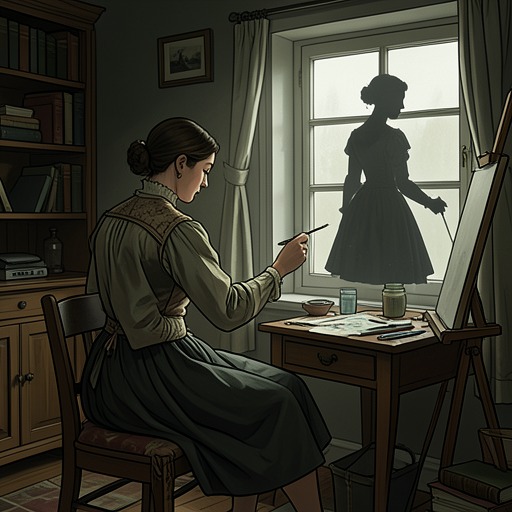
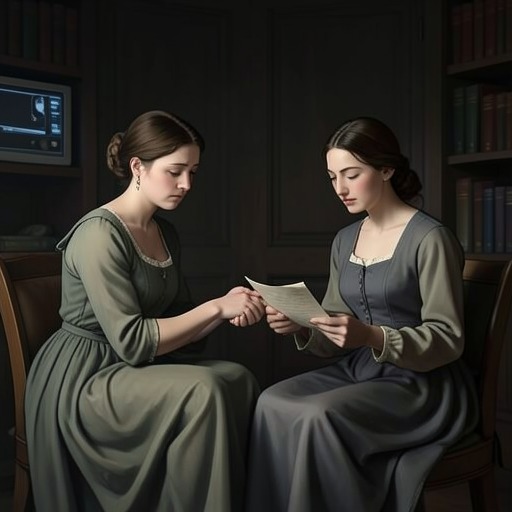
Blanche Glover's visit to Ellen Ash
PossessionBlanche Glover’s visit to Ellen Ash begins as an appeal made under the pressure of illness and delay, then returns decades later as a damaged, unsigned trace whose meaning cannot be recovered with certainty. The encounter matters because it places Ellen in possession of some undisclosed evidence and leaves Maud Bailey to weigh competing possibilities about the secret history of Randolph Henry Ash and Christabel LaMotte.
Causes and Delay
In June, Ellen was suffering a severe headache that confined her to a darkened bedroom. She described the preceding dizziness as a bodily warning and the resulting state as a twilight world in which life and death seemed of little consequence. Against that physical and mental exhaustion came a letter from a mysterious woman, educated and urgent, who called the matter one of life and death. Ellen put the letter aside, too low in spirits to decide what to do.
The next account makes the delay concrete. Dr Pimlott prescribed laudanum, which gave Ellen some relief, but she remained unwell and was sipping broth when the stranger arrived. Bertha let the visitor in after a hammering at the door. Ellen asked her to return when she had recovered; the woman accepted the postponement briskly but nervously. The episode therefore turns not on a refusal to hear the warning, but on the bodily vulnerability that interrupts its delivery.
The Visit and Its Apparent Resolution
The visitor did return. Ellen recorded that they talked for some time and that the matter was, she hoped, “quite at an end and wholly cleared up.” That cautiously phrased conclusion establishes that a substantive conversation took place, but does not disclose what was said or what Ellen decided. The hope embedded in the sentence leaves room for the later evidence to unsettle the apparent closure.
The surviving appeal identifies the visitor as Blanche Glover. In her letter to Mrs Ash, Blanche presents herself as a gentlewoman unknown to Ellen and says she has something to impart that concerns them both. She insists that she is speaking the cold truth and asks to visit, writing that Ellen may come to thank her or not, but “you must know.” The letter’s urgent, pleading language frames the visit as disclosure offered to Ellen, while withholding the content that would explain its life-or-death stakes.
The Evidence Reappears
Much later, Beatrice Nest and Maud Bailey sift through a shoe-box of letters addressed to Ellen. Among pleas for charity, offers of secretarial help, and passionate expressions of admiration for Randolph Henry Ash, they find Blanche’s agitated, faintly Gothic letter. The box’s contents place the warning among the accumulated correspondence of Ellen’s household, but the discovery does not itself resolve what became of Blanche’s message or what passed between the women.
A further sheet carries Blanche’s reproach: Ellen had done wrong to keep her evidence; if it was not Blanche’s, it was not Ellen’s either. Blanche acknowledges that she may have appeared badly and chosen her words poorly, but maintains that what she said was true and urgent. This note transforms the earlier visit from a seemingly settled conversation into a dispute over possession and disclosure. It confirms that Ellen kept something Blanche regarded as evidence, without identifying that material or establishing whether it was a letter, manuscript, or other proof.
Maud’s Unresolved Inferences
Holding the sheet, Maud is caught between possible explanations. She wonders whether Ellen had kept evidence of a clandestine correspondence or of a Yorkshire Coast trip taken by a solitary poet occupied with biological observation. She also considers whether Blanche had handed Ellen the purloined manuscript of Swammerdam. These are questions, not answers: the surviving documents make several readings plausible but do not settle which evidence Blanche meant.
Maud must also consider the practical danger of copying the documents without alerting Beatrice, and through her, Mortimer Cropper and James Blackadder. The discovery is therefore both interpretive and tactical: the paper may alter the account of Ash and LaMotte, yet access to it is entangled with scholarly rivalry. Beatrice’s statement that Maud came looking for something and found it marks the moment when private inference becomes visible to another person. Maud answers in a whisper and gestures for silence toward the partition walls behind which Blackadder and the Ash Factory are present. Blanche’s warning thus survives as a fragment whose central revelation is also its central absence: Ellen kept evidence, but the exact evidence and its consequences remain uncertain.