Randolph Ash's 1859 Yorkshire expedition
PossessionRandolph Ash's 1859 Yorkshire expedition takes the poet away from home and library and into close, sustained observation of the coast. Travelling alone for a month after the clergyman and naturalist Francis Tugwell fell ill, Ash studies geology and marine life while writing regularly to Ellen Ash. His journey places particular organisms, eroding cliffs, and vanished settlements alongside difficult questions about evolution, creation, religious faith, and mortality. Recounted through Ash’s letters and later scholarly accounts, it also becomes a case study in how observation and interpretation can shape the story told about a poet’s work.
Purpose and Scholarly Context
Ash’s expedition took place in June 1859, during a wider movement toward the study of nature. Roland Michell explains to Maud Bailey that critics have associated Ash’s month of fieldwork with a shift in his poetry from historical to natural subjects, but Roland does not accept that simple causal explanation. He situates Ash instead among broader contemporary interests in natural history. The Origin of Species appeared in 1859, and Jules Michelet was working on a sequence of books related to the elements, including La Mer. Roland compares Ash’s natural poems with Michelet’s work and with the elemental light of Turner’s late paintings.
The journey had been planned as an expedition with Francis Tugwell, author of Anemones of the British Coast, but illness prevented Tugwell from accompanying Ash. Ash therefore travelled on his own, walking along shores and cliffs and studying geology and marine life. He wrote to Ellen on most, perhaps all, days. Roland and Maud consult photocopies of the letters in Cropper’s edition, so the expedition reaches them as both a record of field observation and a text mediated by later editing and research.
Travel and Coastal Observation
Ash’s account of arriving at Robin Hood’s Bay makes the journey itself part of his encounter with geological time. His train crosses Newtondale Gorge, a cleft formed during the Ice Age; the steep railway gradient makes the engine seem to produce an eruption among the moorland. Ash connects this modern industrial passage through the landscape with Milton’s Satan and with Charles Lyell’s account of hills raised and valleys carved by ice. The comparison does not make the scene merely picturesque: it joins a contemporary journey to a vast geological history.
The coast supplies Ash with further instances of change. At Flamborough Head, he describes cliffs shaped by the elements and considers Lyell’s account of their gradual decomposition by salt spray. He notes that the King and Queen rocks have not endured equally: only the Queen remains standing. Ash also records the coast’s springs and reflects on the patient work of water in forming caves and channels. Geology appears not as a static scenery but as the accumulated result of processes that continue to alter the visible world.
On another part of the tour, Ash visits Whitby, which he describes as a prosperous fishing town arranged in descending streets and stairs toward the harbour. From the town’s heights he takes in the harbour, the Abbey ruins, and the German Ocean, then turns to the past held in the surrounding landscape. He recalls the ancient burial places on the moors, Roman occupation, the early Christian history associated with St Hilda, and the Synod of Whitby in 664, which he notes was then called the Synod of Streonshalh. His attention to places and names makes the coast legible through successive human histories as well as natural change.
Fieldwork and the Study of Living Forms
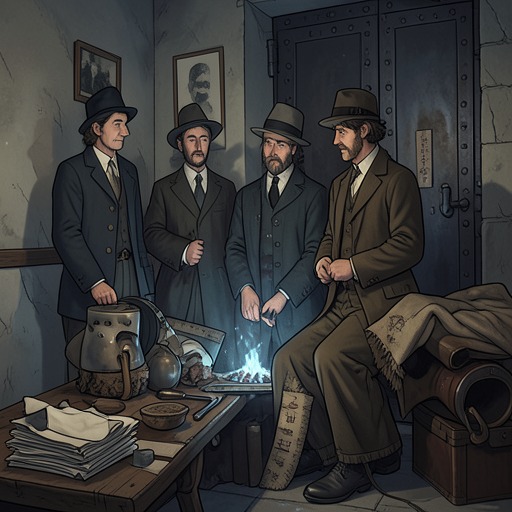
Ash’s collecting equipment reflects the exacting material practice behind his natural-history work. Mortimer Cropper’s later account imagines him crossing the sands toward Filey Brigg with a landing net, basket, geologist’s hammer, chisels, knives, bottles, and wire probes. Ash has designed a watertight specimen case with a glass vessel inside, intended to keep tiny creatures in their own atmosphere. He also carries an ash-plant, which Cropper describes as part of Ash’s personal mythology and regrets being unable to obtain an authenticated example of for the Stant Collection. The contrast between the poet’s symbolic staff and his instruments of collection makes the expedition’s two modes of attention visible: imaginative association and practical investigation.
Ash’s letters to Ellen record the transition from collecting to study. He first mentions carrying tall specimen jars, then writes that he has replaced them with plain yellow pie dishes spread across the available surfaces of his room. In them he examines Eolis pellucida, Doris billomellata, Aplysia, several types of polyps, Aeolides, and compound Ascidians. He reads Lyell in the evenings and performs dissections in the daylight between his walks and dinner. The expedition’s natural history is thus built from repeated practices—collecting, preserving, reading, and examining—rather than from a single revelation in the field.
This close investigation also raises a practical and ethical question about the treatment of living organisms. Cropper reports that Ash knew the criticism directed at dissection and the charges of cruelty made against naturalists. Ash conducted experiments to determine whether the movements of simple organisms indicated pain, concluding that some apparent responses continued after death and were not, in his view, evidence of pain as humans understand it. Cropper presents him as both resolved to pursue knowledge and aware of the claims that such work placed on its practitioners. The episode reveals the period’s effort to establish what counted as reliable evidence about animal sensation, while showing how conclusions about life could authorize further investigation.
Development, Reproduction, and Religious Doubt
Ash’s most sustained scientific questions concern how living forms originate and continue. The organisms he examines seem to him so beautiful and functionally intricate that he finds it difficult not to imagine a designing intelligence. At the same time, he acknowledges the evidentiary force of the Development Theory: species change through the gradual action of ordinary causes over immense periods. Rather than resolving the conflict between these positions, his letters make its persistence part of the expedition’s intellectual record.
The problem becomes especially vivid when Ash considers reproduction. He asks how a form is transmitted to offspring even when the individual organism fails, and wonders how a cutting can grow into a whole tree with roots and crown. The question of how a twig can produce a complete plant becomes a model for the larger problem of development: how a living form carries the conditions of its continuation. Ash calls his generation Faustian for seeking knowledge that humans may not have been designed to possess. His language registers both the excitement of inquiry and a religious unease about its reach.
Ash’s own experiments with marine organisms intensify the problem. Influenced by Richard Owen’s work on parthenogenesis, or reproduction without sexual congress, he studies hydras and plumed worms that can grow new heads or segments, and the apparent relation between jellyfish and polyps. Cropper says Ash cut hydra tentacles and divided polyps into fragments, each of which developed into a new creature. To Ash, this evidence suggested the continuity and interdependence of life and might help modify the notion of individual death, a question made more pressing as certainty about Heaven faltered. Michelet’s work on the sea similarly sought a possibility of life beyond death. In the expedition, biological development does not settle a theological question; it gives that question a new material form.
Loss, Risk, and the Expedition’s Afterlife
Ash’s attention to the coast includes places where change has become loss. He recalls villages engulfed by the sea, among them Auburn, Hartburn, and Hyde, and notes that Aldbrough has moved inland. Fishermen have found remains of houses and churches on offshore sandbanks. Ash contrasts the absence, as far as he can discover, of local legends about these vanished communities with the Breton stories of drowned cities. The missing settlements are simultaneously geological evidence and an absence of human memory: their remains persist, but Ash cannot find a corresponding tradition to explain them.
At Hob Hole, near Kettleness, the landscape’s vulnerability is tied to a local story. Ash identifies the cave as the dwelling of a benevolent Hob said to cure whooping cough, while also recording that the village of Kettleness fell into the sea on a December night in 1829. Folklore and geological history coexist in his account without becoming identical kinds of proof. A wave later sweeps away Ash’s net while he is searching a deep pool at Filey Brigg for a polyp; he escapes unhurt, with scratches from barnacles and young mussels. His return is planned for two weeks later, carrying the marine specimens he has collected. The episode makes the coast not just an object of study but an environment with forces that can interrupt the study.
The tour’s meaning is also shaped by its later interpreters. Cropper claims to have traced Ash’s route and imagines the poet as a solitary, equipped observer; Roland, by contrast, questions whether the expedition alone explains a change in Ash’s poetry. Maud’s response to Cropper’s biography is coloured by her discomfort with his portrayal of Ash and by her defence of Christabel LaMotte’s independence. The journey therefore enters a wider dispute about biography: whether Ash is best understood through his records, his poetic work, his scientific practice, or the claims made by those who reconstruct his life.
As an episode in the novel, the expedition joins field science to the unresolved questions that recur across Ash’s writing and the researchers’ investigations. Its letters preserve particular observations—organisms in dishes, cliffs shaped by water, villages under the sea—while also recording the limits of what Ash can explain. The journey’s lasting significance lies in that tension: careful empirical work deepens, rather than dispels, his uncertainty about design, development, and the persistence of life.