Alban Caradoc
ShōgunAlban Caradoc is the pilot and shipwright who trained John Blackthorne in the work and judgment of the sea, becoming a father figure after Blackthorne had lost his own father. His lessons endure as both practical knowledge and an inner voice, but the most consequential voyage they shared ended with Caradoc’s terrible death and a secret Blackthorne carried thereafter.
Identity and Apprenticeship
Caradoc taught Blackthorne and other boys the secrets of shipbuilding and what Blackthorne understood as the intimate way of the sea. He had never beaten Blackthorne; his authority rested instead on experience, instruction, and the trust built between teacher and apprentice. By thirteen, Blackthorne had already spent a year apprenticed to him. Caradoc had become, in Blackthorne’s recollection, the father he had lost.
The lessons were practical because a pilot’s responsibility was immediate and immense. At sea, it was the pilot who set the course and ran the ship, bringing it from port to port, even when the Captain-General and other men aboard feared or hated him. Caradoc prepared Blackthorne for that responsibility not as abstract mastery, but as a discipline of judgment under danger.
Navigation and the Rutter
Caradoc impressed on Blackthorne how badly navigators needed a way to determine longitude. The charts then available could be so vague as to be useless, and there was no way to fix longitude. Caradoc framed the unsolved problem in terms Blackthorne would remember: “Find how to fix longitude and you’re the richest man in the world.” He said that the Queen would offer a fortune and a dukedom for the answer, while Portugal and Spain would pay even more. Away from land, he warned, a sailor was lost unless he had another means of finding the way.
That means was a rutter: a pilot’s record of a route already sailed. Caradoc’s teaching gave Blackthorne a clear account of what such a book held. It could record compass courses between ports and capes, soundings and depths, water color and seabed, the route out and the way back, the days spent on a particular tack, winds and currents, storms and fair weather. It could also mark where to careen and water a ship, where friends or enemies might be found, and the shoals, reefs, tides, and havens that shaped a safe passage. Blackthorne, recalling the lesson, had answered with delight that a rutter was the solution Caradoc had been leading him toward.
The knowledge was also political and dangerous. English, Dutch, and French pilots had rutters for their own waters, while Portugal and Spain treated accounts of the rest of the world’s seaways as secrets. The routes to the New World, through the Pass of Magellan and around the Cape of Good Hope, and onward to Asia were guarded as national treasures and coveted by their rivals. Caradoc’s instruction thus joined seamanship to the larger contest over who could travel, trade, and wage war across distant waters.
He also taught Blackthorne to look for solutions where others had not found them. When Blackthorne wondered how to keep vegetables fresh and whether boiling them might preserve the broth, Caradoc answered that the broth made a man sick and that no one had discovered a way to store it. The exchange links the young pilot’s questioning mind to the stubborn material limits of long voyages, including the shipboard problem of scurvy that Blackthorne was still trying to understand.
The Armada and Caradoc’s Death
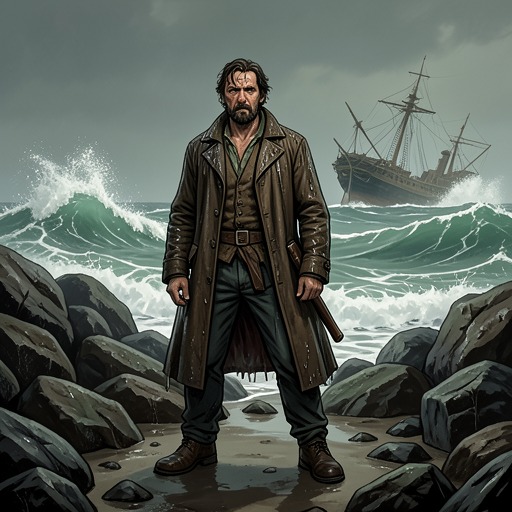
Caradoc died on the seventh day of the Armada, while Blackthorne was commanding a hundred-ton, gaff-rigged ketch out of Portsmouth. The ship was carrying arms, powder, shot, and food to Francis Drake’s war galleons off Dover as they attacked the Spanish fleet, which was moving up the Channel toward Dunkirk. Caradoc had joined the voyage as second in command. Although he had no right to be aboard in that capacity, Blackthorne’s recollection makes his presence a matter of shared English danger: he believed that, in that darkest time, every Englishman had a right to fight.
In a swirling attack near Admiral Howard’s flagship, the wind changed and rose to gale force. Blackthorne faced a choice between trying to beat to windward, as Caradoc urged, and running before the wind through the enemy squadron. A galleon ahead threatened to fire a broadside into the ketch; the other way meant steering into the opposing fleet. Caradoc shouted, “Go north to windward!” Blackthorne, responsible as Captain-Pilot and in his first command, ordered the opposite course: “Belay there!” and swung the tiller south.
The ketch ran before the wind through the galleons. The great ship’s cannonade passed overhead, and Blackthorne’s vessel fired two broadsides in return, which he remembered as little more than flea bites. Enemy ships did not fire on the lone ketch as it crossed between them, lest their guns strike one another. The escape lasted only until the cannonade of the Madre de Dios straddled the small ship. Both masts went over, men were caught in the rigging, and half the starboard main deck disappeared amid the dead and dying.
The Secret and Its Afterlife
Blackthorne found Caradoc against a shattered gun carriage, his legs gone and his eyes wide with terror. The old sailor was screaming that he did not want to die and begging for help as pain overwhelmed him. Blackthorne believed there was only one thing he could do for him. He took up a belaying pin and struck with all his force, ending Caradoc’s suffering. The hand that had learned from Caradoc’s hands-on teaching became the hand that killed him at the old man’s request for relief.
Weeks later, Blackthorne told Felicity that her father was dead. He told her only that Caradoc had been killed instantly; he did not reveal that Caradoc had lingered in agony or that Blackthorne himself had ended it. His recollection presents the concealment not as a passing omission but as a lasting burden: he says that he had blood on his hands that would never come off. The account also divides what he could do for Caradoc in the moment from what he could tell the daughter left behind.
Caradoc continues to speak in Blackthorne’s memory after his death. During Blackthorne’s trial in the village square at Anjiro, he tries to steady himself while Father Sebastio interprets for the hostile authorities. Recalling Caradoc’s advice to keep his wits when the storm is worst, Blackthorne hears the old teacher’s voice as a guide to staying alive and acting as spokesman for his companions. In that scene, the memory is not simply comfort: Caradoc’s discipline becomes a resource for a new ordeal, in a country and trial he has never faced.
Later, as Blackthorne is taken through the streets away from the harbor, Caradoc’s warning that one must be strong in the head to live with the sea returns beside the thought of his death. The contrast is lasting: the man who once seemed huge and all-knowing died terrified, and the pupil who survived him did so by making an agonizing decision he would conceal. Caradoc’s narrative importance lies in that double inheritance—an exacting education in survival, and a memory Blackthorne cannot separate from the guilt of having fulfilled its final demand.