Yabu, the Lord of Izu
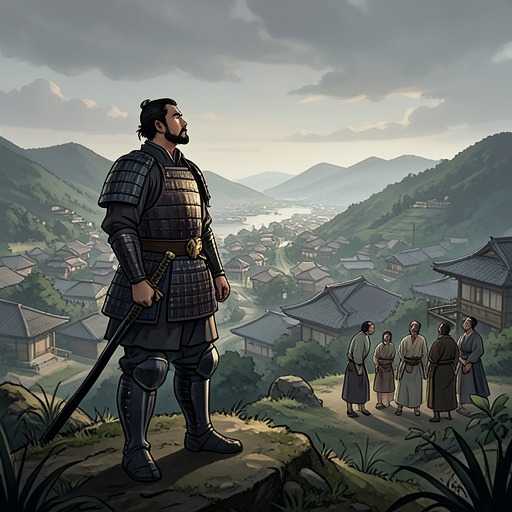
ShōgunYabu, the Lord of Izu, is revealed in the escape from Osaka as a commander whose tactical judgment serves Toranaga while his private ambition keeps open the possibility of betraying him. With the galley trapped between hostile forces and the shore, Yabu weighs the risks of attack, proposes a devastating diversion, and ultimately prepares his men to fight. Yet as the danger closes in, he imagines turning Toranaga’s capture or death into a path to rule. The same man who helps propel the galley toward safety can picture himself taking the highest prize in the realm.
Identity and Setting
Yabu’s decisions unfold during Toranaga’s attempt to escape Osaka aboard a galley. The harbor is not an open route to freedom: Portuguese and other foreign ships are watched, Gray forces are positioned near the Santa Theresa, and the galley risks being bottled in before it can reach open water. Toranaga’s party has limited men, uncertain support aboard its vessel, and little time before Ishido’s forces can gather. The escape therefore tests Yabu not in a settled domain but in a compressed military crisis, where each choice may decide whether his lord lives or the party is captured.
The setting makes maritime knowledge part of the political contest. Earlier, Rodrigues pilots Toranaga’s galley from the Izu Peninsula toward Anjiro by leaving the coast near Cape Ito and steering west-southwest toward Cape Shinto. His account emphasizes that the Japanese are experienced coastal sailors and fighters but that the open sea frightens them; the Taikō’s law requires Portuguese pilots aboard the few Japanese ocean-going ships. This dependence complicates Toranaga’s escape. Later, the Santa Theresa slips offshore when its Gray escort leaves, where its guns and armed crew can cover the shore. Yabu’s choices are shaped by a harbor in which ships, pilots, wind, and enemy surveillance determine which political plans can become action.
Tactical Judgment Under Pressure
When a samurai offers to attack at once, Yabu advises against it. He does not know whether their men are aboard, warns that a much larger force may be concealed nearby, and points out that the Grays beside the Portuguese ship could raise the alarm. A hundred and fifty men, he argues, are not enough to seize the ship and get it to sea safely; they would need ten times as many. His caution is practical rather than passive: he recognizes that an attack without prepared sailors at the oars could trap the party instead of freeing it.
Yabu proposes a different use of force: setting fire to the street to draw the Grays and any hidden defenders away. The suggestion is shocking because arson carries collective punishment against the guilty person’s family across generations, and fire threatens a city built largely of wood and paper. A samurai protests that the street cannot be burned. Yabu counters by setting that legal and human cost against the possible death of their master. His proposal exposes the brutal arithmetic of the crisis: he is willing to risk destruction ashore if it creates a chance to save Toranaga. It also shows him thinking beyond a conventional assault, treating the enemy’s attention as something that can be redirected.
Ambition and the Prospect of Betrayal
While the galley remains trapped, Yabu’s thoughts turn from immediate survival to the power that might follow Toranaga’s defeat. He blames the delay over Buntaro, believing that a direct run for the harbor mouth would already have carried them to sea. He suspects that Toranaga is losing his judgment and fears that Ishido will conclude that Yabu has betrayed him. At the same time, he recognizes that he is now committed to fighting for Toranaga against Ishido.
Yabu then imagines another course: giving Ishido Toranaga’s head in exchange for advancement. He calculates that this could make him a Regent and bring him the Kwanto; with time and the musket samurai, he might rise further. He also imagines eliminating Ishido and controlling Osaka Castle and the realm’s wealth while Yaemon is a minor, holding power second only to the heir. The fantasy does not stop there: Yabu considers removing Yaemon and becoming Shōgun. These are possibilities he entertains, not actions he carries out in the scene. Their sequence nevertheless reveals how quickly his loyalty gives way, in thought, to an escalating calculation of titles, territory, and control.
Command and Action
Toranaga finally orders the party to its attack stations, and Yabu passes the command to the samurai as they prepare. The order places him back in the role of operational commander even as his private reflections have made his allegiance uncertain. He does not act on the imagined bargain with Ishido; instead, he organizes the force for the fight Toranaga has chosen.
As the galley and Santa Theresa race through the narrow approach, Blackthorne has to maintain the galley’s position alongside the faster frigate, with little room between the cliffs, the enemy vessel, and the fishing boats. The boats draw close enough for the galley’s starboard oars to nearly touch the frigate while its port oars threaten to swamp the fishing craft. When Grays rowing from the fishing boats throw grappling hooks, the galley swamps their boats; the hooks are thrown overboard before they catch, but samurai holding them drown. The stroke does not falter. In the same push, Yabu shouts commands and joins the men at the oars. His physical effort is a concrete counterpoint to his earlier dream of rising through betrayal: at this moment, he helps drive Toranaga’s party forward with his own strength.
Narrative Role and Significance
Yabu’s importance in these scenes lies in the tension between effective service and opportunism. His warnings about inadequate numbers and his proposal to divert the Grays show a commander alert to the practical limits of force. His willingness to consider burning streets shows the severity of the measures he will entertain when Toranaga’s life is at stake. But his private ladder of possible betrayals reveals that service does not erase self-interest: he can plan for Toranaga’s survival and imagine profiting from Toranaga’s death within the same crisis.
The escape also tests what political allegiance means under pressure. Yabu’s fear that Ishido will mistake him for a traitor sits beside his recognition that he is committed to fighting Ishido, while his fantasy of surrendering Toranaga’s head offers a way to convert danger into power. The galley’s progress depends on collective effort, navigation, and command; Yabu contributes to that effort even as he calculates a future in which he might command the realm. His actions and thoughts therefore keep the escape’s stakes personal as well as military: the threat comes not only from the forces surrounding the vessel, but also from the ambitions of a man rowing beside Toranaga.