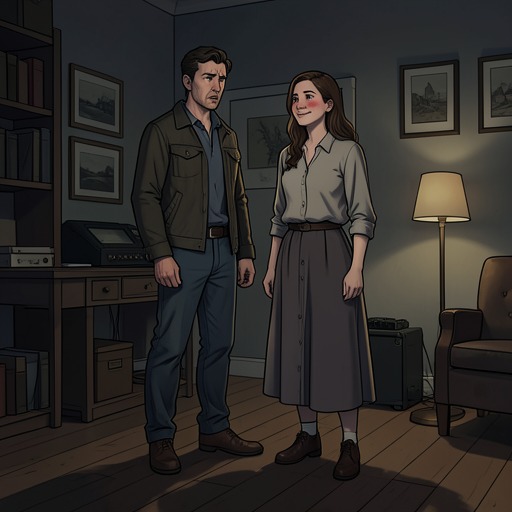
British soldiers search and harass Gerry and Cushla at a checkpoint
TrespassesThe checkpoint search and harassment of Gerry Devlin and Cushla Lavery transforms an ordinary drive to a party into a scene of coercive scrutiny. On the lower Antrim Road, among gaps left by the Belfast Blitz, armed soldiers stop Gerry’s car, search it, and subject both travelers to threats and humiliation. The encounter leaves Gerry visibly shaken and Cushla to reckon with the difference between objecting and getting safely away.
The checkpoint and the search
The scene begins at the bottom of the Antrim Road, where dim, gaping spaces mark streets still scarred by the Belfast Blitz. An army checkpoint blocks the way. Gerry stops and opens his window; a soldier approaches with a rifle swinging at his waist and asks where they are going. Gerry says they are going to a party, but the soldier demands an address. The music playing in the car—a traditional air overlaid with drums and electric guitar—sounds to the soldiers like a provocation. Their attention is therefore fixed not only on the occupants and destination but also on a sound that can be treated as evidence of defiance.
The questioning quickly becomes an order to get out. Gerry pulls up the handbrake and wipes his hands on his trousers before standing in front of the car. His shirt is open one button too far, a silver Celtic cross visible at his chest. Against the soldiers’ bulked-up flak jackets, he looks flimsy. Cushla wishes he were wearing his leather coat, a small, immediate wish for protection in a scene where the balance of power is unmistakable. One soldier swings his rifle into the middle of Gerry’s back and prods him toward the footpath. The other searches the boot, shuts it hard enough to make Cushla jump, then rummages through the rear passenger compartment. Gerry’s coat ends up on the handbrake: an ordinary possession displaced by the search, and a reminder that the soldiers control the car as well as the people in it.
Harassment and public humiliation
After shutting the car door, a soldier taps his gun against Cushla’s window. She rolls it down. He leans fully into the car and comments on her makeup, calling it warpaint. His acne-scarred face and the smell of Juicy Fruit are recorded at close range, making the intrusion bodily as well as verbal. Cushla’s hem has ridden halfway up her thighs. She pulls it down over her knees, but the fabric snaps back when she lets go; the detail makes her effort to regain control of her appearance momentary and visible.
The soldier asks whether her boyfriend is on a promise. Cushla says no. A few feet away, Gerry has been made to face a brick wall with his hands behind his ears. The streetlamp and the wink of the car’s hazard lights illuminate him while the shuttered, metal-caged premises around him make the stop a public spectacle in a nearly deserted street. A chip shop stands open a few doors away beneath the cracked red sign for The Ritz. A length of loose guttering drips thick rust onto Gerry’s forehead. When he raises a hand to wipe it away, the soldier taps his elbow with the gun butt. The soldiers’ control reaches into even this small gesture of bodily self-care.
The exchange with Cushla escalates from intrusive questioning to sexual insult. The soldier calls her a tease and a prick-tease after she denies that Gerry is her boyfriend. Cushla remembers a magazine recruitment advertisement promising that the army would bring out whatever a person had in them. Against the encounter’s casual intimidation, that promise acquires a bitter irony: the scene displays the force the institution can bring to bear, but it is directed here at civilians who have little room to refuse or answer back.
Aftermath and significance
Cushla opens her mouth to object when the soldier prods Gerry again, but Gerry is already walking toward the car. His gait is jerky and mechanical, and he blinks rapidly. He gets into the driver’s seat and wipes his forehead with the back of his hand. Cushla takes a tissue from her handbag and passes it to him; he blots his face with a trembling hand. The exchange offers practical care rather than a dramatic confrontation, and the contrast makes his distress legible without requiring him to explain it.
Gerry drives away slowly and asks what the soldier said to Cushla. She dismisses it as shite talk. Her answer minimizes the verbal assault, while the scene has shown how closely it was bound to the soldiers’ armed authority: the rifle prods Gerry, the gun taps his window and elbow, and the sexual taunts accompany the search. The difference between her account and the visible details underscores how little safety or dignity the checkpoint affords either traveler.
The journey resumes toward Cave Hill. Gerry eventually parks outside a semi-detached house where music and laughter are coming from inside, but arrival at the party does not undo what happened on the road. The checkpoint interrupts an ordinary social trip with a search that exposes Gerry and Cushla to physical intimidation and gendered scrutiny. Its force lies partly in that abrupt change of scale: a party destination, a tissue from a handbag, and a slow drive away are set against rifles, a compulsory search, and the soldiers’ power to dictate where the travelers stand and what they may say.