Tommy McGeown’s arrest
TrespassesTommy McGeown’s arrest becomes a second rupture in the McGeown family’s escape from their burning home. Police take Tommy from his room, and the following morning a news bulletin announces that he has been charged with murdering Michael Agnew. The arrest converts a family emergency into a criminal accusation, placing the displaced family under new pressure and bringing Cushla Lavery’s act of sheltering them under suspicion.
Background and Circumstances
The arrest is disclosed amid the aftermath of an attack on the McGeown home. During the family’s escape, Cushla remembers a woman confronting them with the question of what would happen to Tommy. Betty later explains that the police had come for him while she was preparing dinner. The juxtaposition matters: while the household faced the fire and the need to get everyone out, Tommy had already been taken into custody. The family’s immediate crisis therefore carries a second, less visible emergency, one that Cushla does not yet understand.
The sequence of disclosure also makes the arrest feel abrupt. Cushla has driven to help after Davy contacts her about the fire; she tells the police later that the family stayed at her house for only one night and that she had not known Tommy had been arrested. Her account distinguishes the reason she went to the McGeown home from the accusation that follows: she says she acted to remove the family from danger, not because she knew Tommy’s situation or sought to conceal him.
The Arrest and the Charge
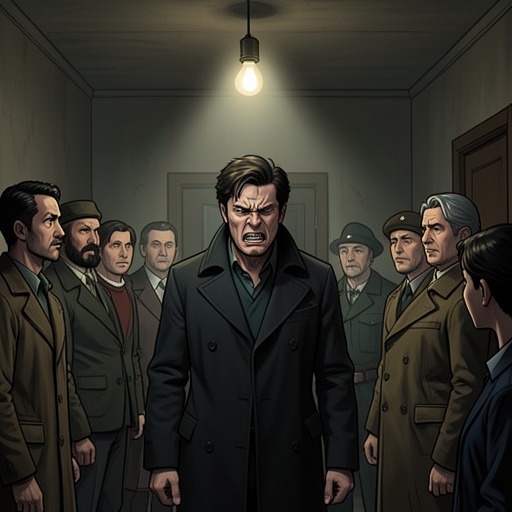
Betty recounts that officers arrived while she was putting dinner on. They entered the house and took Tommy from his upstairs room. The account gives no explanation of the evidence against him, nor does it describe an exchange between Tommy and the police. Its focus is the family’s experience of the arrest: Betty reports the officers’ arrival and removal of her son as part of the same upheaval that forced them from their home.
At first, the accusation reaches the family through this recollection rather than through a formal announcement. Cushla is shocked by the claim that Tommy shot Michael Agnew, a barrister she knew; she cannot reconcile the charge with her understanding that Tommy could not even have known him. Her response records the distance between the police allegation and what she believes she knows, but it does not resolve the question of Tommy’s involvement. The scene offers no evidence that would establish guilt or innocence.
Public Confirmation and Family Response
The next morning, as Cushla clears the breakfast table, the ten o’clock news supplies the official public formulation: an eighteen-year-old man has been charged with the murder of Michael Agnew, described as a prominent Belfast barrister shot dead at his home the previous week. The bulletin confirms the charge and identifies Tommy by age, but its impersonal wording leaves the family’s experience outside the report. To the listeners at the table, the announcement names the crisis that has already entered their home.
Betty responds by beginning to weep. Gina goes to her, puts a hand on her shoulder, and speaks quietly to her. Betty looks around the table at her husband and children as she listens, then wipes her face. Cushla and Davy meet eyes briefly; Cushla turns away to the sink. The news has made the arrest public, but the household’s response is intimate and restrained. The brief exchange of looks, followed by Cushla’s turning back to the washing-up, shows how the charge circulates through the family without being openly discussed at that moment.
Aftermath and Significance
The arrest also changes how Cushla’s help can be interpreted by others. When questioned about the McGeowns’ presence in her house, she stresses that they stayed one night, that Davy called to tell her their home was on fire, and that she drove to bring them away. She adds that she did not know Tommy had been taken. The questioning makes her practical response to the fire relevant to an investigation into the murder, even though her account presents the shelter as brief and prompted by immediate danger. The interviewer’s assessment that matters are not looking good leaves the pressure unresolved; the cited episode provides neither a finding against Cushla nor a resolution of the case.
The event’s force lies in the collision between displacement and accusation. The family has just lost the security of its home and is looking out at the town from the car as if seeing it for the last time; now the news identifies one of its members as charged in a prominent killing. For Cushla, the arrest is also the point at which care becomes legible as possible suspicion: helping a family escape a fire does not prevent that help from being scrutinized once Tommy’s arrest is known. The narrative preserves the distinction between that scrutiny and proof. Tommy is reported as charged, while the circumstances and outcome of the allegation remain beyond this account.