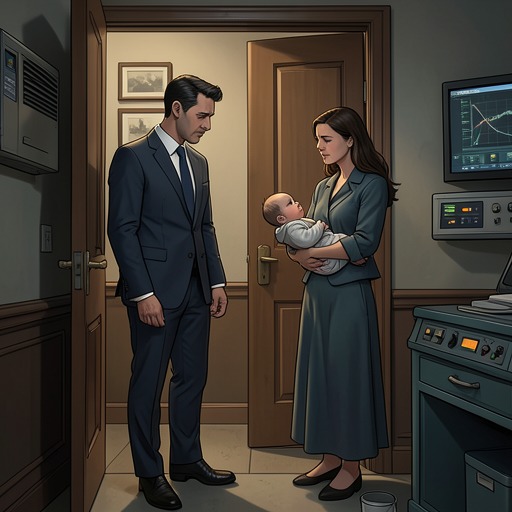
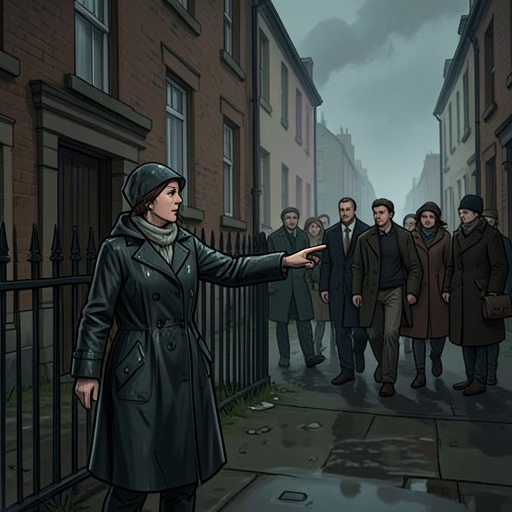
Cushla shelters the McGeown family
TrespassesCushla shelters the McGeown family after their home is attacked with a firebomb, turning her own household into a brief refuge at a moment when the family has nowhere safe to go. Her response is practical and immediate: she gets them out of the crowd, brings them inside, feeds them, and finds them beds. But the shelter cannot last. Eamonn demands that they leave, and Cushla must carry out the painful task of taking them away again, with Davy left behind in the car as she drives off.
The crisis and the decision
The sheltering follows an attack that leaves the McGeown home burning and the family exposed to a hostile crowd. As they try to get away, Cushla takes Davy’s hand and helps the others to her car. Seamie’s steps are slow; Betty supports him on one side, while Mandy walks on the other, her lips moving as if in prayer. The crowd begins to follow, but a siren briefly distracts it, giving Cushla the chance to get the family into the vehicle. She tells them to lock the doors.
An RUC Land Rover arrives as she starts the engine. Officers head toward the house, while another bangs on Cushla’s window to ask who they are and where they are going. After taking her name and address, he lets them leave. The stop makes clear that the rescue is occurring under scrutiny as well as amid communal hostility: even as Cushla removes the family from immediate danger, the authorities question their movement.
In the car, Davy searches his satchel and produces a rattling paper bag of tablets for his father, explaining that Seamie will be able to sleep. The small act of care comes from the child himself, amid the adults’ effort to get the family to safety. Mandy weeps softly once they are out of the estate. Betty looks out of the window rather than comforting her, and Cushla’s glance in the rear-view mirror registers the family’s distress without resolving it.
A household made into temporary refuge
Gina opens the front door as soon as Cushla arrives and leads the family to the kitchen. She begins buttering bread and making tea; Cushla pours orangeade for Mandy and Davy. Seamie sits opposite them with his palms turned upward, an imploring gesture. Cushla pushes Gina’s cigarettes and lighter toward him while she goes to check on the tea. Betty recounts the attack: the window breaking, the bottle smashing on the hearth, and flames spreading across the carpet and up the settee where Davy and Mandy had been sitting. The family had to tip Seamie’s chair back to pull him away from the fire. She also tells them that Tommy has been arrested and that he is being accused of shooting Michael Agnew.
The family arrives with almost nothing. Apart from Davy’s schoolbag, they have brought no belongings. Seamie and Betty take Eamonn’s old bed, while Cushla brings the children into the spare room, which still contains equipment from her father’s illness: a commode, boxes of pads, and disposable sheets. She worries that the beds may be dusty, then remembers that Gina changed them recently, on the last soup day. She switches on the bedside lamp, shows the children the old books in a wardrobe box in case they cannot sleep, and finds T-shirts for them. Mandy and Davy sit on the edge of the bed in their clothes, evidence of how abruptly they have been displaced.
Mandy insists that Tommy did not kill anyone. Downstairs, Gina pours tea; her not reaching for gin registers the seriousness of the crisis. Yet she also voices the social risk of taking in the family, asking Cushla what people will think. The refuge therefore places the household under pressure even before it ends: the McGeowns need immediate shelter, while the Laverys are conscious that helping them may carry consequences in their community.
The limits of the refuge
Eamonn summons Cushla and Gina into the hall and tells them the family has to go. Cushla says she will try to arrange something that morning and that the family will stay only a few days. Eamonn turns toward her with his hand open, as if about to slap her, but Gina catches it. The moment gives the household’s disagreement a physical edge: Gina intervenes between her son and daughter, but does not thereby secure the McGeowns’ continued stay.
After Eamonn leaves, Cushla asks what she should do. Gina tells her to do as he says, and quickly. Cushla clears the table, then hears the news report that an eighteen-year-old has been charged with the murder of Michael Agnew, the prominent Belfast barrister shot dead the previous week. Betty begins to weep. Gina puts a hand on her shoulder and speaks quietly to her, while Cushla turns to the sink. The family’s immediate danger and Tommy’s arrest now meet in the same room: the shelter is not separate from the accusation that has helped make them vulnerable.
Cushla drives them through town after the morning rush hour, with schools closed for the summer. The ordinary shopfronts pass outside—the greengrocer’s bananas, the record shop’s faded ABBA display, a runaway supermarket trolley, and a baker setting a meringue on a pyramid. Inside the car, the McGeowns press their faces to the glass as if seeing the place for the last time. The contrast makes their departure feel like more than a change of address: familiar streets have become a landscape from which they are being driven out.
Departure and what remains
On the way, Cushla passes the boarding school where Michael had watched a hanged boy’s body carried away on a stretcher, then the narrowing terraces, flags, and bunting of the area into which she is taking the family. They also pass the waste ground where Seamie had been left for dead. He does not flinch, but Cushla sees despair on Betty’s face in the mirror. At the perimeter of the Catholic enclave where Seamie’s brother lives, an RUC Land Rover is parked across the road and shipyard cranes tower above the roofs. Betty helps Seamie out and leads him across the pavement. He puts his wounded hand against a wall and looks around blankly.
Betty thanks Cushla, who begins to apologise, but Betty raises a hand to stop her. Mandy murmurs goodbye and goes to her father. Davy stays in the car until Cushla calls him over. She tells him that getting to know him has been the joy of her life; he throws his arms around her neck, and she holds him so tightly that she worries she is hurting him. Then she drives away. In the rear-view mirror, Seamie, Betty, and Mandy walk along the footpath while Davy stands with his back to them, one hand raised, watching Cushla’s car leave.
Back at the house, the spare room is neat, but Davy’s satchel remains on the floor, its leather marked by smoke. Inside are his Sports Day medals, the rosary beads Cushla bought him in Dublin, his Communion missal, and schoolbooks bearing the traces of names written and crossed out. His English exercise book contains a letter addressed to Jim, asking for his father to get better, for Tommy to come home, and for Miss Lavery to get the person she loves. The objects make visible what the temporary refuge could not repair: the family’s separation, Seamie’s injuries, Tommy’s absence, and Davy’s attachment to Cushla. Shelter gives them a place to sleep and a route out of immediate danger, but its ending leaves Cushla alone with the child’s written hopes.