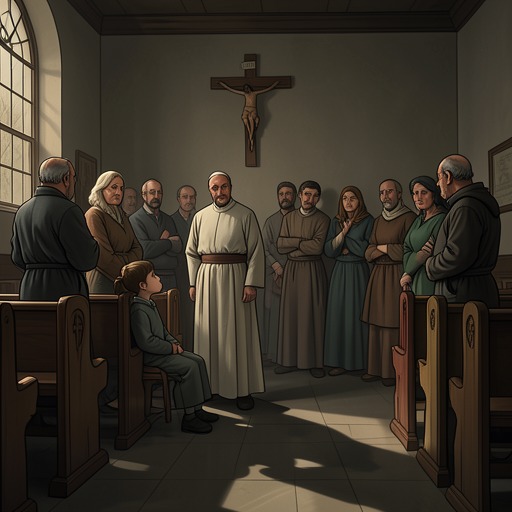
Gerry interrupts Slattery with a peace song at a school assembly
TrespassesAfter Davy McGeown’s father is attacked and taken to hospital, Bradley summons the children to the school hall. At the assembly, Father Slattery turns a call for prayer into an account of the rooms used by loyalist murder gangs. Gerry Devlin walks onto the stage and begins a peace song; the pupils join him, while Slattery and Bradley remain behind him in silence. The scene makes the assembly a contest over who may speak for the school, and over whether violence will be met with fear or a public appeal for peace.
Background and Assembly
The assembly follows an attack so severe that Davy’s father had initially been reported as dead. A report that an unidentified man’s body had been found in East Belfast has helped spread alarm, and word of the attack has already passed through the school. Bradley sends a note ordering teachers to bring their pupils to the hall immediately. The children file from their classrooms along the terrazzo corridor in silence, their orderly movement registering the effect of the news before anyone addresses them.
Bradley stands on the stage with Father Slattery. He tells the children that the father of one of their pupils is in hospital, warns against idle gossip, and proposes prayer. His appeal frames the gathering as an occasion for restraint and religious consolation. The children bring their hands together in readiness for familiar prayers, but Slattery changes the subject before the prayers begin.
Slattery’s Intervention
Slattery asks whether the children know about a television programme called Romper Room. A pupil answers that it is a programme in which a presenter gets children to sing songs. Slattery then asks what else the term can mean and, after the children respond with giggles, describes rooms used by loyalist murder gangs in the backs of bars and social clubs. The shift from a children’s programme to political violence gives the assembly a disturbing turn: the children have been gathered in response to an attack on a pupil’s family, but Slattery redirects their attention toward the workings of murder gangs.
Cushla waits for Bradley to intervene. He does not. Some of the teachers begin shifting uneasily, but the headmaster’s silence leaves Slattery’s speech unanswered from the school’s leadership. The scene distinguishes between the authority formally present onstage and the action needed to challenge what is being said. Bradley’s inaction makes room for another teacher to respond.
Gerry’s Song and the Pupils’ Response
Gerry Devlin steps away from the other teachers and walks along the edge of the hall, with his guitar strap around his neck and a woven crios belt in red, yellow, and green. He climbs the stage steps. Bradley leans forward and says something to him, but Gerry continues to Father Slattery’s side. Rather than answer the priest with another speech, he runs his thumb down the guitar strings and starts singing a song for peace.
Cushla remembers the song as awkwardly written, with poor rhymes and familiar appeals to love and forgiveness. Its lack of polish does not blunt its immediate purpose: she considers it preferable to listening to Slattery. At first Gerry sings alone, accompanied by the trill of his pupils. Cushla then finds herself singing too, and by the song’s end everyone has joined except the two men standing behind Gerry on the stage. The pupils’ participation changes the assembly from a gathering in which Slattery controls the subject into a shared, if imperfect, expression of opposition to hatred and violence.
Consequences and Significance
The contrast between the two men onstage and the singing children gives the moment its force. Bradley appears to be waiting for permission to leave; Slattery stays motionless, watching Gerry’s back. Neither joins the song, but neither stops it. The scene does not suggest that the song resolves the violence outside the hall. Its consequence is narrower and more immediate: the pupils and teachers are given a way to answer Slattery’s intervention together, while the school’s leaders are exposed by their inability or unwillingness to respond.
Afterward, Cushla makes her way through the lines of children to Gerry, who thanks her for her moral support. She replies that she could not let him make a fool of himself alone and praises him for having the courage to silence Slattery. Her response recognizes that Gerry has taken a risk by continuing onto the stage after Bradley addresses him, and that his action has not been solitary: the song becomes effective when the children, and then Cushla, join in. The episode presents peace not as an abstract conclusion but as a public act of interruption, dependent on people choosing to answer together when an authority figure stays silent.