Social services investigate the McGeown family
TrespassesThe investigation of the McGeown family brings the school’s child-welfare responsibilities into direct conflict with the fragile trust Cushla Lavery has built with Betty McGeown. Cushla wants assistance for a struggling household, not its condemnation; the referral nevertheless reaches Betty as an intrusion into her home and her fitness as a mother. The episode turns on that gap between intention and consequence, without establishing that the visit resolves the family’s needs.
Circumstances Behind the Referral
The McGeown family are already subject to judgments from outside their home. At school, headmaster Bradley regards Davy McGeown as a likely discipline problem in part because of his family’s poverty and its religious complexity: Davy’s father, Seamie McGeown, rarely has roofing work, while Betty McGeown is Protestant and the children are being raised Catholic. Cushla Lavery steps in when Bradley questions Davy about forgetting his coat, steering the child away rather than allowing a minor lapse to become a punishment. Davy sits in the front row not because he is naughty but because the other children torment him. The school’s attention to the family is therefore mixed with assumptions about class, religion, and conduct.
At home, Cushla Lavery has encountered the family’s hardship at close quarters. When she first takes Davy home, he guides her through an estate where the McGeown house stands at the back, with coal bags by the door and sectarian graffiti on the garden wall. Later, she visits with Gina Lavery and finds Davy with his sister Mandy McGeown in a crowded but carefully kept house. Davy tells Cushla that his father has been attacked, speaking as though he were delivering classroom news. The kitchen is clean, though crowded with household goods and laundry. These details make the family’s situation visible without reducing Betty McGeown to a neglectful parent.
Cushla’s concern is grounded in repeated encounters, not a single inspection. She has offered practical help and has seen the effects of violence on Seamie McGeown: when he returns home, he cannot use his hands normally, and Betty McGeown quietly gives Cushla a moment to steady herself before directing her toward the kitchen. Cushla also knows how unstable care can be in her own household. On one occasion, she arrives late to meet Eamonn Lavery because Gina Lavery is unconscious and needs her to stay. The novel places Cushla’s intervention among these competing demands on care, rather than presenting her as a detached observer.
The Visit and Cushla’s Confrontation
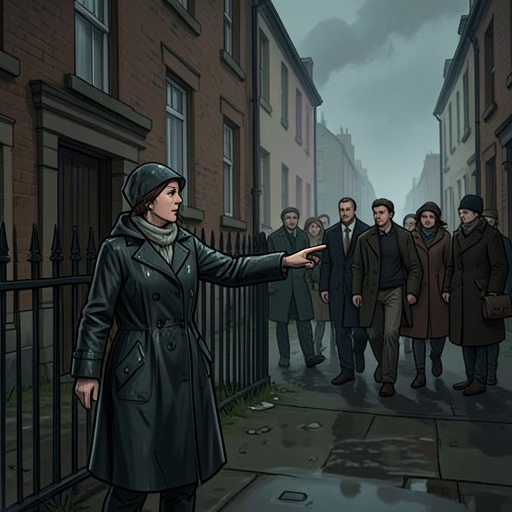
When Cushla Lavery drops Davy McGeown home after school, Betty McGeown comes down the path and asks Davy to go inside. She then challenges Cushla about whether she reported her for failing to look after the children. Betty explains that a social worker has visited, looked in the refrigerator, and asked where the children sleep. The questions make the official visit concrete: it has entered the domestic space and examined the material conditions of family life. Cushla denies knowing anything about it and says she did not make a report.
Betty’s suspicion is understandable from what she has been told. The worker said the school had contacted social services, and Cushla is the only member of school staff who has visited the house. Betty asks whether Cushla described her as unable to cope, then insists that she is managing and doing her best. Her words express both a defense of her mothering and a boundary against being defined by an institutional assessment. In the scene, she is not reassured by Cushla’s denial; the connection between school contact and home inspection has already made the intervention feel personal.
Cushla goes to Bradley to ask directly whether he sent the social worker. Bradley consults his diary and finds his record of her earlier concern about Betty McGeown. He explains that, as principal, he is obliged to pass on concerns about pupils’ welfare to the relevant authorities. Cushla replies that she had raised the difficulty to elicit sympathy for Betty and hoped Davy might receive free school dinners. She does not deny that Betty is struggling; she distinguishes that struggle from being a bad mother and says she wanted the family to receive help. Bradley treats this as an exaggeration and warns that children have been taken into care, invoking the seriousness of safeguarding cases and his duty to act rationally.
Consequences for the Family and Cushla
The encounter leaves Cushla feeling that a request for support has been translated into an accusation. Bradley’s formal responsibility is real, but his response does not address the distinction Cushla is trying to make between hardship and parental unfitness. Nor does the visit, as presented, produce a reported resolution or a concrete offer of assistance. The evidence instead shows Betty confronting Cushla, Cushla confronting Bradley, and each encounter sharpening the uncertainty about who can be trusted with the family’s difficulties.
After leaving Bradley, Cushla sits in her car until her hands are steady enough to start it. She recognizes that the report was not simply an act of personal betrayal: Bradley is following a stated duty, though Cushla believes his concern is also directed at her. She recalls that, in another case, a nurse rather than Bradley reported a child’s injury, and that Bradley had previously sent Slattery to speak privately with a father. Her reflections complicate the headmaster’s claim to be acting solely as a safeguarding authority; to Cushla, his handling of child welfare is entangled with his judgment of her.
The consequences also reach Cushla’s understanding of her own interference. At home she finds Davy’s exercise book and reads his response to a prompt about a favourite place: his preferred place is wherever the family is together. The answer makes the cost of the referral feel immediate to her, because she connects the social-services visit with the fear and scrutiny Betty has just described. It does not prove that the investigation has harmed the children or that the referral was improper; rather, it records Cushla’s guilt and her awareness that intervention can unsettle the very household it is meant to support.
Significance
The episode distinguishes care as a relationship from care as an institutional procedure. Cushla’s help has involved visiting the house, responding to the children, and trying to make their circumstances easier; the school’s obligation requires concerns to be passed beyond that relationship to social services. Neither form of care is presented as sufficient on its own. Informal assistance depends on trust and personal judgment, while formal intervention can ask necessary questions but may be experienced as surveillance, especially by a parent already conscious of being judged.
The referral’s ambiguous outcome is central to its force. Betty McGeown is shown defending her efforts, not being shown as incapable of caring for her children. Bradley’s stated duty explains why the report was made, but it does not settle whether Cushla’s phrasing conveyed what she intended or whether the visit helped. Through the clash among Cushla, Betty, and Bradley, the episode makes the boundary between seeking help and triggering scrutiny difficult to locate. Its lasting effect in the available scenes is not a verdict on the family, but a fracture in trust and a burden of responsibility that Cushla carries back into her own home.