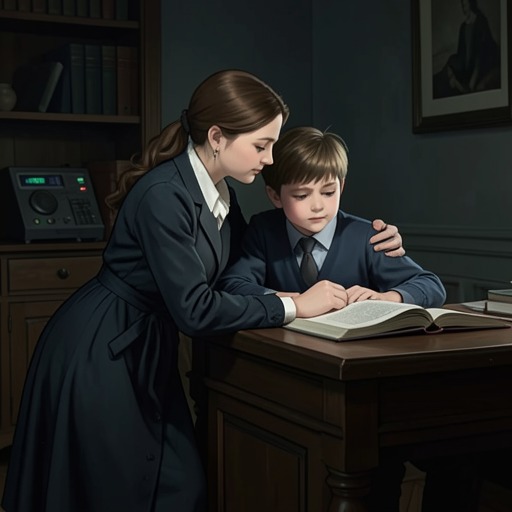
Cushla's ongoing support for the McGeown family
TrespassesCushla’s ongoing support for the McGeown family is expressed less through declarations than through concrete acts of care: she gives Davy rides, carries food into the family’s home, offers Tommy a way to contact her, and makes space for the children amid the pressures surrounding their household. Her help grows from the ordinary responsibilities of a teacher and neighbor into a sustained commitment, set against sectarian hostility, the family’s precarious circumstances, and the demands of her own home.
First Acts of Assistance
The relationship begins with a small decision on the road from school. Cushla sees Davy walking about a hundred yards away, brakes, sounds the horn, and opens the passenger door to offer him a lift. Davy objects that he is not allowed to get into cars with strangers. Cushla answers that she is hardly a stranger and promises to explain the arrangement to his mother. The exchange makes the practical obstacle explicit: her willingness to help has to pass through the safeguards a child has been taught to observe. She does not dismiss Davy’s caution; she offers to take responsibility for it.
Davy directs her through a grid of beige houses to the family’s home at the back of the estate. The setting bears visible signs of intimidation: kerbstones retain smudges of red, white, and blue paint, and sectarian graffiti runs down the low wall outside the house. Cushla sees Tommy walking slowly, head held high, before Davy insists that she come inside. At the door, Betty greets her son with a kiss on the forehead and immediately asks why he is not wearing a coat. Cushla’s introduction to the household is thus framed by care already in progress: Betty’s attention to Davy’s clothing meets Cushla’s willingness to bring him home safely. Their contact begins not as an abstract act of charity but as an entry into the family’s everyday responsibilities.
Food, Hospitality, and Recognition
Cushla’s support extends beyond transport. After hearing in the hairdresser’s that Seamie McGeown has been seen staggering home drunk, Gina condemns the account as no excuse for the beating that left him badly hurt. Cushla says that one of his children is in her class and that she had recently had him at her own home. When she decides to visit the family, Gina fills two shopping bags from an overstocked pantry with enough soup to feed an army. The supplies have a history: during the previous year’s Ulster Workers’ Council strike, the family had run out of food, and Gina is determined that loyalists will not make them hungry again. The visit therefore joins present assistance to an earlier experience of deprivation and fear.
The journey through the estate also reveals how exposure to hostility shapes the adults around Cushla. Gina remarks that the McGeowns should have been given a house nearer the front. Born above a pub in 1920, days after her parents were burned out by their Protestant neighbors during the first Troubles, Gina looks for an escape route wherever she goes. The account does not turn that memory into a simple explanation of her actions; it places her willingness to bring food alongside a lifelong awareness of danger and displacement. At the family’s table, she becomes actively hospitable. Mandy sets the table, Davy unpacks the bags and holds up pink wafer biscuits, and Gina urges the children to take second helpings and teases them about their crusts. Cushla, who sometimes finds her mother overbearing in company, is grateful for her warmth that evening.
Maintaining Contact Under Threat
Cushla’s help also takes the form of keeping a channel open to Tommy. She gives him her phone number, which he records in Tommy McGeown’s notebook, a small black notebook he carries in his back pocket. As the family sees her out, Tommy looks past her toward the teenagers who had surrounded him and are now sitting on the wall. One strikes matches and flicks them onto the path. Tommy starts toward the door, but Gina catches his arm and tells him to go back inside. The scene sets Cushla’s offer of continued contact beside the immediate possibility of confrontation: her number gives Tommy a route back to her, while Gina’s intervention prevents the encounter from escalating in that moment.
After Mass, Cushla again offers the McGeowns a lift. Sleet slants across the church steps, and she waits for them after sending Gina to the car. Tommy initially begins to refuse, but the weather is severe enough that he accepts. Davy sits so far forward in the back seat that he is almost on the handbrake. Cushla points out bags on the ledge behind him and tells him to open them; Davy responds that the family’s house is worth seeing. Once she has left Gina at home, Cushla and Tommy continue together, with Tommy in the passenger seat. At the turn for the estate, he looks at her without turning away when she notices. The ride remains an ordinary piece of assistance, but its quietness contrasts with the hostility outside the car and permits a moment of unembarrassed recognition between them.
Support and Its Limits
Cushla’s home becomes another point of contact. When Tommy comes into her kitchen, he remarks on the size of the house compared with his own. Cushla is conscious of that difference, but rather than dwell on it, she asks why he has missed school. He says he does not plan to return. She urges him to stay for the few weeks remaining, at least long enough to sit his exams. Her response combines concern for his future with the direct authority of a teacher: she does not treat his absence as a settled choice but tries to persuade him that finishing the school term is still possible.
This continuing attention sits within a crowded field of family obligations. Cushla has long concealed the extent of Gina’s drinking partly from a sense of failure: she believes she should be looking after her mother but cannot keep her sober. When Davy says Gina can hardly walk, Cushla remembers that Betty did not seem surprised, and recognizes that Gina’s attempts to hide her drinking have not prevented other people from knowing. The recognition links the two households through vulnerability, but it does not erase their differences or make Cushla’s care limitless. Gina’s tearful pleasure when Cushla is home leads Cushla to feel guilty about being away and to resolve to cancel shifts she had volunteered for. Care for the McGeowns is therefore undertaken alongside, and sometimes in tension with, her responsibility to her mother.
The strain becomes more visible when Gina falls while drunk and Cushla searches the house for the bottles her mother has hidden. She finds twenty-nine empty Gordon’s gin bottles, including bottles tucked among clothes, inside handbags, in the kitchen, beneath the sink, and even in the toilet cistern. She gathers them on the hall table and tries twice to reach Michael by telephone. Later, after drinking with Gina and listening to stories about Michael, Cushla wakes with a hangover and remembers that Michael is dead. These episodes do not cancel her assistance to the McGeowns; they show the private grief and care work from which she continues to offer it. The pattern is defined by presence rather than rescue: Cushla can provide a lift, food, a phone number, or an argument for staying in school, but she cannot remove the threats around the family or resolve every crisis in her own home.