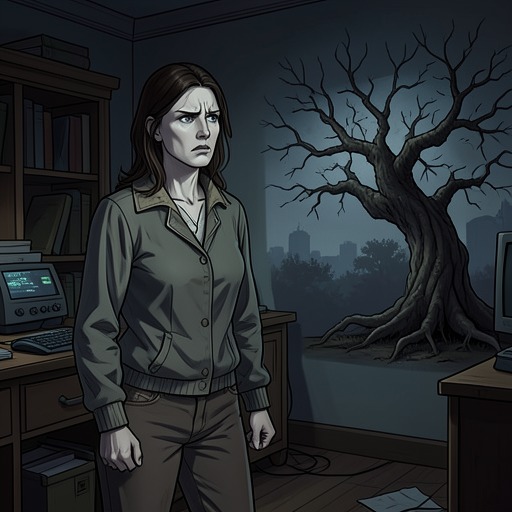
Emma’s delusions
UpEmma’s delusions are convictions that can remake the world from the inside: what she believes feels not merely possible but more normal and certain than ordinary reality. In her account, this altered certainty helps explain both a suicidal crisis understood as a beginning rather than an end and the belief that she could fly. The book’s central distinction is between seeing something unusual and experiencing the mind’s interpretation as an unquestionable truth.
The Shape of Delusional Certainty
Emma describes delusions as ideas that may arrive first as a feeling: something she believes even when it does not make logical sense. During the crisis that preceded her admission, she had been depressed for months. Then, while making breakfast on the day before she was admitted, she felt that the time had come to die. The decision did not register to her as a suicide plan demanding alarm. It seemed like an obvious task that had to be completed.
In that state, Emma imagined that removing herself and the suffering attached to her would clear the way for what mattered: work, productivity, and action without the interference of feeling. The fact that taking the pills would mean death had, she later explained to Rajid Panjani, somehow receded from view. Death seemed inevitable in any case, so the distinction between dying now and dying later appeared irrelevant. That reasoning gave the conviction an expansive, almost universal logic: everything seemed to come together, and the prospect brought her a powerful sense of peace and clarity. She understood the act not as an ending but as the start of something better, and wanted to preserve the feeling of certainty.
This is why her account resists reducing the episode to a rational choice or a simple wish to die. Emma knew, in another sense, that death would prevent her from continuing her life, yet that knowledge did not dislodge what she believed. She could distinguish knowing a fact from believing something with an intensity that made it feel true. The gap between those forms of understanding is central to her description of delusion.
A World That Seems Newly Normal
The belief that she could fly follows the same pattern. Emma insists that it did not feel like suddenly becoming irrational and imagining an impossible ability. Instead, it seemed that she had become entirely normal and recognized something that had always been true. The belief fitted the world so completely that it did not announce itself as an idea to be questioned. Once accepted, it became a premise around which the rest of reality had to be arranged.
In conversation with Michiel, Emma considers whether she is thinking the thought or whether the thought is thinking her. Her explanation is that, in these moments, the brain does not merely interpret reality but makes it. A single belief expands until it appears to explain everything; new evidence is then pressed into that framework. The result feels less like speculation than like an undeniable truth. This account makes the danger of the belief legible without suggesting that Emma experiences it as a warning sign while it is happening.
Emma says that the delusion was never properly broken. She did not begin with a jump from a roof; she reasoned that jumping from a small stool could not demonstrate flight because height was required. The belief could therefore accommodate failure by treating it as an inadequate test rather than a refutation. She recalls another conviction, that she could see through closed eyelids, and describes repeatedly testing it by trying to determine whether a curtain was open or closed or whether a door stood ajar. She got the answers wrong, but closing her eyes brought the belief back. An idea could be reasoned against while its felt authority remained.
Her rueful lesson is not that a person can simply think a delusion away. Even when its factual claims fail, the conviction can return and make the world feel coherent again. Emma says she eventually became depressed, which ended the period in which these beliefs had seemed so compelling; she does not describe this as having disproved them through reasoning. Michiel recognizes the distinction when he observes that she may have survived without ever truly breaking the delusion.
Interpretation, Communication, and Care
Emma’s difficulty in describing delusions also shapes her exchanges with Rajid Panjani. Earlier psychological tests from a previous PAAZ admission had asked whether she saw things other people did not see or heard sounds that were not there. Emma found the questions inadequate. Eyes and ears register, she explains, but the problem lies in interpretation: her brain can insert an image into experience, like a slide into a projector. She therefore answered that she saw and heard nothing unusual, although she believed she thought differently. The screening questions treated unusual experience as a matter of sensory detection; Emma’s account locates the disturbance in the meaning her mind gives what it registers.
That mismatch helps explain why disclosure does not happen automatically. Emma had not told Lars about her hallucinations, in part because she feared his reaction. When Lars questions the new manic-depressive diagnosis and says he had never seen it in her, Emma objects that the experience is in her mind and need not be visible from the outside. She is willing to consider a diagnosis if it leads to better treatment, but feels undermined when Lars dismisses what he has not experienced or been told.
When she challenges him for not asking what she suffers from, Lars pauses and asks what she sees when she experiences things that are not there. Emma does not answer by offering a catalogue of images. Instead, she explains the disorientation of finding the world changed: like leaving a room and discovering that the television guide is somewhere else, despite being certain that no one else has moved it. The important injury is not the misplaced guide itself but the shock, fear, stress, anger, and helplessness of a change that may happen again. Trying to hide the confusion compounds it: a missing object may seem trivial, while the fear that one’s mind is failing is not.
Lars initially distinguishes losing a television guide from having a hallucination. Emma replies that they may feel the same. He then allows that she may be right and says they should talk about the distress. He also apologizes for his earlier response to her readmission and diagnosis. Emma accepts the apology and feels some relief, but doubt remains about why the diagnosis provoked such a different reaction. The exchange does not establish that Lars fully understands the experience; it shows a change from dismissing a condition he had not recognized to listening to the account Emma can offer.
Delusion Alongside Depression and Change
Emma’s descriptions place delusional certainty beside, rather than outside, the shifting experience of mood. She evokes a moment when an enduring fog lifts and the world appears newly visible, as if its underlying truth has become clear. That sense of revelation can feel exhilarating and peaceful even when the conviction organizing it is dangerous. By contrast, she describes depression as draining her energy until only fragments of the self remain, clinging to life while being pulled deeper. The recollection of the depth beyond a balcony makes the contrast stark: certainty may brighten the world, but that brightness is not proof that the belief is safe or true.
Time itself changes with these states. Recalling Beatrice’s observation that depression has no time, Emma distinguishes it from mania, which seems to detach itself from past and future because only the present matters. Depression, in her description, lets the past consume the future; whichever direction she looks, she sees only the depression. These are not neutral descriptions of passing moods. They show how a state can determine what feels possible, what seems to matter, and how much room remains for other interpretations.
Near the end of the supplied account, Emma asks to be allowed to go. She recognizes that the people around her may see a patient for whom they are responsible, someone who may need protection from herself, but insists that this is also who she has always been and that she must live her life herself. When told there is a fear that things may worsen, she answers that they will. The exchange offers no promise that delusions or depression have been permanently resolved. Instead, it places the need for care beside the reality of recurrence and Emma’s insistence on being more than the risk others are trying to manage.
Across these scenes, the book makes the experience of delusion a problem of knowledge as well as belief: Emma can know that a conviction is illogical and still feel its truth, while other people may mistake what they cannot see for something that is not there. Her metaphors—the projector, the displaced television guide, and a world suddenly made to fit one explanation—give concrete form to that divide. They also clarify why listening matters: the decisive disturbance may lie less in the image itself than in the fear and certainty with which the altered world arrives.