Emma’s manic and hypomanic episodes
UpEmma’s manic and hypomanic episodes alter not only her mood but her sense of what is real: music can seem to come from outside her mind, and the belief that she can fly can feel more certain than ordinary perception. Their significance lies in this reversal. While an episode is underway, Emma may experience herself as clear, capable, and entirely normal; from the depression that follows, she and Rajid can recognize the change as illness. The narrative sets that gap between lived certainty and later understanding at the center of her experience of bipolar disorder.
Identity and Clinical Framing
Emma’s episodes are not presented as a simple alternation between a prolonged depression and an occasional burst of happiness. Rajid explains that people in a manic episode may feel so well that they do not recognize anything is wrong, and that the loss of illness insight may become apparent only when depression returns. Emma’s own account gives that clinical distinction its force: a delusion does not announce itself to her as an implausible thought. It arrives with the authority of something she has always known.
Rajid also compares Emma’s frequent mood changes with the general pattern he describes for bipolar disorder. He says that many patients have an average of three episodes in ten years and feel normal during the rest of that time. Emma responds that she can have three changes in a month, or even regard three in a year as unremarkable. Rajid does not treat that frequency as reassuring: he says less frequent episodes are not necessarily easier, since they can last longer and be more disruptive and destructive. He had already worried, from Emma’s record, that her mood swings were unusually frequent, though he had hoped the pressure of her earlier hospitalization might explain them. Her reaction shows how a recurrent pattern can become her personal baseline even when her psychiatrist sees it as a striking departure from the pattern he expects.
The Feeling of Clarity
Emma initially struggles to explain what being well feels like. She reaches for images of perception changing: the familiar sky appears to conceal a much larger, darker reality, and an obscuring mist lifts to reveal things as they truly are. Her account presents this not as a modest improvement in mood but as a transformation in knowledge. The world seems newly intelligible, and that felt certainty is precisely what makes the experience difficult to explain to a psychiatrist.
That sense of revelation also clarifies why Emma does not experience mania as an obvious warning. In retrospect she can call the experience a delusion, but at the time its conviction makes it seem like the world has finally become as it ought to have been. She describes a movement in which an idea becomes belief and then organizes everything around it: instead of testing the belief from a distance, the mind makes reality fit it. Her account distinguishes knowing that an idea is present from being able to doubt it. During the episode, the belief feels less like a thought that might be wrong than like a truth that has always been there.
The Vienna Episode
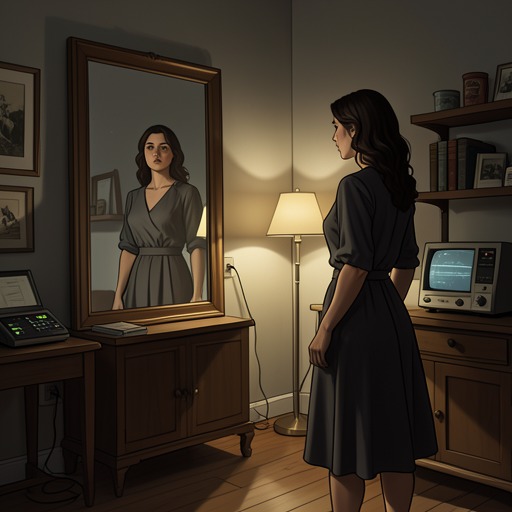
Emma recalls a weekend in Vienna with Sergei as a possible hypomanic episode, or perhaps a manic one. She heard what seemed to be a string orchestra, possibly fifty metres away, while Sergei heard nothing. By concentrating intensely, she could identify the source as passing traffic; when her concentration relaxed, the traffic again became music. The perception continued through the weekend, and at night it kept her from sleeping.
The episode involved more than unusual hearing. Emma says she felt energetic and wonderful and did not need sleep, while the city itself seemed wonderful too. When Rajid asks whether she recorded that period on her mood forms, she admits she has not yet filled them in. He asks her to do so and identifies the weekend as potentially hypomanic or manic, noting that she appeared able to keep the hallucinations and her behavior under control. Emma’s account, however, presents that control as active vigilance: she checks her senses and scrutinizes her thoughts because she knows her mind can make strange associations. Rajid calls this exhausting. The scene therefore holds two facts together: Emma retains some capacity to question what she perceives, but managing that uncertainty requires sustained effort.
The Delusion of Flight
Emma’s belief that she could fly shows how a manic delusion can turn a possibility into a physical certainty. Asked whether she merely thought she could fly, she insists in retrospect that she believed it. The conviction felt embodied, as if she had always possessed the ability and had only just understood it. In the recollection, the balcony rail presses against her waist; beyond it, the empty space seems transformed into something open and usable. She feels the wind beneath her arms, lifting and carrying her, and remembers the belief as exhilarating and difficult to resist.
Emma did not jump. She says she wanted to, but her reasoning shifted into a plan to build up in small steps: if flying was possible, she could begin with a low-risk test. She tried it from a stool, reasoning that the consequences would be manageable if it failed. It did fail. That sequence matters because the delusion did not simply erase all calculation; instead, ordinary caution was recruited into its logic. The risk assessment accepted the premise of flight and focused on how to test it safely. The episode’s intensity lies in that combination of profound certainty and reasoning that, from inside the belief, seemed practical.
Time, Recurrence, and Aftermath
Emma describes mania as escaping both past and future because the present becomes everything: an urgent now that seems impossible to relinquish. Depression produces the opposite temporal collapse. Without a felt present to interrupt it, the past seems to consume the future, and time itself loses meaning. Her account makes the conditions of each state distinct, while showing how both can narrow experience until other possibilities disappear.
After a manic or hypomanic period, Emma may feel worse rather than better. Rajid explains that the apparent well-being of mania can conceal the episode from the person experiencing it, while depression makes the contrast—and the possibility that something was wrong—more apparent. Emma also describes the return of depression through a recurring memory and image of the depth beyond a balcony. In that moment, the struggle is not only with thoughts or emotions but with a remembered feeling that has followed her for much of her life. The image gives her recurrent illness a personal history without reducing every episode to the same experience.
These accounts resist a cure-shaped reading in which a single diagnosis or insight resolves the problem. Emma can recognize that a belief was delusional after the fact, and she can work with Rajid to identify patterns through mood records, yet her own descriptions insist that the episodes are compelling while they last and that depression can return. Her growing understanding is therefore not proof that the illness has ended. It is a way of describing its recurring shifts, the unequal distance between experiencing an episode and interpreting it afterward, and the work required to live with both.