Bipolar disorder
UpBipolar disorder is the diagnosis that forces Emma to reconsider both her history of depression and the future she had hoped to escape it. Initially raised as a possibility by Rajid Panjani, it becomes a framework for understanding not only recurring low periods but also episodes of unusual energy and psychotic experiences. For Emma, the decisive consequence is not simply receiving a name for her condition: the diagnosis threatens the belief that one depression might be the last, then gradually helps her describe an illness she does not expect to be cured of.
Recognition and diagnosis
Rajid first suggests that Emma may be manic-depressive after considering what she and Sergei have told him and what he has read in her file. The suggestion is tentative. Emma already has an Asperger syndrome diagnosis, and she later tells another patient that clinicians are now considering bipolar disorder as well. Rajid explains that manic-depressive illness involves mood moving not only between ordinary and depressed states but also upward into elevated states. He does not claim to know at once which pattern applies to Emma.
To gather a longer view, Rajid gives Emma two mood charts: one for daily entries from then on and another to complete retrospectively for the preceding months and years. Each day is marked in relation to a middle line, with lower entries representing depression, higher ones hypomania or mania, and the line itself a normal mood. The charts are meant to make a pattern visible across time and help assess which type of bipolar illness may fit. Rajid also proposes discussing the forms with Emma and Sergei, whose observations of her life could supplement what staff see on the ward.
His explanation distinguishes two types and emphasizes management rather than cure. Medication and psychoeducation, he says, may reduce mood swings in their intensity, duration, and frequency, but cannot eliminate the disorder. In the account of type two, hypomanic periods occur alongside depressed and ordinary periods. They can involve unusual energy and talkativeness, taking on new activities impulsively, spending more money, and losing interest in eating or sleeping. Such periods may trouble people around the patient more than the patient, who may not recognize how difficult the change is for others. Rajid recalls that Emma’s file describes stretches devoted almost exclusively to puzzles or folded-paper activities, but remains unsure how to classify her.
Depression, recurrence, and time
The diagnosis strikes Emma hardest because it appears to turn depression from an unpredictable episode into a recurring feature of her life. Before it is raised, she can imagine that a depressive period might be a kind of mental flu: if its arrival has no clear logic, perhaps one day it will simply fail to arrive, or skip a year. Bipolar disorder unsettles that hope. If depression is part of an enduring pattern, the prospect of a final episode seems to disappear.
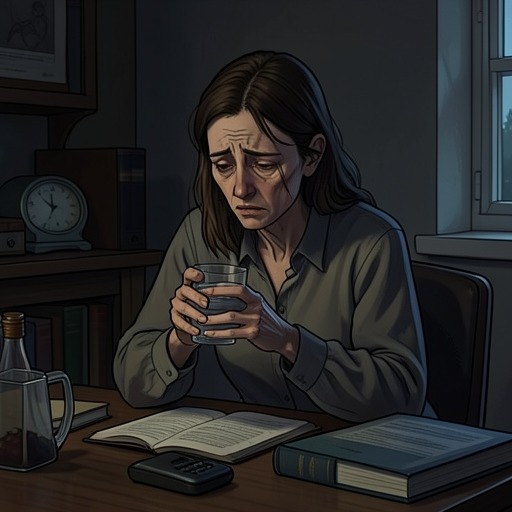
Emma connects this fear to her earlier decision to collect pills. She had wanted the previous depression to be the last by ending her life, and had imagined that the depressive part of her might die so she could go on living. The new explanation seems to reverse that imagined escape: depression is not only something behind her but something that may shape the future. In the aftermath of this realization, she curls up on a narrow, hard bed and remembers the recurring crisis of standing on a balcony and facing the same choice again. The diagnosis is therefore experienced not as a neutral label but as a threat to the possibility of ever being finished with despair.
The narrative also gives the mood states different relationships to time. In Emma’s description, mania is like a firework launched out of both past and future: the present becomes an urgent, all-consuming now. Depression works in the opposite direction. With the present seemingly absent, the past swallows the future, and time itself loses meaning; looking backward or forward reveals only depression. This contrast makes recurrence more than a medical forecast. It describes how each state reorganizes what Emma can imagine: mania contracts life into immediacy, while depression makes the future seem already occupied by the past.
Elevated states and altered certainty
The account distinguishes an elevated mood from the way it can transform Emma’s sense of what is real. Looking back on the belief that she could fly, Emma does not describe it as a thought she merely entertained. It felt like knowledge in her bones, as if the world had finally become the way it was meant to be and she had always been able to fly. The belief did not present itself as a suspicious novelty that she could stand back from; its felt certainty made it seem self-confirming. Emma identifies this kind of conviction as a delusion.
She similarly differentiates delusional belief from an ordinary intention to die. Recalling an expansive idea that seemed to gather her thoughts and feelings into itself, she says its emotional force was unlike suicide: it felt like a beginning, with the promise that everything afterward would be better. She can know that a belief is not logically possible and nevertheless believe it deeply. That division between intellectual knowledge and felt certainty is central to the book’s portrayal of psychosis: recognizing the contradiction does not automatically dissolve the conviction.
Hallucinations enter the diagnostic discussion unevenly. At first, Rajid says that he can find no indication of delusions, hallucinations, or psychotic symptoms in Emma’s records. Later, he tells her that what she describes sounds like recurring hallucinations and that these could fit the manic-depressive picture. The difference between the file and Emma’s account matters: clinical documentation does not initially contain what she eventually discloses. Her report that she felt almost nothing on hearing that Doctor Visser’s husband had died adds another kind of disturbance to the conversation. Emma remembers surprise that Doctor Visser had children and an incongruous sense of absurdity, as though the vast idea occupying her had absorbed the space where other feelings might have been.
Living with the diagnosis
By the time Emma names her new diagnosis to Sergei as bipolar disorder, the term has become part of how she explains herself and her relationship with those around her. She fears that others, including Sergei, may not understand the seriousness of her condition. Another patient suggests that Sergei’s apparent minimization could serve as self-protection: if he does not take Emma’s problems fully seriously, he need not face how close he may have come to losing her. This remains an interpretation offered to Emma, not a confirmed account of Sergei’s motives, but it shows how diagnosis reshapes the couple’s understanding of the danger and weight of her illness.
Emma eventually describes herself as rapid cycling, expecting a hypomanic week, then a depressive one, with only a few good days between. She does not believe that waiting for those days will solve the underlying problem. Medication may flatten the peaks, she says, but her mood will continue to change; the PAAZ cannot cure her, and neither can Rajid. In this moment, the diagnosis becomes a reason to ask Sergei to let her go. The account does not present that statement as proof that Emma has stopped caring about him. Instead, it records her bleak conclusion about what treatment can and cannot promise while she is confronting the pattern she believes lies ahead.
Her understanding later becomes more differentiated. Speaking with Beatrice, Emma says that hallucinations and delusions can be irritating or problematic, but are not always felt as the central difficulty. Depression is different: it is always perceptible in the background, and when it is felt, it feels eternal. She thinks she may be able to bear that background presence. This is not a declaration of recovery or an assurance that future episodes will be easy. It marks a change from hoping that a final depression can be prevented by dying to attempting to imagine life while the illness remains. The book’s account of bipolar disorder rests in that unresolved shift: a diagnosis that first seems to close the future becomes, without promising a cure, a vocabulary for recognizing its recurring states and their unequal claims on time, belief, and feeling.