Emma’s depressive episodes
UpEmma’s depressive episodes are not a single interruption with a clean before and after, but a recurring condition that reshapes how she experiences time, feeling, work, and intimacy. The book sets their exhausting darkness against the apparent brightness of mania, while showing how easily a person who looks well can still be vulnerable. Hospital care and the support of others matter, but neither makes recurrence disappear; Emma’s eventual departure from the PAAZ is therefore an ending to a stay, not a declaration that the illness is over.
Felt Experience and Contrast
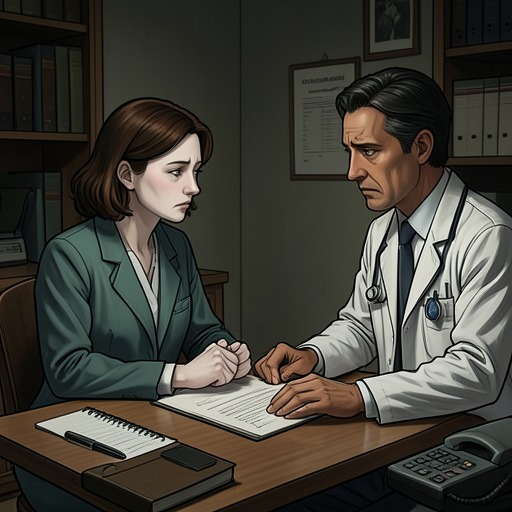
Emma struggles to explain a changed state of mind to a psychiatrist. When asked how she feels now, she reaches for an image of perception: the world seems newly visible after an enduring mist lifts, as if ordinary appearances had concealed what things really are. She says she feels well, but the intensity of that clarity sits beside her history of depression rather than resolving it. The episode shows how difficult it is to translate an inward state into language that another person, including a clinician, can assess.
The contrast is also visible to the people around her. A staff member remembers Emma’s previous admission as a time when she was severely depressed, wanted nothing, and barely spoke. During her later stay, she appears so normal that staff find it easier to forget she has no leave privileges. Emma objects that she is normal, while the staff member can only say that the earlier Emma seemed more thoughtful and cautious. Appearance thus becomes an unreliable measure: the outwardly composed patient may not fit the familiar picture of depression, but that does not erase the illness or the restrictions attached to it.
Depression also returns through memory. During a night-time round, a nurse’s flashlight crosses Emma’s face; she raises a hand and manages a strained smile, then struggles in the dark against panic and recollection. Before the nurses have reached the next room, she begins to cry. What overwhelms her is not thought or emotion alone, but a long-familiar memory of being emptied of energy, reduced to fragments that keep clinging to life while being pulled downward. The remembered depth beyond a balcony makes the depressive state recur as both present suffering and an older, frightening experience.
Crisis, Care, and Emotional Numbness
A depressive period can narrow Emma’s emotional world until a suicidal idea seems less like a crisis than an unquestionable task. Looking back with Rajid, she recalls that after months of depression she felt nothing when told that Dokter Visser’s husband had died. She was surprised that Dokter Visser had children, and found that fact absurdly funny; she had no emotional room for another person’s loss. Her attention had been absorbed by the conviction that she needed to die, which she understood not as a suicide plan but as something that simply had to happen. In her reasoning, removing herself and the misery attached to her would clear the way for work and productivity. The account exposes the dangerous distortion of the episode: a life-threatening intention is experienced as practical and self-evident, rather than as an emergency.
The consequences continue inside the hospital. After an emergency assessment, a doctor advises Emma to stop her current pills, but stopping them means beginning another medication the following week. She sits over still-empty mood forms, distressed that the change in treatment means spending the weekend in the PAAZ instead of with Sergei. He regrets the separation but reassures her that another weekend will come; Emma fears having to endure another weekend as a patient. The ward is nearly empty because other patients have gone on leave. Rajid has kept her there so her heart rate and blood pressure can be monitored while the side effects lessen. Treatment, in this scene, is not an uncomplicated route out of depression: medication changes, physical monitoring, and restricted leave become part of the immediate burden of care.
At another low point, a conversation with Lars intensifies Emma’s despair. As he dismisses hallucinations and questions whether she has delusions or manic episodes, she concludes that even the PAAZ may no longer be able to help her. Her readmission feels like evidence that she has failed to get better and cannot manage alone; the years behind her seem like only a reprieve, now exhausted. While Lars continues speaking kindly, her last sense of support slips away and depression takes hold as cold hopelessness. His friendly gesture at the end of the meeting does not reassure her: when she takes his hand, her mind flares into panic. The scene makes clear that an exchange intended as ordinary or kind can land inside an episode whose meaning has already turned against hope.
Time, Treatment, and Recurrence
Emma describes depression as a collapse of time. In a conversation with herself while waiting outside Rajid’s office, she contrasts it with mania: mania rockets away from past and future because only the present seems to matter, an urgent now that must never end. Depression works in the opposite direction. With no present to anchor her, the past and future seem to pour into one unending expanse of despair. Wherever she looks, backward or forward, she sees only the depression. The distinction is not simply between sadness and elation; each state alters what time feels like and what possibilities can be imagined.
Medication offers no simple promise of relief from that pattern. Rajid explains that most mood stabilizers work better against hypomanic and manic periods than against depression. Emma hears the bad news inside the apparent benefit: removing the highs may leave her without anything to soften the current low, and she fears that happiness may be permanently unavailable. Rajid does not promise a lasting high. He says that he would want her to have its lightness, but recognizes that living only in that state is not reality. The exchange holds treatment within a difficult limit: reducing one kind of episode cannot guarantee freedom from another.
After beginning Depakine, Emma develops a dry mouth, a headache, and trembling hands. She counts it as a small gain that she is still alive, but knows that the thought no longer feels like a victory once distraction stops. Working on a puzzle and concentrating on other people can temporarily keep the depression at bay; alone at night, that distraction feels like thin ice above a deep, dark lake. Laughter hurts, and company sharpens the sense of missing a feeling she can no longer reach. When Sergei visits, she expects to feel his hand in hers but fears that she will feel nothing, because the sorrow leaves no room for love. The puzzle itself becomes uncertain in her hands: after placing its last piece, she no longer knows what the picture represents, and the corner crumbles when she lifts it.
Relationships, Work, and Patient Identity
Emma’s illness is entangled with shame about work. During her first admission, what had been planned as four weeks of holiday became a five-month stay in the PAAZ. Her employer had to explain her absence to colleagues without knowing whether she would return in a week, a month, or ever. Emma feels she has imposed that uncertainty on him. Her colleagues were not told she was in hospital; her employer described her as being at home with burnout, hoping she might soon return and decide for herself what to disclose. When a group discussion identifies this as stigma, Emma resists the label because she understands the decision as an attempt to protect her. The discussion clarifies that stigma can arise through effects as well as intentions, including silence about a difficult subject; her employer could instead have asked what she wanted shared. The episode reveals how concealment can be both an act of care and a source of isolation.
The strain extends into Emma’s relationship with Sergei. Her psychiatrist had asked him to remove her stored medication, but Sergei resisted for more than three weeks, and it took two conversations with the psychiatrist before he finally did so, still reluctantly. Emma fears that his reluctance means he does not take her suffering seriously. Another patient suggests a different possibility: if Sergei can avoid acknowledging how life-threatening the situation was, he can avoid facing how close he came to losing her. This interpretation does not cancel Emma’s hurt, but it shows how a safety measure can expose the unequal ways partners confront risk. Later, Emma sees herself through Sergei’s fearful gaze as a patient he feels responsible for protecting. She understands his concern, yet insists that the illness is part of her life and that she must live it herself. Her recognition that things may worsen again is not confidence in a cure; it is an insistence on agency amid recurrence.
Emma also responds to Beatrice’s account of losing her sense of God after starting medication. Beatrice says that she had felt God throughout her life, even during depression, but that the feeling vanished after three days on pills. She had gone home hoping it would return if she stopped them; when it did not, she came back to the PAAZ. Emma admits that she has not understood Beatrice before. She cannot claim the same experience, but suggests that depression itself can consume the energy needed to believe, laugh, feel happiness, or love, and that the feeling might return as depression recedes. The exchange matters because Emma, who has repeatedly struggled to make her own inner state intelligible, offers another patient a tentative account without pretending certainty.
Change and Continuing Life
Near the end of her stay, Emma tells Sergei that he must let her go. She recognizes that he is afraid of another decline, but does not confuse leaving the hospital with a guarantee that her condition will not worsen. Her position joins two truths that the episodes keep forcing together: she needs help and is vulnerable to danger, yet she is not only a patient to be managed by other people.
When Emma sees Dokter Visser on the day she leaves, she explains that she is going home and has come only to collect her prescriptions. She describes herself as returning to life as an outpatient. The distinction is concrete: the inpatient stay ends, but treatment continues beyond the ward. She also apologizes for having learned, on the day she was admitted, that Dokter Visser’s husband had died. That encounter returns to the earlier account of her emotional numbness, when the news could not reach her. The book closes this stretch of care without presenting departure as cure. Emma leaves with an ongoing illness, a history of recurrence, and a clearer claim to participate in the life she must continue to navigate.