The decline and merger status of PAAZ
UpThe PAAZ’s decline and impending reorganization unfold on two connected levels: its aging buildings are left increasingly unrepaired as a move approaches, while familiar forms of treatment and community are being phased out. Emma encounters these changes not as an abstract administrative plan but as alterations to the place where she is living and trying to recover. The ward has helped hold her through periods when she could not hold herself together; its decay therefore carries both institutional and intimate weight.
A ward divided and a move deferred
When Emma follows Gwen to the nursing office, she recognizes the walls with unsettling ease, a reminder that leaving the PAAZ does not necessarily remove it from a patient’s sense of place. Inside, she finds that a door now cuts off one arm of the old U-shaped layout from the rest of the ward. Gwen unlocks it and locks it again behind them. The office has been moved into the PAAZ locked ward, so this is not a transfer of Emma to that ward, but a practical change that momentarily makes the boundary feel consequential. Emma asks whether the two separate sections are an improvement. Gwen describes the arrangement as different and says the open ward is less burdened by more severely ill patients. Emma accepts the explanation with the immediate qualification that she wants to remain on the open side.
The altered layout makes reorganization tangible at the scale of a doorway. The ward, once organized around a central corridor linking its sleeping wings, office, living rooms, and consultation rooms, has been divided by a new barrier. The change is presented as an adjustment intended to make the open ward less demanding for its patients, but for Emma it also gives the institution’s categories a physical edge: the office is now behind a locked door, and remaining on the preferred side matters to her.
The unrepaired door and the unfinished new building
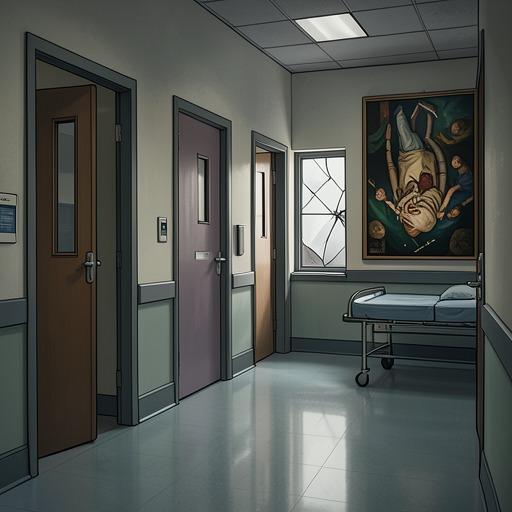
The condition of the garden door gives the PAAZ’s deterioration a visible, practical form. Its glass is broken, and the wood has warped after a previous replacement. Karel explains that the door must now be left either open or locked to prevent the damage from getting worse. Emma wonders why the whole door cannot simply be replaced. The answer appears beyond the hospital: across a cold, windy expanse of sand stands the bare, angular concrete frame of the new building. The move is expected in six months, making repairs to the old premises seem wasteful to those responsible for them.
That promised future does not solve the immediate problem. Karel says the damaged door will remain as it is because the merger has left responsibility for maintenance disputed between the hospital’s management departments and those at the other location. The argument has already continued for three months, with the departments contesting who should act and who should not. The consequence is more than an inconvenience: people are still living in the old building while responsibility for maintaining it has become unclear. Emma first responds with laughter, then feels close to tears as she looks back at the ward she now calls home. She imagines it as a wounded, dying body, still being used for its people and equipment before it is discarded. The image joins the physical neglect to her gratitude: the building has sheltered her and helped her recover, even as it is itself being allowed to fail.
Treatment community being phased out
The reorganization also affects the PAAZ’s social and therapeutic life. Dimitri tells Emma that the former treatment group is no longer part of the ward’s present. Its disappearance is not merely because Lars is away: Dimitri says the new building will have no treatment group at all. He describes the process as a gradual winding down. When someone leaves, the vacancy will not be filled; the group will shrink until it is too small to continue. The anticipated move thus carries a specific loss alongside the promise of new premises: a collective form of treatment is being removed from the future plan.
Emma laughs at the prospect, imagining that Lars will not welcome it, while Dimitri wonders how long he will remain in a setting where a psychologist is an awkward fit. The exchange places personal uncertainty within institutional contraction. Individual staff members may leave, but the treatment group is also being deliberately allowed to diminish. The PAAZ’s change is therefore not simply a move from an old building to a new one; at least one established way of organizing care is not expected to make the journey.
The institution and the patient’s changing identity
The ward’s decline and division take place alongside Emma’s effort to explain an internal state that others cannot readily see. Asked how she feels now, she imagines the lifting of a fog as a sudden perception of reality in its immense scale and complexity. Yet when she must answer the psychiatrist, she says only that she feels well and clear. The contrast shows how difficult it is to translate a private change in perception into a clinical conversation; it does not make the institution’s physical decline a metaphor for her illness, but it places both within the limits of what can be recognized and communicated.
The staff’s perception of Emma changes with her appearance. A nurse recalls that during the earlier admission her severe depression had been apparent: she wanted nothing and barely spoke. Now she looks as though she might go home the next day and seems ordinary, making it easier for staff to forget that she has no leave privileges. The contrast exposes a practical risk in reading visible composure as evidence that restrictions no longer matter. It also shows how the patient’s status is negotiated in everyday encounters, rather than determined only by the buildings or formal arrangements around her.
In a discussion about work and shame, Emma recalls that during her first admission her colleagues did not know she was in the PAAZ. Her employer told them she was at home with burnout, initially leaving open the possibility that she would return after a short absence. The stay lasted five months, and Emma felt responsible for the uncertainty her absence created. Pieter uses the example to explain that stigma can arise from the effects of behavior even when the intention is protective, including decisions made without discussing them with the person concerned. Emma contests the interpretation of her employer’s actions, insisting that he meant to help. This exchange broadens the picture of the institution’s boundaries: admission separates a patient from ordinary work life, while the language used outside the ward can conceal that separation or leave the patient without a say in how it is explained.
Departure without a promise of cure
When Emma asks to be allowed to leave, she acknowledges that things may get worse again. Her request does not rest on the claim that future deterioration is impossible; she insists that the risk is part of her life and that she must live it herself, even while accepting that others watch over her. This moment makes the institution’s role neither wholly curative nor dispensable. Care can protect and accompany her, but cannot take the place of her own life or guarantee that illness will not return.
At the end of this stretch, Emma tells Doctor Visser that she is going home and has come only to collect her prescriptions. She will be an outpatient again. The change is marked by a bag in her hand and a practical errand, not by a declaration that all difficulty has ended. Against the planned move from the old premises, her departure is another passage out of the ward, but not a clean severance from treatment. The PAAZ remains part of the story as a place that has cared for her, constrained her, and helped shape how she understands being a patient—even as its own future is being transferred, reduced, and left unresolved.