Emma’s bipolar disorder
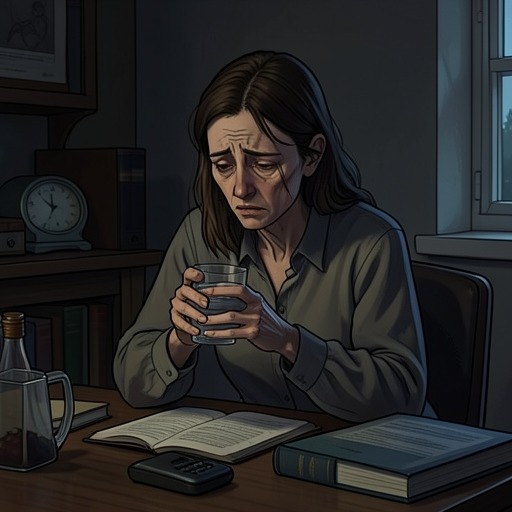
UpEmma’s bipolar disorder takes shape through experiences that are at once clinical symptoms and a private upheaval in how the world appears. A diagnosis gives Rajid a framework for understanding her sharply changing moods, hallucinations, and suicidal crisis, but it does not capture their felt reality by itself. Emma must find language for those experiences, while negotiating what the diagnosis means with her psychiatrist, her therapist Lars, and the people around her. The account resists a neat story of illness followed by cure: its central fact is recurrence, and the recognition that what feels normal to Emma may still be unusually intense and destructive.
Diagnosis and its limits
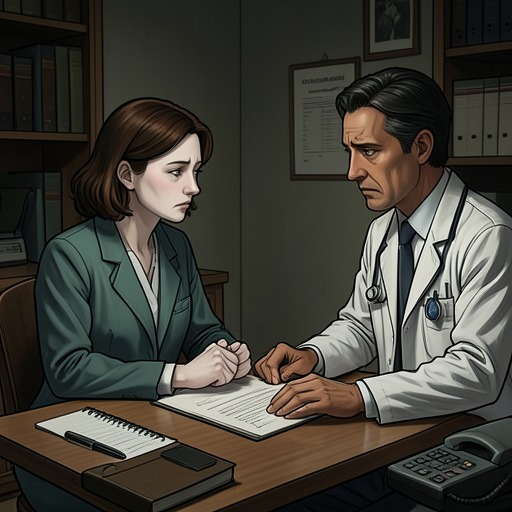
Rajid tells Emma that her experiences sound like recurring hallucinations and that these can fit a manic-depressive picture. He distinguishes hallucinations, in which a person misperceives what is present, from delusions, in which perception may be accurate but is given a false meaning. For Emma, the distinction matters, but it does not settle what the experience is like to endure. She has sometimes seen snakes on a narrow cycle path beside a road through the polder. Concentrating hard, she can recognize that the apparent snakes are branches; when she stops concentrating, they seem to return. The strain lies not only in what appears before her, but in how quickly confidence in ordinary perception can break down.
Rajid’s diagnostic impression becomes more definite after Emma describes the idea that accompanied her admission. Following months of depression, she had suddenly felt that the time had come to die. She recalls being emotionally numb even when told that Doctor Visser’s husband had died; her attention fixed instead on the absurd surprise that the psychiatrist had children. In her account, the suicidal idea absorbed the space that might otherwise have held feeling. She framed death as a task to complete so that she could get on with work and productivity. The calm, practical logic of this belief is part of what makes the episode alarming: to Emma at the time, it did not feel like a suicide plan carrying its true weight.
Mood, time, and recurrence
The disorder is described through contrasting experiences of time. In mania, the present becomes absolute: an urgent now that seems to detach itself from both past and future. Depression has the opposite reach, as the past appears to consume the future and despair erases the sense of waiting for anything. Emma likens depression to a fog lifting, suddenly making the world seem newly and overwhelmingly clear. Elsewhere, she describes depression as leaving her in fragments, with whatever remains of her clinging to life while being pulled deeper. The apparent clarity of one state and the engulfing darkness of another are not stable resolutions; both distort the scale and meaning of what lies ahead.
Rajid uses mood-chart forms to examine how often Emma’s moods change. He explains that the frequency is striking even against the background of bipolar illness: many patients experience only about three episodes in ten years, whereas Emma says that three wrong moods in a month would not be unusual for her. He cautions that less frequent episodes can still be long and devastating, and that her pattern had concerned him when he read her file. The exchange corrects her assumption that these fluctuations are simply ordinary for her. It also makes clear that diagnosis is not only a name for past suffering; the forms are intended to help establish the frequency of episodes and whether particular triggers may be involved.
Disclosure and competing interpretations
Emma initially struggles to explain her altered perceptions to Rajid. She worries about being known as frightened by them, and describes the snakes only after hesitating. Rajid’s explanation gives her terms for discussing hallucinations and delusions, while the treatment conversation connects that discussion to care: he proposes waiting until the physical side effects of Tegretol have passed, then starting Depakine alongside lithium to address manic periods, including delusions and hallucinations. He also wants her to continue the mood forms and talk about what she has disclosed with Lars. These are proposed next steps, not evidence that the treatment has already succeeded.
With Lars, the disagreement is about who can know the illness. Lars says that he has little faith in diagnoses and has not seen Emma as manic-depressive. Emma answers that the symptoms are in her mind, not his, and that she has concealed her hallucinations partly because she feared his response. His failure to recognize them therefore cannot establish that they are absent. Emma does not treat the label as an identity that explains everything; she sees its possible value in making more suitable treatment available, and objects when Lars dismisses a diagnosis before understanding the experiences behind it.
She eventually explains that the hardest part of hallucinations is not simply whether she sees a snake or a cat, hears people speaking Polish, or believes she is being followed. It is the repeated sense that the world has been rearranged while she was not looking. Her comparison is a television guide that suddenly is not where she was certain she left it: the distress comes from the shock, anxiety, anger, and helplessness of finding something changed, and from the fear that the lost object might stand for the loss of her own grasp on reality. By shifting the focus from the image to the disruption it causes, Emma asks Lars to attend to the experience rather than debate its content. She insists that the point is how a person lives with the recurring disturbance.
Relationships, identity, and continuing illness
The diagnosis also unsettles Emma’s sense of what counts as normal. When another patient mistakes her for a medium, she rejects that explanation and describes herself instead as sometimes manic, when she may see, hear, or believe things that cannot be real. Later, talking with Linda, she calls herself ordinary while acknowledging that the ward has told her she was manic and that she must fill in forms about it. The diagnosis feels like a loss, even as she turns toward the possibility of new medication and another chance. These moments show her trying out a way to speak about the condition that neither reduces her to supernatural claims nor makes the clinical label painless.
The disorder also exists within relationships shaped by fear and protection. Emma recounts that Sergei was asked by her psychiatrist to remove her accumulated pills, but resisted for more than three weeks, despite two conversations with the psychiatrist. She experiences his reluctance as a possible failure to take her condition seriously. Another patient suggests that Sergei may be protecting himself from the implications of how close Emma came to being lost: if he does not fully acknowledge the danger, he need not continually face it. This remains an interpretation offered by that patient, not a confirmed account of Sergei’s motive. For Emma, the episode nevertheless makes visible the burden that a suicidal crisis can place on a partner, as well as the tension between being protected and being treated as a person capable of acting for herself.
That tension reaches a different form when Emma recognizes how others may see her: as a patient for whom they are responsible, someone who may need protection from herself. She understands the concern but insists that the illness and its consequences are still her life to live. Her request to be allowed to go does not promise recovery. She acknowledges that things will get worse again. In that admission, the narrative turns away from a cure-shaped ending and toward the harder knowledge that support can matter without abolishing recurrence. Emma’s bipolar disorder remains part of her life, but neither a complete account of who she is nor a future that others can manage on her behalf.