The PAAZ’s understaffing and impending merger
UpThe PAAZ’s understaffing and impending merger are not merely administrative changes in the background of Emma’s admission: they alter the ward’s daily care, leave visible defects unrepaired, and provoke a dispute over what patients need from the people who work there. The planned move promises a new building and a larger service, yet the transition makes the old ward feel increasingly neglected. Emma’s insistence that patients need nurses’ attention exposes the human cost of treating the unit as a place that can simply be kept running until relocation.
Merger, cuts, and a promised new building
The PAAZ is due to merge with another location and move into new construction. Sandra explains that staffing has already been cut as part of this process: where two clinics combine, she says, a third of the nursing staff disappears. Contracts were not renewed, the first layoffs came toward the end of the year, and staff were sometimes hired back at the other site as temporary workers because it cost less. The change affects both locations, rather than providing one with extra capacity at the other’s expense.
The resulting shortage is stark. At times, only two or three staff members have to run the whole PAAZ, although Sandra says that the locked ward alone could use four. Emma notices that staff seem to be present at half their former strength and that, aside from the morning gathering, she hardly sees them. The merger is therefore experienced not just as a future move but as an immediate contraction of attention on the ward.
The projected move is also framed as a reason not to repair the existing building. From the garden, Karel points out the new construction across a sandy expanse behind the hospital: a bare, angular concrete frame. The move is still half a year away, but the old facilities are being left to wait for it. In a later conversation, Sandra says the merged service is to become an admission unit for adults, older people, and young people with acute psychological problems. The expanded remit makes the organizational change larger than a change of address, even as the immediate discussion of a new name turns the reorganization into a ward-level matter patients are invited to help consider.
Material neglect and stalled responsibility
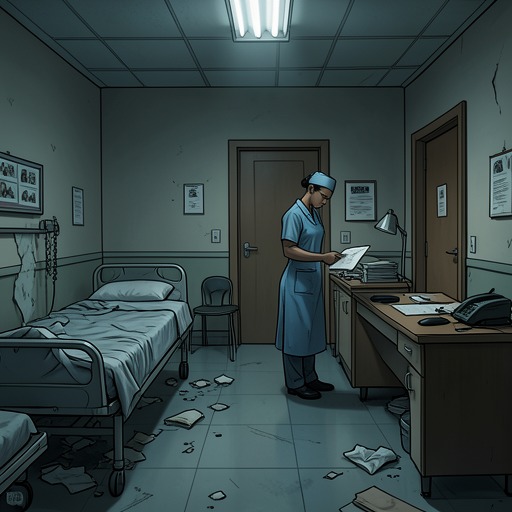
The broken garden door gives the impending move a concrete form. When Emma asks why it is locked on an open ward, Karel explains that the glass has broken before, the frame has warped, and the door must therefore be either open or locked to prevent further damage. Emma points out the broken glass and asks why the whole door cannot simply be replaced. Karel’s account links the defect to the merger: after the organizational changes, nobody knows who is responsible for maintenance. The hospital’s facilities department and the corresponding department at the other location have already spent three months arguing over who should act—and, especially, who should not.
Emma’s response shifts the defective building from inconvenience to a painful emblem. She wants the door repaired and does not want the PAAZ itself to disappear. Although the move is officially to a new building, she feels that everything is already changing. She describes the old ward as worn out, but also as the place whose walls held her when she could not hold herself together and helped her recover piece by piece. In her perception, the building is now like a wounded, dying body, kept alive only long enough to give up its people and equipment before being discarded. The image makes the neglect more than a maintenance dispute: the institution that has supported her is itself being allowed to decline.
Procedures that make care take time
The staffing problem also appears in the gap between an outpatient appointment and one requested by someone on the ward. An outpatient calls the secretary, requests a time, and receives an appointment. A hospitalized patient must tell the nursing staff; the request is passed to the psychiatrist at the next morning meeting, who asks the secretary to find time. The secretary then reports back to the doctor, who informs the nurse at another morning meeting. Emma contrasts a process that can take five minutes with one that may take ten to thirty years, depending on how many weekends intervene. By evening, Karel tells her, nothing further can happen.
The exaggeration conveys how delay feels from inside a system where even a request must travel through several people and stages. Emma has already walked from the nursing station to her room without a doctor’s appointment, and the procedural chain helps explain why a simple wish to speak to the doctor can feel remote. It also places the staffing shortage alongside the ward’s routines: when requests depend on successive handoffs, reduced capacity and the timing of meetings become part of the patient’s experience of care.
What patients need from nurses
Emma challenges the idea that patients on the open ward are doing well simply because they seem to entertain themselves. She tells Sandra that patients may have only a few hours of therapy in a day and see a therapist for at most an hour a week, while nurses used to see them throughout the day. That sustained presence, Emma argues, is the nurses’ distinctive contribution. Their attention matters even when patients are occupied with conversation, a television, a book, or a puzzle.
Sandra admits that it can be difficult to enter the lounge in the evening when patients are already talking or busy with something; she feels like an intruder. Emma turns that discomfort into a question about why patients from the open side go to spend their evenings in the locked ward’s lounge. She argues that the important difference between the two sides is that staff are nearby on the locked ward. Patients may appear calm and independent when left to themselves, she says, but that appearance can conceal loneliness. The exchange gives the staffing cuts a relational consequence: fewer nurses do not merely mean fewer people performing scheduled tasks; they reduce the chance of an ordinary, attentive presence.
A transition whose effects are already present
The impending move is repeatedly presented as a promise that the new building will make things better, but the evidence Emma encounters points to a more unsettled transition. The old door remains damaged because departments dispute responsibility; appointments pass through a lengthy chain; nurses are fewer, and their presence in patients’ daily lives is contested. Meanwhile, the planned expanded unit is being designed and named while the existing ward is still caring for people.
This tension prevents relocation from functioning as a simple resolution. A new building may replace the old one, but Emma’s conversations with Sandra insist that a ward’s work consists in more than its facilities or official structure. The PAAZ is a place of human attention, and its erosion is felt before the move occurs. The approaching merger thus connects institutional decisions to ordinary moments—a locked door, a delayed appointment, an emptying lounge—and shows how organizational neglect can become part of the intimate reality of being a patient.