Emma’s rapid cycling
UpEmma’s rapid cycling describes the unusually frequent shifts in her mood that Rajid recognizes in her records during her stay at the PAAZ. Its significance lies not only in the frequency of those shifts, but in the gap between what Emma has learned to regard as normal and what her psychiatrist sees as a difficult clinical pattern. The diagnosis changes the terms of treatment, while Emma’s own account shows how depression and elevated states can each alter what feels real, urgent, and possible.
Pattern and Diagnosis
Rajid finds that Emma’s mood records already give a clear picture of how often her mood changes, even though she has not finished filling them in. He stresses that bipolar disorder does not generally mean being depressed or elevated all the time: most patients experience only a few such episodes over a decade, with the rest of the time spent feeling ordinary. Emma’s own comparison is startling. Three episodes in a decade would seem like a holiday to her; she says she can have three in a month. The contrast makes visible how completely she has calibrated her expectations to recurrent instability.
Rajid names this frequency rapid cycling and warns that this variant tends to respond less well to treatment. He had already worried about the pattern when he read Emma’s file, though he had hoped the frequency reflected the pressure of her previous admission rather than a lasting feature of her illness. The records do not settle her history: Rajid asks whether her moods fluctuated less before her first admission, but the evidence leaves that question open. What the conversation does establish is that her current pattern appears frequent even against the background of bipolar illness.
The diagnosis also brings a history of treatment into sharper focus. Emma points out that she has taken at least three different antidepressants over the preceding two years. Rajid says antidepressants can turn an otherwise typical bipolar pattern into rapid cycling, and that they are therefore avoided in this situation. The exchange leaves a difficult tension unresolved: the frequency is recognized now, but Emma’s past medication history raises questions about how her treatment may have interacted with the course of her moods.
The Felt Difference Between States
The changes Emma describes are not simply shifts in mood labels. When asked how she feels after saying that an earlier depression was then and the present is now, she reaches for images of perception: the world seems newly visible once an everlasting fog lifts. What appears to others as a normal sky or a pale moon becomes, in her account, a radically different reality once the obscuring mist is gone. Her difficulty is explaining this certainty to a psychiatrist. She ultimately calls herself well and clear, but the imagery conveys how total the transition feels from within.
Elsewhere, elevated certainty takes a more dangerous form. Emma describes the idea that she had to die as something that did not feel like a suicide plan to her at the time. After months of depression, the idea arrived with a sense of clarity and necessity: death seemed like a way to remove herself and the distress attached to her, and then return to work and productivity. She says that the fact that taking the pills would mean death had somehow disappeared from view. Her account distinguishes what she knew abstractly from what she believed intensely; the idea felt like a beginning, accompanied by calm and a sense that everything was one. That conviction helps explain why the risk could seem invisible to her even while others regarded it as urgent.
Rajid also discusses hallucinations and delusions with Emma, distinguishing altered perception from an incorrect conclusion drawn from ordinary perception. Emma’s examples show why the distinction matters. She says that, during the belief that she could fly, she did not merely think it might be true: she felt that it was true in her bones, as though the world had finally become as it should be. She can recognize that a belief is not logical while still describing it as profoundly convincing. These experiences do not define rapid cycling by themselves, but they show the intensity and altered reality-testing that can accompany her changing states.
Depression, Time, and Recurrence
Emma’s depressive experience is marked by a different disturbance of time. In her reflection while waiting outside Rajid’s room, she contrasts elevated states, in which the present seems to eclipse past and future, with depression, in which the past consumes the future and time itself loses meaning. Looking in either direction brings the same depression into view. This contrast makes rapid cycling more than a sequence of episodes: each state reorganizes the horizon through which she can imagine what comes next.
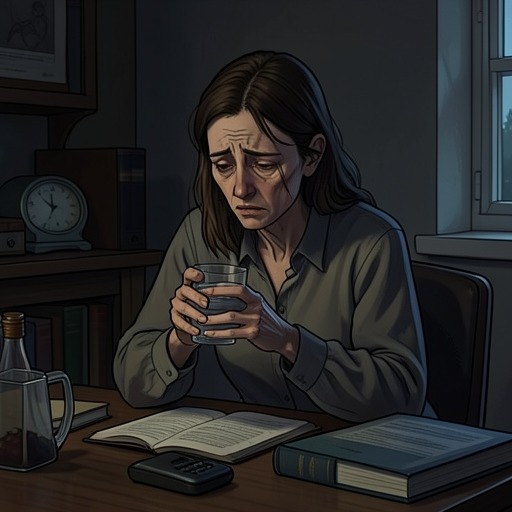
The pattern also returns through memory. During a night check, Emma raises a hand and manages a strained smile as a nurse’s flashlight passes across her face. Once the room darkens again, she tries to keep from feeling or remembering, but breaks down before the nurses reach the next room. The memory carries her back to a depression that feels lifelong, stripping her down to fragments that struggle to hold on to life and are drawn toward the depth beyond a balcony. The scene shows that a temporarily composed appearance does not mean the depressive experience has disappeared; it can return with force when she is alone.
Treatment and the Limits of Resolution
Rajid proposes adding Depakine to lithium, noting that the combination can reduce the duration and frequency of mood changes. Tegretol had caused Emma adverse effects, so Depakine offers a different medication to try. The proposal comes with a condition: Rajid wants her to remain at the PAAZ for at least two more weeks while the dose is built up, possibly longer, so that its effects can be observed before she returns home. Emma’s response to the prospect of staying is captured in a single thought of home as something she can no longer picture clearly. The treatment plan therefore offers a practical next step without promising a quick return to ordinary life.
The larger aim of the mood records is also practical: a daily mark might help clinicians identify the pattern and choose appropriate medication sooner. Emma argues that people on the ward already confront their problems every moment and suggests that the effort of recording a mood could be worthwhile if it improves diagnosis and treatment. The records turn private fluctuations into a pattern that can be examined, but they do not make the pattern easy to live with.
That limit becomes clearest when Emma asks to be allowed to leave. She understands that the people around her see a patient for whom they feel responsible and whom they want to protect, but insists that this identity is part of her life rather than its entirety. She does not promise that her mood will remain stable; she anticipates that things will get worse again. Her account of rapid cycling thus ends not in a cure narrative, but in a recognition of recurrence alongside a demand to take part in deciding how she lives with it.