Emma’s hallucinations
UpEmma’s hallucinations take the form of snakes where there are branches, music where there is traffic, and a dog that appears without explanation. Their deepest effect is not only the strange image or sound, but the repeated shock of having to decide what is real—and the fear that this altered world may go unnoticed by everyone else. In Emma’s account, hallucination is an exhausting lived uncertainty, not merely a list of things she sees or hears.
Perception and the work of interpretation
Emma distinguishes the act of seeing from the mind’s interpretation of what has been seen. She explains to Rajid that the senses register information, but that the brain can supply an image that does not fit the scene. For that reason, she rejects the simplicity of questions about whether she sees things other people do not: she can experience something as sight while understanding that the mistake lies in how her mind interprets it. Her shorthand is that she does not see or hear anything strange; she thinks differently.
That distinction does not make the experience easy to dismiss. Emma describes a state in which the ordinary world seems to have been rearranged while she was not looking. The displacement matters more than the object itself: like discovering that a television guide is no longer where it was left, she must confront the possibility that reality has shifted and wonder whether she has lost not only an object but confidence in her own mind. The resulting shock, stress, fear of recurrence, anger, and helplessness persist even when the apparent cause is small. Her central concern is how to live through the repeated loss of certainty, rather than what a particular image might symbolically mean.
Snakes on the Country bike path
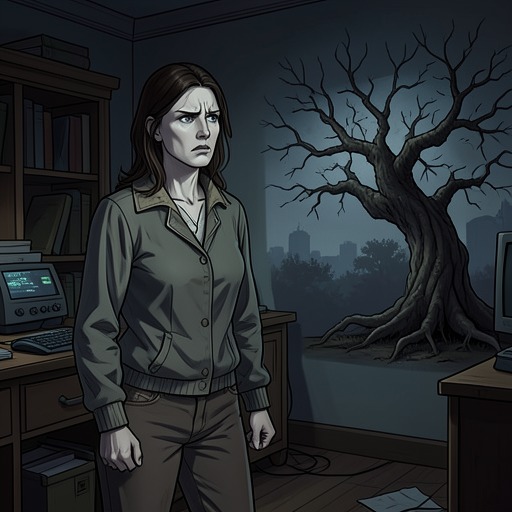
Emma’s most sustained example began years earlier on the Country bike path, a narrow and dangerous route beside an eighty-kilometre-per-hour road through the polder. She first thought she saw a snake there. Reasoning that a snake was unlikely and that the apparent viper would have had to travel a long way from the Veluwe, she concentrated until the shape resolved into a branch. The reassurance was temporary: twenty metres farther on, she saw another snake, which likewise became a branch under concentrated scrutiny. When her attention relaxed, the branch seemed to become a snake again.
The route took half an hour each way, so each episode could occupy an hour; but it was not a single-hour occurrence. Emma had to travel that path several times a week, and the last period in which she saw snakes there lasted three months. She gradually made a habit of trying to think the images away, though each one still startled her. The practical consequences reveal the limits of that strategy. After a storm, a branch perhaps two metres long lay across the path. Although Emma wanted to remove it before dark so that no one would collide with it, she could not touch or kick it away: she feared it might turn into a snake. What had seemed merely odd had become an obstruction to ordinary action.
Music, dogs, and the boundaries of a hallucination
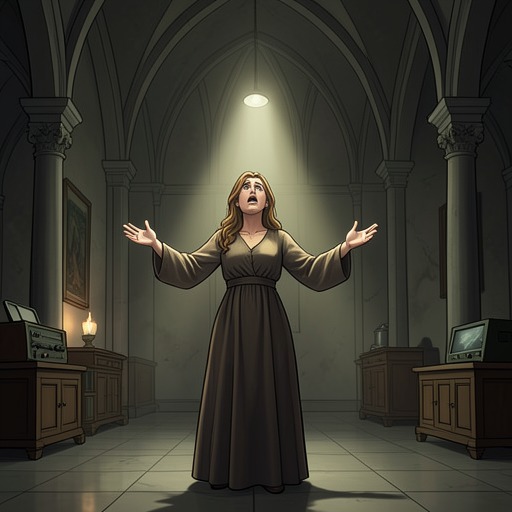
Emma also tells Rajid that she sometimes hears music, though not voices. Usually it is an ordinary tune in her head. On a trip to Vienna with Sergei, however, the music seemed to come from outside her, as though a string orchestra were playing about fifty metres away. Sergei heard nothing. Emma listened harder, eventually recognizing that the sound was traffic; once her concentration eased, it became music again. The effect continued through the weekend. During the day she tried to locate its source, and at night it kept her from sleeping. At the same time, she felt energetic and believed she needed no sleep. The account places the altered sound alongside a period of unusual energy, without reducing the experience to a simple mishearing.
In conversation with Iefke, Emma offers a quieter visual example: sometimes she sees a dog and knows it is not there. It sits without doing anything, and she does not assign it a message or purpose. Linda calls the image peaceful, but Emma resists the idea that a harmless appearance must therefore be easy. The dog may not be frightening in itself; the repeated need to work out what is real is what wears her down. Snakes can be frightening, but even an uneventful apparition demands the same effort of checking and correction.
Disclosure and the cost of recurrence
Emma is reluctant to explain how frightened she can be. When Rajid asks about her experiences, she initially describes them as mostly strange rather than terrifying, then discloses the snakes. She tells him how long the episodes lasted and what happened when she could not move the fallen branch. That disclosure turns a discussion of unusual perception into an account of interference with daily life. Rajid recognizes the burden, while Emma initially minimizes it as annoying rather than a genuine hardship.
She later gives a fuller account of what makes the experiences difficult: not whether the image is a snake, a cat, or something else, but the repeated alteration of what she thought she knew. In explaining this to Rajid, Emma challenges the distance that can enter clinical discussion of hallucinations and delusions. She is not asking him to decode the images. She is asking how a person can cope when the world keeps seeming to move familiar things, and when concealing that uncertainty becomes part of the strain.
Hallucination within a changing inner world
Emma’s descriptions sit alongside her accounts of depression and elevated states, but the narrative does not make every hallucination a direct consequence of a particular mood. Instead, it shows how perception and mood together shape her sense of reality. She contrasts an earlier depression, remembered as a life-long feeling of being drawn down beyond a balcony, with a present sense of suddenly seeing through a fog. Elsewhere, she describes mania as an all-consuming present and depression as a state in which the past swallows the future. Those contrasts make clear that certainty, time, and perception can all feel unstable, though in distinct ways.
The recurring images therefore matter less as a catalogue of symptoms than as tests of trust: Emma has to decide whether to believe her eyes, whether to correct what they show, and whether to tell another person how much effort that correction requires. Her examples move from the joke of a branch mistaken for a snake to the inability to clear an actual branch from a path. That reversal gives the hallucinations their practical and emotional weight. The frightening possibility is not only that something unreal may appear, but that the work of distinguishing it from reality can occupy a day, a journey, or an ordinary decision—and still begin again.