Emma’s episode in the hospital chapel
UpEmma’s episode in the hospital chapel is a turning point in which a search for escape becomes a delusional mission, and the chapel’s light briefly seems to confirm that Emma has found a place beyond ordinary reality. The scene makes the force of her altered perceptions concrete: scraps of everyday life become signs, while the warmth and certainty of revelation give way to breathlessness, fear, and the need to get out. Michiel’s quiet presence on her return offers a human counterpoint to the episode’s isolating logic.
Background and Flight from the Ward
The episode begins with mounting physical distress. Emma feels that the room is airless and its walls oppressive; she coughs and struggles to breathe. She decides she has to leave, gathers her laptop and coat, and moves through a checklist with urgent concentration. At the closed ward’s door, Sandra asks where she is going. Emma says she needs the Ziekenhuiswinkel, and Sandra lets her go, reminding her to return for a blood-pressure check. Emma is upstairs almost as soon as the door has shut behind her.
The urgency is more than a wish for fresh air. Emma experiences the world as charged with meaning and believes that a direction will become clear if she finds the right sign. Earlier, she had described a state in which the fog lifts and the world seems suddenly visible in its true form. That feeling of clarity is not reliable knowledge: in the chapel episode, certainty grows alongside perceptions and conclusions that are detached from what other people around her can verify. The contrast matters because Emma experiences the revelation not as confusion, but as an answer.
The Ziekenhuiswinkel as a Field of Signs
In the Ziekenhuiswinkel, Emma tries to reconstruct an earlier encounter with Sergei. She stands where she remembers him being near the newspapers and searches for the object he had put away when he saw her. A newspaper becomes the missing link. She examines the front pages for a clue, then returns it and takes a magazine, reasoning that she needs to look ordinary.
An older man selecting a large bouquet catches her eye. Their brief exchange of glances convinces Emma that his choice is a sign and that she has been given an assignment. She decides she must not be seen. As she navigates the shop, this rule dictates her route: she avoids occupied aisles, picks up a stuffed toy as a pretext, changes direction when people move, and passes through the greeting cards and chocolate toward the till. The ordinary layout becomes a system of obstacles and instructions, and each turn seems to confirm that she must keep moving without attracting notice.
The system begins to falter when Emma recognizes that the people in the shop speak Dutch, as do the people outside it. She had been treating the language around her as strange, but the realization that everyone is speaking the same language exposes a break between her impression and the shared scene. She turns toward a dark doorway and understands, within the episode, that the task is not simply to find answers but to ask the right questions. She crosses the corridor and enters the Ziekenhuiskapel, convinced that the real message is there.
Revelation and Its Reversal
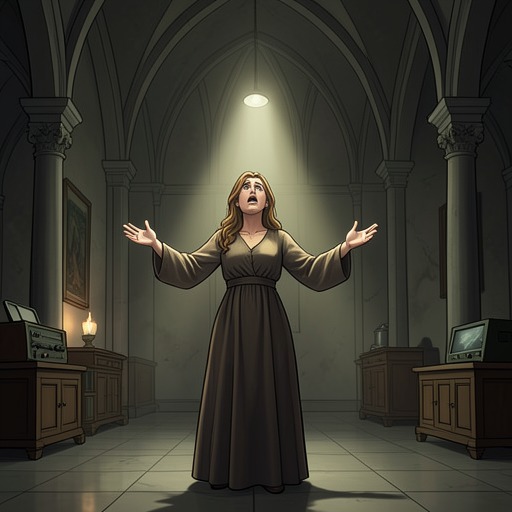
At first the chapel appears plain: a few chairs, a small altar, and otherwise bare walls. Then Emma looks up at three narrow stained-glass windows. Their colors transform the room for her. She experiences the light as the reason she has come and as proof that this is where she belongs. When she lowers her eyes, however, the shadows take on a threatening presence. Emma senses Honden, a large black, wolf-like creature waiting in a corner, although she knows she cannot actually see it. She fears it is coming for her and interprets it as a price she must pay.
Seeking something that will prolong the revelation, Emma fixes on a small statue of Mary holding a child. The child’s outstretched hand seems directed at her. Emma takes this as confirmation that she is safe in the chapel so long as the nurses do not find her. The belief turns concealment into protection: if she is hidden there, she can become invisible even to herself. When sunlight breaks through, the stained-glass colors spill across the floor, her body, and the statue. Emma experiences herself dissolving into the scene. The stones seem to become her skin, the window frames move with her breathing, and her heart seems to beat in the figure opposite her. In this moment, she understands herself as the key to the universe and feels that the circle is complete.
The transformation depends on light, but it does not hold. A woman lights a candle and a man puts money in a collection box; people sit down and leave while Emma remains absorbed in the scene. Eventually the sun disappears behind rain clouds. The window that seemed like liquid gold becomes, in her perception, a set of roughly joined pieces of glass, and the statue is only an inanimate image. The chapel grows heavy and airless. Emma coughs and gasps, feeling that the air, the light, and the extraordinary certainty have all vanished. The reversal is not merely a change in mood: the same room that had promised safety now feels suffocating, and she has to leave.
Michiel and the Return to the Ward
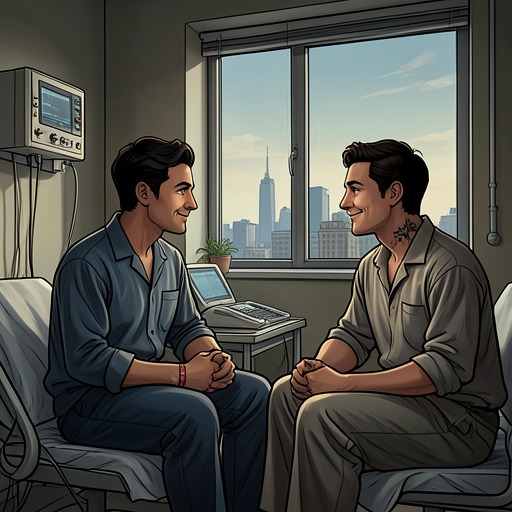
Emma rises stiffly and makes her way toward the door, which seems twice as far away as before. Just as she reaches for the handle, a tall figure stands up from a chair in the corner. It is Michiel, holding a cigarette packet. Emma is confused to see him and tries to speak to him; he replies that he had not known the chapel was there. His presence punctures the sense that the room is organized solely around Emma’s private revelation, though it does not immediately explain what has happened to her.
Michiel follows half a step behind as Emma leaves, moving as if she might flee. On the way past the Ziekenhuiswinkel, he notices the rubbish bin and the corner of a plastic bag protruding from it. He points out the magazine and stuffed toy Emma abandoned and asks whether she wants her things. Those objects, which she had used as cover while navigating the shop, now expose the practical trace of her frantic route. Michiel’s attention is understated: rather than confront her with the delusion, he helps her notice what she left behind and accompanies her out.
Retelling, Diagnosis, and Significance
The episode’s later significance lies partly in Emma’s difficulty telling others what has happened. When she returns to a conversation with Rajid, she begins by acknowledging that she behaved strangely at their previous meeting, but distinguishes this from the physical reaction she had to Tegretol. She eventually tells him that she sometimes sees Slangen. Her account of an earlier incident on a narrow country bike path describes how a snake repeatedly seemed to appear where a branch was, returning whenever she stopped concentrating. The disclosure shows that the chapel episode belongs to a wider pattern of perceptions she has not readily shared with her clinicians.
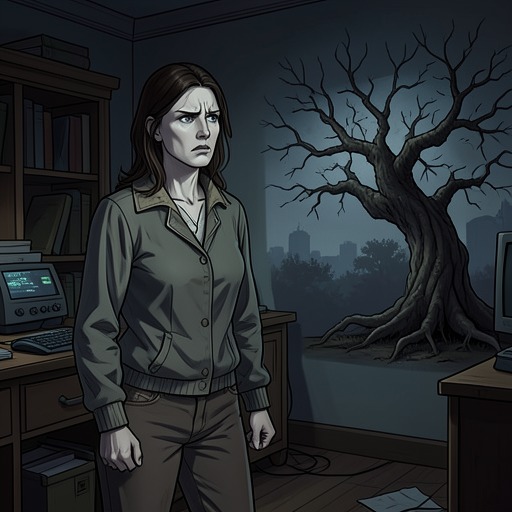
In a later confrontation with Lars, Emma resists having those experiences reduced to a list of unusual objects or mistaken perceptions. Her emphasis is on the shock and fear produced when the world seems to have changed while she was not looking, like finding that a television guide has inexplicably moved. That account clarifies what the chapel scene dramatizes: the distress lies not only in seeing Honden or reading a message into stained glass, but in losing confidence about what is happening and what can be trusted. Emma has concealed hallucinations partly because she fears how others will respond, leaving those around her with only an incomplete picture of her experience.
The episode also sets revelation against depression without suggesting that either state is a simple, self-contained interval. Emma’s earlier description of the fog lifting presents clarity as overwhelming and total; her later reflection on depression describes time itself as swallowed by despair. At the chapel, the brilliant present seems to abolish ordinary limits, only for darkness and fear to return. The episode’s movement from mission to revelation to retreat therefore resists a neat recovery narrative. Its decisive change is that an intensely private experience becomes something Emma will later begin to name, even as explaining it remains difficult.