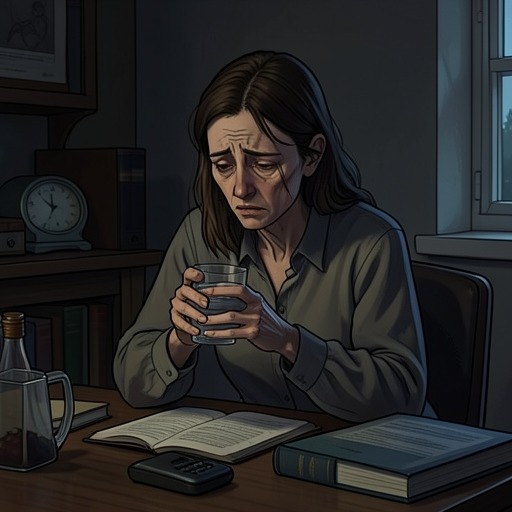
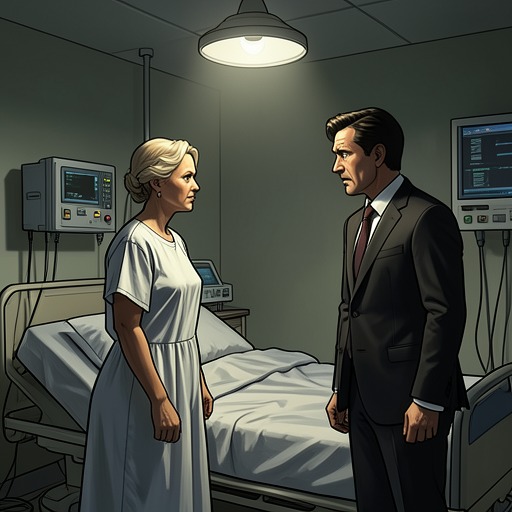
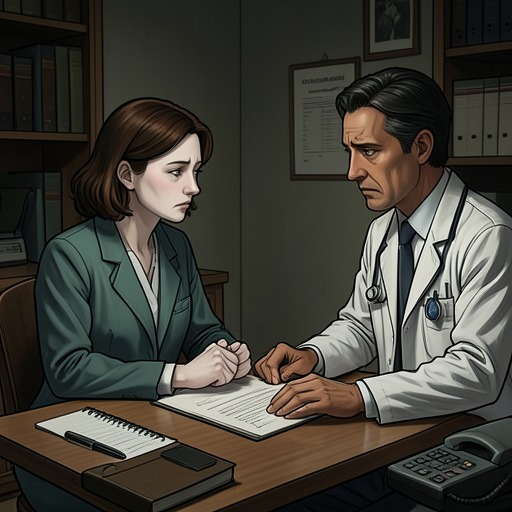
Emma receives a bipolar diagnosis
UpEmma’s bipolar diagnosis marks a turn from hoping that depression will simply stop returning to recognizing a long-standing pattern of illness. The diagnosis does not provide a cure or an easy explanation for every experience; instead, it makes the instability visible in her mood records and forces her to reconsider what counts as a normal day, what support can accomplish, and how she can live beyond the PAAZ.
From Episodic Depression to a Diagnosis
Before the diagnosis, Emma could imagine depression as a kind of mental flu: unpleasant but temporary, with the possibility that an episode might eventually skip a year or never come back. That hope changes when she looks again at her mood forms. Their marks wander across the page, recording not a steady return to health but repeated movement between depression and hypomania. The moments on the normal line do not feel like secure wellbeing when she considers the surrounding entries; they feel like brief pauses in a continuing pattern.
The records make the diagnosis emotionally consequential. Emma had previously been able to separate depression from the rest of her life and hope for a future without it. A bipolar framework suggests that the elevated periods are also part of the problem. She asks, in effect, where she can locate a self who is neither unwell nor a risk or burden to other people. Her distress is not simply resistance to a label: it comes from seeing the marks accumulate and understanding that the label may describe a life in which normality has been rare.
Experiences the Diagnosis Reframes
Emma’s account to Rajid Panjani shows why a symptom list cannot convey the force of her episodes. During a period of suicidal certainty, she recalls feeling little in response to news that her psychiatrist’s husband had died. Her attention had been consumed by an idea that she had to die, which seemed to her not like a suicide plan but like an inevitable beginning. Death itself receded as a fact; in its place came a sense of universal unity, calm, and extraordinary clarity. She believed that dying would let her move on to what mattered: work and productivity. The conviction felt emotionally real even though she could recognize that its logic did not hold.
That distinction between knowing and believing also shapes her descriptions of psychotic experiences. Rajid explains the difference between hallucinations, in which perception is altered, and delusions, in which ordinary perceptions acquire false meanings. Emma says she has experienced both kinds of disturbance, and recounts believing she could fly. The belief did not arrive as an obviously implausible thought; it felt to her like a return to how the world had always been meant to be. Her brain seemed not merely to interpret reality but to make a new reality that everything else had to fit.
The diagnosis also gives a framework to the contrast between her states without making them interchangeable. Emma describes mania as an intense present in which the feeling must never end, while depression erases the sense of time and leaves the sufferer seeing only depression in every direction. Elsewhere, a returning memory of despair takes her back to the depth beyond a balcony. These accounts show the diagnosis encompassing both an energized, compelling certainty and a depressive state marked by depletion and the return of old pain.
Disclosure and Relationships
Emma tells her mother that she has received a new diagnosis in addition to Asperger syndrome: bipolar disorder, or manic depression. Her mother already knows that Elise has mentioned it, and Emma says Elise calls regularly, though she does not always manage to call her back. The disclosure therefore places the diagnosis within a family network that is already trying to understand what it means, while also exposing the limits of Emma’s ability to keep up with those closest to her.
The diagnosis is entangled with the practical question of safety. Emma tells her mother that Sergei took more than three weeks and two conversations with Rajid before he removed her stored medication, and that he did so reluctantly. Emma experiences that reluctance as a sign that he may not take her illness seriously. Her mother offers another possible interpretation: minimizing the danger may be Sergei’s way of protecting himself from the fear that Emma could die. The exchange does not settle their disagreement, but it shows how a diagnosis affects intimate relationships as people struggle to interpret both illness and the precautions it requires.
Emma’s conversations also put her experience beside that of Beatrice, who says that medication was followed by the loss of her felt connection to God. Emma cannot claim to share that experience, but tries to understand it through the possibility that depression can consume the energy needed for belief. This encounter underscores that a psychiatric framework does not make every person’s suffering identical: the diagnosis helps Emma name her own shifting states, while Beatrice’s distress has a different spiritual meaning.
Living with the Diagnosis
The decisive change comes when Emma presents her mood form to Rajid and asks him to let her go. She does not mistake leaving the PAAZ for being cured. She expects that she will become hypomanic again and then depressed, with only a few better days between those states. In her view, medication may soften the peaks, but her rapid cycling will continue; neither the hospital nor Rajid can make her well in the sense of removing the condition.
Emma instead defines help as intervention when she can no longer protect herself. She recognizes that support has mattered, while insisting that remaining in the PAAZ is not a life she can continue. Her account shifts from hoping for a final, illness-free recovery to facing the recurrence directly and considering how to live with it. The diagnosis is significant not because it resolves the tension between autonomy and protection, but because Emma can name that tension and ask to leave while acknowledging that future crises may require others to step in.