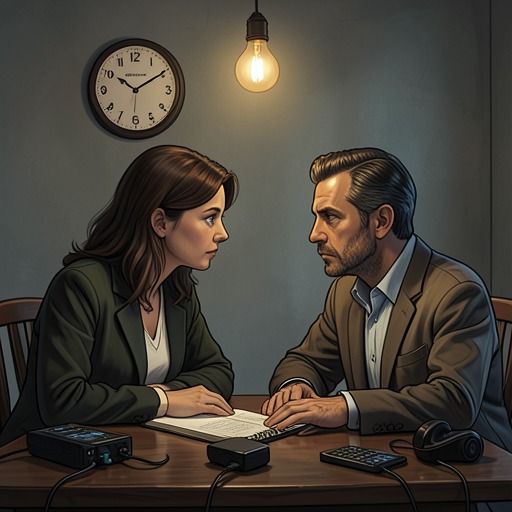
Lars apologizes to Emma and reopens discussion of their therapeutic relationship
UpLars apologizes to Emma and reopens discussion of their therapeutic relationship after she confronts him about how he responded to her readmission, bipolar diagnosis, and disclosure of hallucinations. The encounter matters because it shifts the problem from whether her experiences fit a label to whether her therapist will listen to their effects—and because Emma accepts his apology while keeping a crucial part of her recent crisis to herself.
Causes and Background
The rupture grows out of a conversation earlier that day. Emma had told Lars that she sometimes saw or heard things that were not there and felt ashamed to disclose it. He questioned whether her experiences qualified as genuine hallucinations, since she often knew that what she saw was not real, and said he had never recognized bipolar disorder in her. To Emma, this response did not merely dispute terminology: it made her feel that the distress she had risked describing was being judged before he had asked what it was like to live with it.
The disagreement sits within a frightening change in Emma’s mental state. She had been depressed for months, then experienced a sudden, compelling conviction that she had to die. At the time, she did not understand this as a suicide plan in the emotionally charged sense others might assume; it felt like an unquestionable task, and she imagined that removing herself would let her return to work and productivity. That gap between the force of her experience and the way others interpret it helps explain why the diagnosis—and Lars’s response to it—carries such weight.
Emma had also recently tried to describe her unusual perceptions to Rajid. She recounted repeatedly seeing snakes on a narrow country bike path, concentrating until each apparent snake resolved into a branch, then seeing it as a snake again when she stopped concentrating. The problem was not simply identifying the object correctly. The experience unsettled her confidence in what she was seeing and in her ability to keep that uncertainty hidden. By the time she meets Lars, she is trying to explain not only what appears to her but what it costs to keep testing reality alone.
The Confrontation
Lars arrives outside his usual working hours because the nursing staff have told him Emma was upset by their previous conversation. His manner strikes her as casual and brusque: he invites her to speak freely without first showing that he understands what is at stake. Emma’s anger rises as she recalls the remarks that hurt her, including his doubts about the diagnosis and his response to her admission. She repeats them in sequence, then waits, fearing that he will say she has misunderstood or once again got everything wrong.
Instead, Lars listens and acknowledges that, taken together, his words sound different from what he intended. He says he was trying to express concern and does not mean to abandon her. He admits that hearing she had been admitted again shocked him; he had not expected or hoped for it. Crucially, he recognizes that his shock was his own feeling, not something Emma should have had to carry, and that it did not excuse the way he reacted. His apology answers the immediate injury without pretending that the injury was imaginary.
Emma then returns to the diagnosis. Lars says that he is wary of diagnoses and more concerned with what a person is suffering from in the moment. He has not seen manic depression in her, he explains, and does not want a label to outweigh the person. Emma objects that a condition can be real without being visible to a therapist: it is in her mind, and she may have lived with it for half her life without anyone knowing. A diagnosis is not valuable to her as a name alone; it may help make better treatment possible. What she cannot accept is being encouraged to examine her difficulties and then having that examination dismissed.
Making Experience Speakable
Emma points out that Lars has not asked what troubles her. He pauses, then asks what she experiences when she is affected by things that are not there. She stops herself from answering directly, refusing to describe the images in a conversation that still feels unsafe. Instead, she explains the disorientation through the example of a television guide that has moved when nobody else has been in the room. What matters is not the missing object by itself but the shock, stress, fear that it will happen again, and anger and helplessness at being unable to stop it. Even while experiencing that distress, she tries not to let anyone notice, because a misplaced guide might also make her fear that she is losing her mind.
The analogy lets Emma describe the burden without turning the conversation into a debate over whether a snake, cat, branch, or imagined pursuit meets a technical definition. She is asking how to live with repeated disruptions in what seems real. Lars initially distinguishes a hallucination from losing a television guide, but then allows that the experience may feel the same to her and that they should discuss the distress it causes. He again apologizes for the earlier conversation, this time recognizing that he did not know how his words had landed. Emma accepts the apology, though not without reservation.
What the Apology Repairs—and Does Not
Emma still wants to understand why Lars reacted so strongly when, as she sees it, her admission, diagnosis, and condition were already in her file. His answer changes her reading of the encounter: he had not read her records. He could have read other people’s accounts and interpretations, but wanted to let Emma explain what had happened in her own words. This is a significant act of restraint, yet its timing complicates its meaning. She realizes that he had offered her a chance to speak, but she also remembers the rail of a bridge and the cold reaching deep into her bones—a recent crisis she does not tell him about. She answers that the chance has been given, while keeping that part of her story private.
The scene therefore closes with partial, not complete, reconciliation. Emma appreciates that Lars apologizes and is relieved that he does not insist she imagined the hurt, but her doubt remains: she cannot fully understand why the bipolar diagnosis provoked such a different response from the depression and personal difficulties he had already known about. The encounter makes room for a more useful therapeutic conversation by shifting attention toward her lived distress, yet it also shows how shame and fear can restrict what she is able to disclose. The apology repairs a breach in trust enough for dialogue to continue; it does not make Emma’s experience transparent, or guarantee that she will feel safe enough to tell him everything.