Sergei removes Emma’s stockpiled medication
UpSergei’s removal of Emma’s stockpiled medication is a conflict over both immediate suicide risk and the meaning of taking that risk seriously. When Rajid discovers that the pills are still at Emma’s home, the practical question of where they should go becomes a test of whether an agreed safety measure will actually be carried out—and whether Sergei understands why it matters.
Discovery and Background
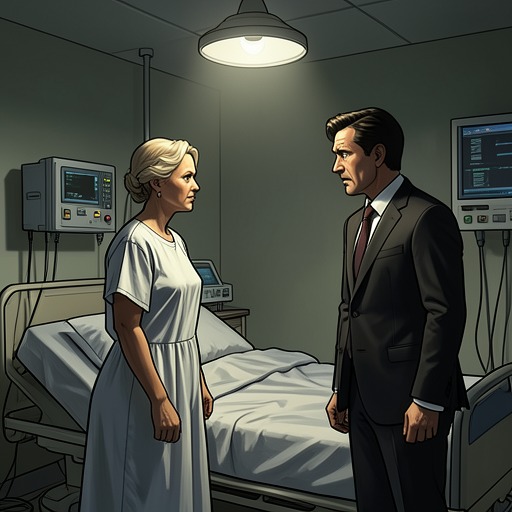
The disagreement surfaces in a conversation with Rajid after Emma has been away from the PAAZ. Rajid turns to Sergei in disbelief: the medication they had agreed should be removed is apparently still at Emma’s home. Emma looks down at the table and clarifies that she has not been home. Sergei’s silence leaves Rajid asking whether the pills are still there, while Emma’s brief answer makes clear that leaving the hospital has not meant returning home.
When Rajid asks why he has not removed them, Sergei explains that Emma had seemed substantially better. He thought it would be wasteful to dispose of medication she might need again. His explanation sets the practical logic of a household against the psychiatric logic of crisis prevention: the pills look like a useful supply if the danger has passed, but their presence matters precisely because Emma’s condition can change.
Rajid’s Safety Argument
Rajid reminds Sergei that Emma was admitted during a crisis after collecting a large quantity of medication with the intention of taking it all at once. The danger, he explains, is not only the possibility of another crisis but the ease with which Emma could act if the means were already close at hand. Before building the stockpile, she would have had to visit multiple pharmacies over two days; with the pills gathered, they would be available within minutes.
Rajid describes psychiatric prevention as an effort to raise the threshold for suicide as far as possible. Emma’s stockpiling had nearly removed that threshold. This makes the proposed disposal more than routine tidying or a judgment on whether she currently appears well: it is meant to put distance between a future crisis and an immediately available means of acting on it.
Sergei asks whether he could simply take the pills to his own home. Rajid rejects that compromise. If the medication remains with Sergei, Emma has not truly been separated from it; it is still part of her life and could remain accessible. Rajid says the pills must be gone, whether they are discarded, returned to a pharmacy, or handed in at the hospital. The destination is flexible, but keeping them in either home is not an acceptable solution.
Agreement and Immediate Aftermath
Rajid makes clear that if Sergei cannot manage the removal, he needs to know at once so that another arrangement can be made. After a silence that seems to Emma to stretch on, Sergei says he will clear the pills away. Rajid asks him to confirm that he is certain and requests that he tell either Emma or Rajid that same day once the medication is gone. Sergei agrees, though his response does not sound wholehearted.
Emma feels relief and disappointment together. The agreement means the pills are finally to be removed, but the resistance that preceded it leaves her expecting a quarrel; she recognizes that this is how she and Sergei end up fighting. Rajid ends the discussion for the day, while offering to meet with them again. Sergei then asks when Emma can go home, bringing the conversation back to discharge even as the unresolved safety issue has only just produced a commitment.
Delay and Relationship Consequences
Emma later explains the dispute to another patient as a problem with pills, carefully distinguishing it from Sergei’s having a drug problem or being depressed. Her account adds the consequence that the meeting’s promise alone does not convey: it took more than three weeks and two conversations with her psychiatrist before Sergei finally removed the medication, and even then he did so reluctantly.
For Emma, the delay carries a relational meaning as well as a practical one. It makes her feel that Sergei may not take her seriously, or may still not believe that she is genuinely struggling. The other patient offers a different interpretation, suggesting that minimizing the seriousness of Emma’s problems could be Sergei’s way of protecting himself from the possibility that he had nearly lost her. That is presented as a possible explanation, not as a settled account of Sergei’s motives. The event therefore remains emotionally unresolved: the medication is eventually removed, but compliance does not erase the hurt caused by having to press for the danger to be acknowledged.