Emma’s reconciliation with her mother
UpEmma’s reconciliation with her mother grows out of a visit that begins with questions neither of them has managed to ask. In the hospital restaurant, Emma discovers that her mother’s distance during an earlier admission was bound up with repeated pregnancy losses in the same building, not shame about her daughter’s illness. The revelation changes how Emma sees both her mother’s past and her own place in the family; an embrace leaves her feeling, briefly but unmistakably, found.
A visit clouded by uncertainty
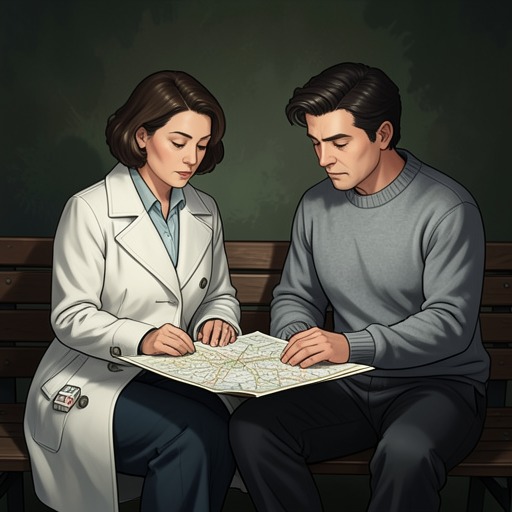
When Emma’s mother visits during Emma’s fifth week in the PAAZ, Emma is unsure what she feels. She walks to the hospital restaurant, finds a table by the window, and orders two teas. She can imagine being glad, but part of that feeling seems to be triumph over Pieter, who had suggested that her mother stigmatized her. Without that argument to react against, Emma cannot tell whether she is glad at all. After the events of the weekend, her mind still feels bruised; Michiel has disappeared, and no one has seen Beatrice. The visit takes place amid the unsettled daily reality of the ward, not after a clean recovery.
Leny’s question about how Emma feels about her mother’s visit stays with her as she walks. Emma’s uncertainty matters: she is not entering the conversation with an uncomplicated expectation of comfort or reconciliation. Instead, she has to work out what she feels while sitting across from the person whose absence has become a painful question. The two cups of tea make the meeting concrete, but do not make its emotional purpose clear in advance.
The family’s other crisis
The conversation turns to David, who is also in hospital, on a ward where Emma’s mother believes he is being well cared for. She tells Emma that he was admitted a few weeks earlier, on the day Emma called Elise to say that she herself had been admitted. Emma is shaken by the news. She recalls a lifetime of wishing she had one fewer brother, then recoils from the reality of what has happened: not this way. Her question about why no one told her exposes how much of the family crisis she has experienced from a distance.
Emma’s mother asks whether Emma might accompany her to visit David after leaving the PAAZ, and only if she feels ready. She explains that Emma knows from the inside how a ward works and what to look out for, whereas she is an outsider. The request gives Emma a possible role in her family’s present crisis, but it does not erase her own needs or make her responsible for David’s care. Emma is moved by the thought that her experience as a patient might help her brother and mother. She agrees.
The absence explained
The central question arrives when Emma asks why her mother did not visit during Emma’s previous admission. Her mother initially remembers having visited, and Emma allows that it may have been once or twice, but says she was not visited on the PAAZ or elsewhere in the hospital. The question carries the suspicion Emma has been left with: perhaps her mother was ashamed of her. Her mother answers emphatically that she has never been ashamed and would not be, no matter how many further admissions Emma might have.
Then she explains what the hospital means to her. Before Emma was born, she had difficulty becoming pregnant and staying pregnant, and she suffered three miscarriages. Each happened in this hospital. Although the losses were years ago, seeing the building still makes her feel sick and makes her grieve as if she were losing a child again. She connects that history to Emma’s admission: leaving her daughter there felt, in some painful sense, like losing another child. The explanation does not make the earlier absence painless, but it changes its meaning. Emma had interpreted distance as possible rejection; her mother describes avoidance shaped by grief and by the unbearable association of the place itself.
A shift in perspective
Emma responds that she came back. In that brief exchange, the hospital is no longer only the place where her mother could not bear to visit her; it is also the place from which Emma returned. Her mother’s tears and the account of her losses let Emma imagine the other side of the family’s suffering. She recognizes her mother not only as the person who failed to appear, but as someone who had spent years trying to protect her children while facing an invisible enemy and feeling powerless to prevent their pain.
That recognition does not depend on Emma pretending that nothing hurt. She has also had to ask why Sergei resisted removing her stockpiled medication after her psychiatrist requested it. Her mother suggests that his reluctance may be self-protection: if he minimizes the seriousness of Emma’s problems, he need not face how close he might have come to losing her. Emma initially hears this as making her the danger, but her mother clarifies that it may be a way of warding off fear. Across these conversations, care appears alongside misunderstanding; concern does not always make another person’s choices easy to accept.
An embrace without a cure
After Emma agrees to accompany her mother to see David, her mother swallows and puts her arms around her. Emma feels, for a moment, no longer like a lost child; she feels found. The reconciliation is therefore both intimate and limited. It brings an explanation, a changed understanding, and a renewed gesture of connection, but it does not end Emma’s illness or settle the family’s difficulties. Her mother’s request looks toward a visit that will happen only after Emma leaves the PAAZ and when she is ready. The scene offers neither instant normality nor a promise that grief and illness have been overcome. Its change is quieter: Emma can understand her mother’s absence differently, and her mother can ask for her help without denying that Emma needs care herself.