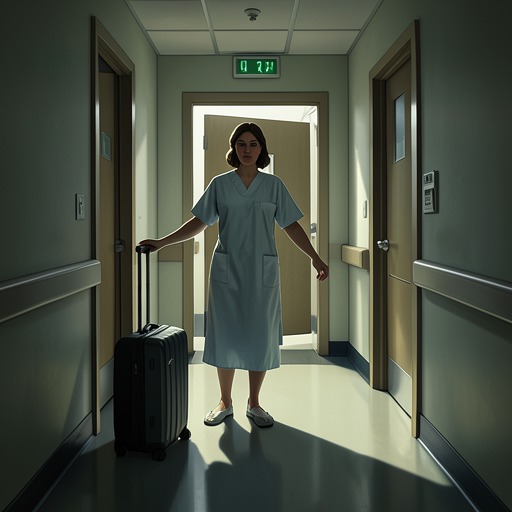
Emma leaves the PAAZ
UpEmma leaves the PAAZ by insisting that discharge need not mean cure. Although she is still depressed and expects her mood to keep shifting, she asks to go home, explaining to Rajid that the hospital can help by intervening when she cannot protect herself, but cannot make chronic illness disappear. The departure is therefore both a practical release and a change in how she understands care: she accepts support without surrendering the authority to live beyond the ward.
The decision to go home
Emma raises the prospect of returning home while discussing an increase in her medication. When Rajid asks about a timeframe, she names Friday. His hesitation follows from the reason for her admission: she had wanted to take all her pills, and he cannot accept a discharge plan that leaves that danger unaddressed. He would prefer her depression to have passed and her mood to be stable before she leaves.
Emma does not claim that she is well. Instead, she tells Rajid that things will get worse again. She traces the likely pattern ahead: hypomania the following week, depression the week after, and perhaps four better days in between. Waiting for that brief interval, she argues, would only create the appearance of a safe, definitive recovery. She identifies herself as manic-depressive with rapid cycling, and says that medication may flatten the peaks but will not stop her mood from changing. The PAAZ cannot cure her, and Rajid cannot make her better in the sense he hopes for.
Care without a promise of cure
The exchange turns on a difference between Rajid’s responsibility for a vulnerable patient and Emma’s knowledge of a life she has lived for years. She sees that he is looking at someone for whom he feels responsible: a person who may need protection from herself. She understands why that weighs on him, but also insists that this is not her whole identity. She has been this person for Sergei, her family, Rajid, Dokter Visser, the nursing staff, and the PAAZ; the illness is part of her life, but she must live it herself.
Emma describes the hospital’s useful role more narrowly and more concretely than a cure. Rajid can step in when she is no longer able to do so for herself. She acknowledges that this may sound like little, but says that it has been enough and that his help has mattered enormously. She has lived with manic-depressive illness for half her life and believes she can continue to live with it, but not in the hospital. Her request to leave is thus not a denial of risk or a rejection of help. It is a boundary around the form and duration of that help.
Mood, memory, and the limits of stability
The decision gains force against Emma’s descriptions of depression and mania as different experiences of time. In mania, the present expands until it seems to displace both past and future; in depression, the past and future collapse into a single field of despair, with no meaningful sense of what she is waiting for. This account makes Rajid’s wish for a stable departure understandable, while explaining why Emma sees a temporary good interval as an inadequate measure of her life ahead.
Her insistence on going home also follows earlier accounts of how difficult it is to explain a changed state of mind to a psychiatrist. She compares emerging from the fog of depression to suddenly seeing the world’s scale and reality differently, a perception that feels clear to her but is hard to convey to someone who has not experienced it. Elsewhere, she describes trying to resist a painful memory during the night, only to break down as the remembered feeling returns, connected to the depth beyond the balcony. These recollections give weight to her recognition that illness can recur; they do not make discharge a claim that the danger or the memory has vanished.
Discharge and its unfinished feeling
When Emma meets Dokter Visser, she clarifies that she is going home that day and has come only to collect her prescriptions. She describes her status as that of an outpatient again. The practical change is clear even as Dokter Visser appears distracted by her own bereavement, which Emma acknowledges after noticing her expression.
Emma accepts an envelope and examines a small pill device with a blade for halving a tablet and a compartment for crushing it. She declines it with a smile, saying she does not think she needs it anymore. The refusal marks a specific object as part of the transition out of treatment, but the scene does not present departure as simple certainty. Looking around the office, she thinks that the PAAZ is better at receiving people than letting them go. Karel asks whether she has everything. Emma checks her work bag and laptop, an orange weekend bag of clothes, and Sergei’s scarf around her neck, then hesitates, unsure whether anything else remains to be done. She leaves the ward as an outpatient, carrying both the practical equipment of ordinary life and the uncertainty of an ending that cannot promise stability.