Emma’s first PAAZ admission
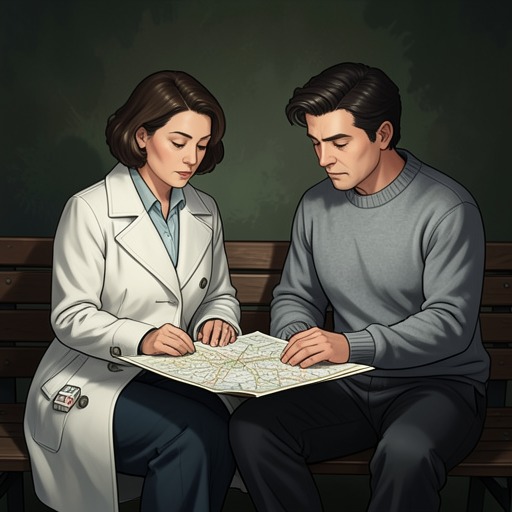
UpEmma’s first admission to the PAAZ lasted five months, beginning when she was depressed and wanted to die. Recalled two years later during another admission, it is both a clinical turning point and a memory Emma cannot fully retrieve: the ward’s familiar setting returns, but the original experience survives mostly as fragments, fear, and a sense of being overwhelmed. The contrast between the frightened patient she was and the more prepared patient she has become gives the event its lasting significance.
Causes and Background
Emma’s first stay occurred before anyone understood what was driving her condition. During a later meeting, Rajid discovers that he had admitted her two years earlier, shortly before she left the PAAZ. Emma confirms that the admission lasted five months, but she remembers little of the day that began it. What remains is not a clear account of the decision to hospitalize her, but the knowledge that she had been depressed and wanted to die.
The later explanation changes how that earlier crisis can be understood. Rajid tells Emma that she has Asperger syndrome and that autistic people, including her, can respond to stress with depression. With that diagnosis, the clinicians have a direction in which to look and can take her needs into account. It does not erase the earlier suffering or make the first admission retrospectively simple; it supplies a framework that was unavailable when she first arrived.
The Admission and Its Return
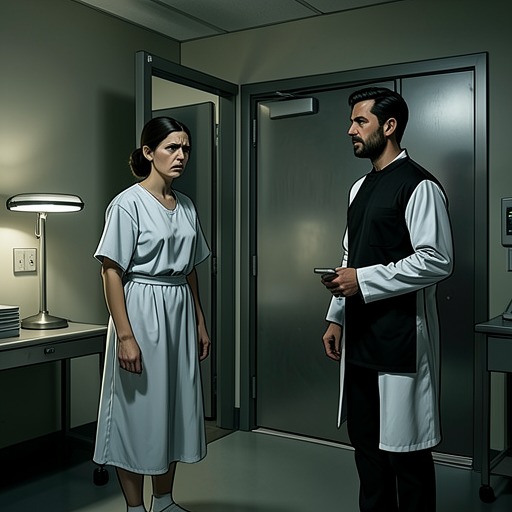
The first stay is recalled against the immediate reality of Emma’s return to the ward. The PAAZ is not an abstract place to her: its worn linoleum, the subdued murmuring of patients in the hall, and the characteristic smell of dust, dryness, disinfectant, and fear make recognition physical. That sensory familiarity turns entry into a threshold. Emma panics and pleads that nothing is wrong, unsure whether the crisis has truly happened or whether it might still be possible to deny it. Rajid steadies her with a firm handshake and reassures her that she is not crazy and that they can help her find her way back together.
That present-day arrival clarifies what the earlier admission meant without supplying a complete record of it. The first time, Emma felt as if she had been thrown into deep water and overturned by the first wave. She was afraid and had no distance from what was happening. On her return, she still fears the ward, but knows what to expect. The difference is not that admission has become pleasant or that the danger has vanished; she feels more able to face it.
Memory, Depression, and Time
Emma’s account of her earlier illness is marked by gaps. The day of the first admission has nearly disappeared from memory, leaving only a few disconnected phrases. Later, during a night on the ward, she tries to resist remembering and then breaks down. The memory that comes is larger than a single admission: depression has, in her description, followed her through life, draining her until only fragments of herself remain, still clinging to life while being pulled deeper. She associates that depth with the drop beyond a balcony. The image conveys the extremity of her despair, but the passage does not turn it into a detailed account of what happened during the first stay.
The book also sets the depressive experience against a changed sense of time. Emma reflects that mania seems to escape both past and future because only the urgent present matters, while depression lets the past consume the future and submerges both in hopelessness. In depression, whichever direction she looks, she sees depression. This reflection helps explain why the first admission is difficult to narrate as a bounded episode with a clean beginning and end: the illness itself distorts the sense of duration and possibility.
Changed Understanding and Narrative Significance
At first, Emma reaches for an uncomplicated description of her present condition, saying she is well and clear. Privately, that clarity is almost impossible to explain: she imagines trying to communicate to someone who cannot see what it is like to see, or to convey the scale of the universe hidden behind an ordinary-looking sky. The contrast between that expansive certainty and the earlier depression underscores how dramatically her inner state can shift, while also showing the difficulty of translating it into a clinical conversation.
The first admission’s meaning continues to be negotiated in later encounters. Emma eventually describes hallucinations and delusions to Lars, emphasizing that their deepest harm lies not simply in seeing a snake instead of a branch or believing that someone is pursuing her, but in the shock and fear of finding the world suddenly altered—and in worrying that the next thing lost might be her own grasp on reality. When Lars questions the relevance of the new diagnosis because he has not seen these experiences, Emma recognizes that he did not know about them because she had been afraid to tell him. Her account exposes the distance between a patient’s concealed experience and what a clinician can observe from outside.
Against that history, Emma’s return to the PAAZ is not a simple repetition of the first admission. She can see that the ward feels more like a small, old, calm lake than the violent sea she once encountered; she has written pages, and some rest and routine seem useful. But she is also clear-eyed about the possibility of worsening again. When she asks to leave, she does not promise that the illness will be over; she says it will get worse again. The earlier admission therefore remains present not as a resolved past, but as the experience through which Emma measures fear, recognizes recurrence, and understands that accepting help does not mean surrendering authorship of her own life.