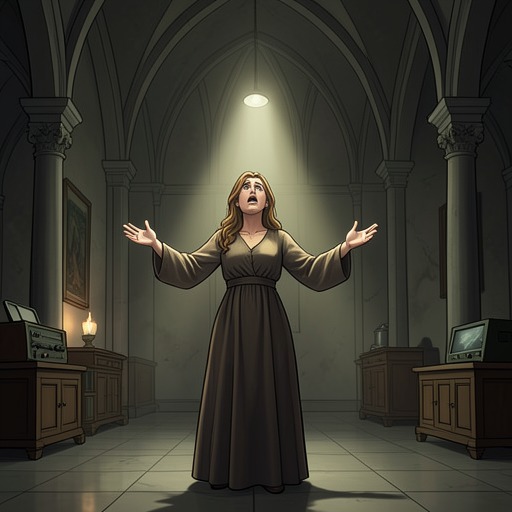
Michiel confirms he helped Emma in the chapel
UpMichiel confirms he helped Emma in the chapel during a conversation in the PAAZ garden that answers one question without resolving all the others. Emma has been struggling to distinguish hallucination from reality; Michiel’s confirmation matters not only because it establishes that he was present, but because it means she was not entirely alone in an experience she had feared might exist only in her mind.
Setting and Uncertainty
The question comes while Emma paces the garden beneath a thick gray sky that seems to threaten snow. She repeatedly touches the wall, walks fifteen paces to the garden wall, touches that, and returns. She has lost count, but counting is not the point: she is trying to think through a more unsettling problem. If her thoughts can be wrong, she cannot easily tell when reality differs from what she experiences as real.
Her doubts gather around particular images and places. She wonders whether there were therapy dogs on the PAAZ, recalls a walk with Karel, and questions whether wolves in the chapel and snakes on a path were ever there. The hospital shop raises another unresolved question. The chapel is therefore not an isolated memory but part of a wider uncertainty: Emma cannot tell which parts of her recent experience were hallucinations and which belonged to the shared world. Her question about Michiel is a search for an external point of reference, not simply a request to be reassured.
As Emma paces, she hears a metallic creak from the far corner of the garden. Michiel is pushing a bicycle out through the gate and pulling it shut behind him. The ordinary action gives her a reason to interrupt him, but also makes the choice immediate: she has found someone who might know what happened, and now she must ask.
The Question and Confirmation
Emma calls Michiel’s name, then hesitates as she tries to form the question. She asks whether he was in the chapel a few days earlier, when she was there. The pause matters: she wants the answer to be yes, but recognizes that confirmation would carry more than one meaning. If he was present, then someone saw what was happening; if he was not, she would have to keep facing the possibility that her memory had supplied another person as well as the episode itself.
Michiel confirms that he was nearby. He says Emma was acting strangely and had not even seen him. His account is plain and limited. He does not reconstruct the whole chapel episode, explain what Emma perceived, or settle the truth of every other image she has questioned. It does, however, establish that Michiel was a real witness to her distress, rather than a figure present only within the experience she is trying to test.
Emma tells him that she is glad he was there. She says this is partly because it means she is not crazy, but also because it means she was not alone: somebody was there trying to help, or at least keeping watch over her. The distinction she draws is significant. Proof of another person’s presence cannot by itself answer every question about her mental state; it can answer the more immediate fear that no one saw her when her mind’s rules changed.
Recognition, Shame, and Relief
Emma understands this as a first of a particular kind. It is not the first time someone has been nearby while her brain changed the rules, but the first time she believes someone noticed what was happening. Being seen is therefore both frightening and embarrassing. It also creates a small opening: amid the fragments of the episode, she suspects that Michiel was real.
She thanks him. Michiel shrugs off the importance of what he did, explaining that he was nearby and that she seemed strange. Emma turns quickly to the bicycle, telling him it cannot be parked in the garden. He replies by questioning whether it is even his. The exchange lets them move away from the exposed question without undoing its answer. His ensuing smile strikes Emma as laughter at the PAAZ, the world, and life itself, rather than laughter directed at her. To her surprise, she smiles too.
That movement—from asking whether she imagined the witness, through the discomfort of being recognized, to sharing a smile—is the scene’s emotional turn. The relief she feels is intense, and she finds it impossible to describe. Spooky dogs, living images, messages in glass, and strange languages remain part of the surrounding confusion; Michiel’s confirmation does not make those uncertainties disappear. It gives Emma one concrete thing she can hold on to: he was there, and she saw him as a real person afterward.
Significance and Limits
The episode makes recognition a form of support distinct from explanation or cure. Michiel cannot tell Emma which perceptions were real, and the conversation supplies no complete account of what happened in the chapel. What it supplies is narrower and, for Emma, consequential: another person observed her at a moment when she herself could not reliably interpret what she was experiencing. Her gratitude is directed toward that presence and attempted help, not toward a definitive diagnosis of the episode.
The scene’s hope is deliberately small. Emma wonders whether things may yet work out, but the moment offers relief rather than proof that her difficulties are over. Elsewhere, she struggles to explain an altered sense of clarity even to a psychiatrist; later, depression returns her to a remembered depth beyond a balcony, and she describes depression as swallowing the future along with the past. Those contrasting experiences underline why Michiel’s confirmation matters without making it a resolution: a single reliable encounter can puncture isolation, even when it cannot stabilize reality or time as a whole.
In this exchange, the PAAZ garden becomes a place where Emma tests a memory against another person’s account. The result does not restore certainty to every disputed image. It changes the meaning of this one episode: someone was present, noticed her, and tried to help. The difference between being alone in a delusion and being witnessed through it is, to Emma, small in wording but immense in consequence.