Enclosure movement
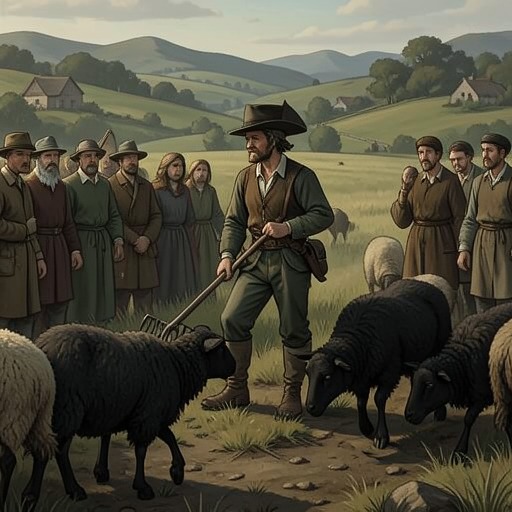
UtopiaThe Enclosure movement, as Raphael Hythloday describes it in Utopia, is a transformation of inhabited and cultivated land into private pasture that concentrates wealth while driving rural families from their homes and work. Its force in his argument lies in the chain it sets in motion: expanding sheep pasture displaces people, weakens agriculture and local production, raises the cost of food and wool, and leaves those without work exposed to begging, imprisonment, or execution for theft. Enclosure is thus not merely a change in land use; it becomes evidence that severe punishment cannot be just when social arrangements help create the crimes being punished.
The Argument at John Morton’s Table
Raphael introduces enclosure during a discussion of England’s punishment of thieves at a dinner with John Morton, then Cardinal and Chancellor of England. A lawyer praises the severity of the law, noting that thieves are hanged so frequently that sometimes twenty are on one gibbet, yet theft continues. Raphael answers that the law treats the symptom while neglecting the circumstances that make theft a means of survival. In his account, people are punished for crimes to which their conditions have helped drive them.
His explanation begins with the growth of pasture, especially where sheep yield unusually fine wool. Aristocrats, gentlemen, and churchmen, Raphael says, want more from their estates than established rents and turn land towards profitable sheep-raising. He condemns not only their acquisition of wealth but the destruction of existing settlements and livelihoods: houses and towns are pulled down, while churches are left standing, and enclosed ground is reserved for flocks. The image of mild sheep multiplying across the countryside is reversed into a social accusation: pasture expands as human communities disappear.
Dispossession and the Loss of Work
The people displaced are not presented as a single class of tenants. Raphael describes owners and tenants alike being removed, whether by trickery, force, or treatment so oppressive that they are worn down and compelled to sell. Families include men and women, married and unmarried people, the old and the young, and children who make country households numerous because agricultural work requires many hands. Their displacement leaves them uncertain where to go.
They sell household goods for little, and the small sum soon runs out. People trained in rural work find that there is no longer arable employment for them where fields have been converted to pasture. The contrast in labor demand makes the mechanism stark: one shepherd can tend a flock on land that would have required many workers to plough and reap. A person willing to work may therefore be unable to find anyone who will hire them. If they beg, Raphael says, they risk being imprisoned as idle vagabonds; if they steal, they face hanging. The law labels the resulting poverty as idleness or crime without restoring the work that enclosure has removed.
Prices, Production, and Wider Poverty
Raphael links enclosure to rising prices and the weakening of several kinds of production. As arable cultivation declines, the price of corn rises. Higher wool prices also exclude poor people who formerly made cloth from buying the material, making them idle as well. The effects extend beyond sheep: villages are pulled down and country labor neglected, so fewer people breed other kinds of cattle. Wealthy landowners instead buy lean cattle cheaply, fatten them on their estates, and sell them at high prices.
That pattern, Raphael warns, could diminish livestock stocks if cattle are consumed faster than the breeding regions can supply them, producing serious scarcity. The warning is prospective: he says that not all the resulting harms have yet become visible. He also describes a sheep disease that destroys many animals, treating it as a consequence through which avarice is punished, though he remarks that it might seem more just for the losses to fall on the owners. Even when sheep survive and multiply, their price need not fall. Because the trade is concentrated in a small number of wealthy hands, sellers can wait and raise prices rather than sell when buyers need them.
These changes, in Raphael’s account, interact with other pressures. Rising corn prices encourage people to reduce the size of their households, leaving dismissed workers with still fewer options. Luxury in clothing and food, gambling, and other costly pastimes further drain resources, including among tradespeople and farmers. Enclosure is therefore one major cause in an accumulating crisis, not the only cause Raphael names.
Criminal Justice and Proposed Remedies
The argument returns to the law. Raphael rejects death as a proportionate or useful punishment for theft, especially when people have been deprived of ways to live. Harsh penalties cannot reliably deter those who see no alternative livelihood; instead, punishing them after social conditions have pushed them towards theft makes the state complicit in the outcome. His formulation that society first makes thieves and then punishes them binds the enclosure argument directly to his challenge to English justice.
Raphael proposes restoring the uses that enclosure has extinguished. Those who have depopulated the land should rebuild the villages they destroyed or lease their ground to people willing to do so. The concentration of land and wealth should be restrained; agriculture revived; and wool manufacture regulated so that work can be found for people made idle by want. These proposals address both the immediate loss of employment and the economic arrangements that allow a few owners to profit while whole communities are displaced. They also distinguish prevention from punishment: providing work and livelihood is, in Raphael’s view, more effective than boasting of severe executions.
Land Use and the Book’s Larger Tension
Raphael’s account is part of a dialogue framed by Thomas More, rather than a detached report of policy. Utopia presents its political and social proposals through a playful fiction whose discussion, as the book’s framing material emphasizes, is also intensely serious. At the close, the narrator says that he sees serious difficulties in Utopian customs, particularly common living without money, and cannot agree with everything Raphael has related. He nevertheless wishes that many features of the commonwealth could be followed. This qualification cautions against treating Raphael’s argument as an unambiguous final statement by the book.
The island’s own land policy also makes the question of use and possession more complicated. The Utopians send colonists to neighboring territory when their population grows and, if they find more soil than its inhabitants can cultivate, establish a colony there. They incorporate inhabitants willing to adopt their way of life, but drive out those who refuse and use force if they resist; they consider a nation’s refusal to leave unused land a just cause of war. Set beside Raphael’s condemnation of English landowners who displace settled communities for pasture, this policy does not yield a simple contrast between dispossession and justice. The accounts differ in who is said to leave land idle and what political order claims the right to use it, but both make land use a basis for judging possession. Enclosure consequently serves as a pointed example of how an economic reorganization of land can produce both material deprivation and the criminal categories used to punish the deprived.