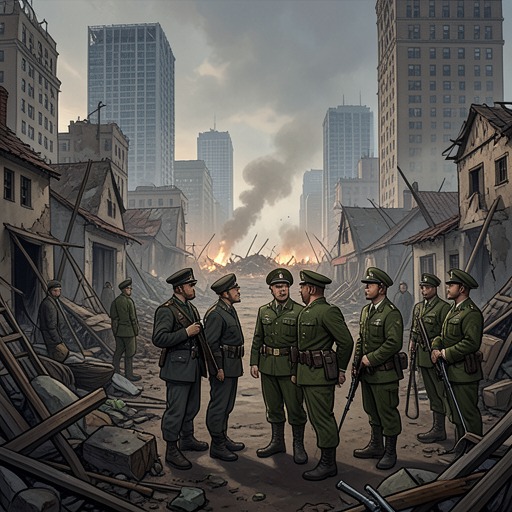
Utopian ethics of war
UtopiaUtopian ethics of war treats war as a grave failure of human conduct, not a source of honor, while allowing force when it is judged necessary to defend the Utopians or their friends, aid an oppressed people, or answer serious injury. Its distinctive ideal is victory won through judgment rather than slaughter, but the methods used to reach that ideal—including bribery, political subversion, and hired troops—make the doctrine more complicated than a simple rejection of violence.
Principles and grounds for war
The Utopians call war brutal and regard military glory as inglorious. They nevertheless train both men and women in military exercises, so that neither sex would be useless if necessity required defense. Preparation is thus distinguished from eagerness to fight: war is not to be entered rashly, but military readiness is maintained for emergencies.
They identify limited grounds for taking up arms. The Utopians may defend themselves or their friends against unjust aggressors, and may assist an oppressed nation seeking release from tyranny. They will support friends in offensive as well as defensive wars only after being consulted before hostilities begin, examining the grounds for action, and finding that demands for reparation have been rejected. In their account, fighting becomes permissible when the injury and refusal to remedy it have made war unavoidable.
The doctrine extends the idea of injury beyond invasion and the seizure of property by public order. It also treats the oppression of merchants through unjust laws, or through the perverse application of sound laws, as a cause of war. The Utopians consider this kind of grievance especially serious because legal forms can disguise the injustice. Their intervention alongside the Nephelogetes against the Aleopolitanes followed such a complaint: alleged mistreatment of merchants led to a destructive war that ended with the Aleopolitanes conquered and enslaved, despite their previous superiority to their opponents. The Utopians claimed no share of the spoils, but the outcome shows how a war undertaken in the name of redress could bring extensive devastation and subjection.
Their response depends on the kind of harm suffered. If their own merchants are defrauded without violence against persons, they prefer to stop trading with the offending people rather than go to war. They reason that the public bears the loss, while the exported goods are plentiful and of little use at home; the damage therefore does not warrant the deaths that retaliation might cause. If a Utopian is wrongfully killed or wounded, however, whether by public authority or a private individual, they send ambassadors to demand that the guilty be surrendered. Refusal leads to a declaration of war; compliance brings punishment of the offenders by death or enslavement.
Victory by calculation rather than slaughter
The Utopians count a bloody victory both shameful and wasteful. Their preferred triumph is achieved through dexterity and sound conduct without bloodshed, which they regard as a victory of human understanding over brute force. Their stated aims are to compel an adversary to grant what would have prevented the war, or, if that proves impossible, to punish those responsible severely enough to deter repetition. Security, rather than fame or vainglory, is presented as the governing purpose.
Their first major stratagem is to distribute sealed schedules in conspicuous places throughout enemy territory. These promise large rewards for killing the enemy prince and lesser sums for killing other leading figures; a still greater reward is offered for capturing a designated person alive and delivering that person to the Utopians. Those named may also be offered rewards and indemnity for turning against their own countrymen. The policy aims to corrode trust within the opposing leadership: targets grow suspicious of fellow citizens and jealous of one another, and even princes have sometimes been betrayed by trusted associates. Rewards include gold and revenues from lands in friendly countries, calibrated to the danger of the service, and the Utopians are said to honor their promises. They defend the scheme as a way to end a protracted war without risking a decisive battle and to avert the deaths of many ordinary soldiers by targeting a few leaders whom they consider responsible.
If inducements fail, they seek to divide the enemy through domestic rivalries, encouraging a prince’s brother or a noble to claim the crown. If internal conflict cannot be provoked, they draw neighboring states into the struggle by reviving old claims and supply them generously with money, but sparingly with auxiliary troops. This caution is explained as concern for their own people: they are reluctant to risk even one Utopian life in exchange for the enemy prince. The contrast is striking. They present subversion and purchased betrayal as merciful alternatives to mass battle, while accepting that those tactics deliberately create fear, distrust, and political instability among their opponents.
Allies, hired forces, and the limits of restraint
The Utopians reserve gold and silver for war and readily spend it when an occasion arises, since they see no advantage in hoarding it for themselves. Their wealth abroad includes debts owed by surrounding nations. They use this financial reach to hire soldiers from elsewhere, especially the Zapolets, a people described as accustomed to hardship and war. The Zapolets serve courageously and faithfully for as long as the terms suit them, but may change sides for better pay, even returning to a former employer if offered more. Their availability allows the Utopians to employ force while limiting the exposure of their own citizens, though the practice sits uneasily beside the stated aim of sparing lives and the claim that war should answer justice rather than advantage.
The Utopians set rules for conduct once fighting begins. They keep truces faithfully despite provocation, do not ravage enemy territory or burn its crops, and take care during marches not to let troops or horses trample the fields. They avoid harming disarmed people unless they are spies. When a town surrenders, they protect it; if it is taken by storm, they do not plunder it. Those who resist surrender may be killed and the rest of the garrison enslaved, while other inhabitants are left unharmed. People who advised surrender receive rewards from the estates of those condemned, and the remainder goes to auxiliary troops; the Utopians themselves take no share of the spoil.
These protections are substantial but conditional. Restraint toward inhabitants coexists with lethal treatment of those who oppose surrender and enslavement of captured garrisons. The rules distinguish among combatants, townspeople, advisers to surrender, and auxiliary forces rather than extending equal protection to everyone caught up in war. The doctrine’s humane claims therefore depend on its definitions of responsibility and resistance.
Aftermath and the work of peace
After a war, the Utopians do not require their friends to reimburse their expenses. Instead, they obtain payment from the conquered, either in money saved for future wars or in lands that yield continuing revenue. Their income from such territories has risen to more than 700,000 ducats a year. Utopian agents collect the revenues and live magnificently in the conquered lands, spending much of the income there; the remainder is brought home or lent to the people among whom it is held. These revenues also fund rewards for dangerous missions. The policy avoids charging allies but preserves the material proceeds of victory, so the refusal to take battlefield plunder does not mean renouncing long-term claims on defeated states.
They also try to keep war from reaching their island. If a prince prepares to invade, they seek to make his own country the theater of war rather than allow fighting to break into Utopia. If the island itself is attacked, they intend to defend it with their own people rather than call in auxiliary forces. This preference for fighting abroad reinforces their concern to protect their citizens, even as it places the costs of conflict on other territories.
The Utopian priests accompany armies in sacred vestments and pray near the battlefield first for peace, then for their own side’s victory, especially one won with little bloodshed. When victory turns toward the Utopians, the priests enter among their soldiers to restrain their fury. Enemies who appeal to them, or reach and touch their garments, are promised protection for both their lives and their fortunes. The priests have also intervened when Utopian armies were fleeing and their opponents were advancing to kill and plunder; by separating the forces, they stopped further bloodshed and helped bring about peace on reasonable terms. Their role gives practical form to the doctrine’s stated preference for limited violence: peace is not only an argument for entering war cautiously, but a task pursued even at the moment of victory.