Utopian labor system
UtopiaThe Utopian labor system treats work as a shared civic obligation and production as a public responsibility, rather than as a contest for private gain. Its defining arrangement is a six-hour working day supported by universal agricultural knowledge, training in a particular trade, and coordinated distribution of goods. The account presents this system as a way to provide material abundance while making time for study and other pursuits available to citizens; it also measures the system against societies whose labor, in its view, is wasted on idleness and luxury.
Universal Work and Agricultural Training
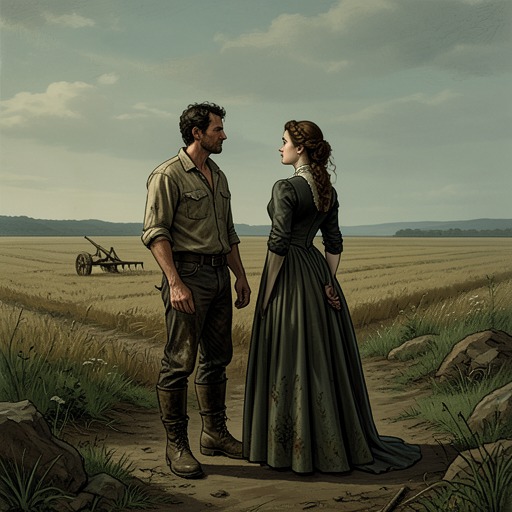
Agriculture is taught to everyone, women and men alike, from childhood. Instruction combines lessons at school with regular practice in the fields around each town, so that agricultural knowledge does not depend on a narrow occupational class. The emphasis is practical as well as educational: the population is meant to know how food is produced, and the account links this shared competence to avoiding mistakes that could lead to a shortage of grain.
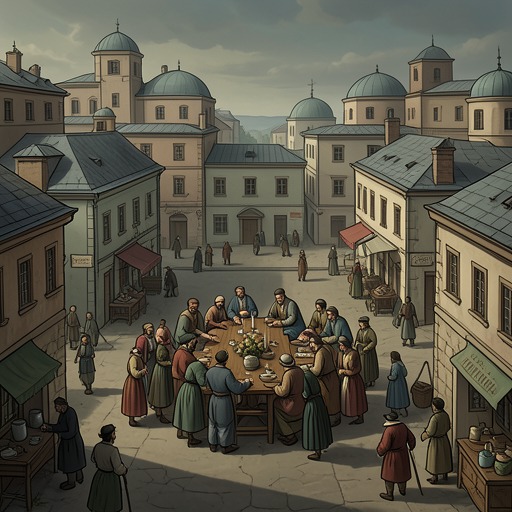
Agricultural work is organized through farmhouses across the countryside. Families from the towns take turns living and working there; a country household has at least forty men and women, as well as two slaves, and is supervised by a master and mistress. A magistrate oversees every thirty such families. Each year, twenty members return to town after a two-year stay, and twenty others replace them. Those who have already spent a year in the country teach the incoming workers, sustaining a cycle of instruction as well as labor. Although the rotation prevents anyone from being required to remain indefinitely in this demanding work, some choose to stay for years because they enjoy it.
Farm workers cultivate the land, raise cattle, cut wood, and transport it to the towns by land or water as convenient. Their production is part of an island-wide system, not an isolated rural economy: agricultural training, rotating service, and the movement of supplies connect town and countryside. The passage also describes agricultural work as broadly competent and continuously renewed, reducing the risk that a lack of knowledge will turn into scarcity.
Trades, Training, and Civic Oversight
Besides agriculture, each person learns a particular trade. The examples given include working wool or flax, masonry, smithing, and carpentry; no trade is presented as inherently more honorable than another. Families generally pass a trade from parent to child, but this pattern is not binding. Someone whose abilities point elsewhere may be adopted into a family that practices the desired trade, with the father and magistrate responsible for placing that person with a suitable teacher. After learning one occupation, a person may learn another; ordinarily, the individual follows the trade preferred, unless the public has greater need for the alternative.
The Syphogrants have a central supervisory responsibility: they ensure that people do not live idle and that each pursues a trade diligently. This oversight operates within a political structure that includes annual magistrates and safeguards against decisions being made precipitously. The Prince is chosen by secret votes cast by two hundred Syphogrants from a list of four candidates named by the city's divisions; the Syphogrants swear to choose the person they consider most fit. For important public business, proposals move through family and local deliberation before reaching the Senate or, on major occasions, the Council of the Whole Island. The rule against debating a proposal on the day it is first introduced is intended to let judgment cool before the council commits itself. Together, these arrangements place labor within a system of public administration and deliberation, rather than leaving its organization solely to individual employers or private households.
The Six-Hour Day and the Use of Time
The ordinary workday lasts six hours: three hours before dinner and three after it. The schedule divides the day and night into twenty-four hours, sets aside eight hours for sleep, and leaves the remaining time—apart from work, meals, and sleep—to individual discretion. That freedom has limits: leisure is not supposed to become idleness or luxury, and people are expected to use it in an appropriate activity suited to their inclinations.
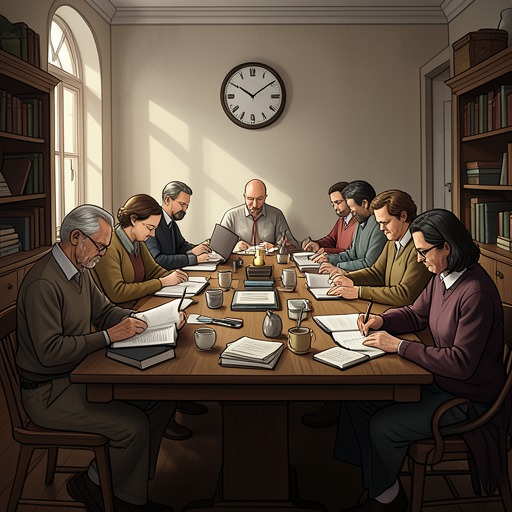
Study is one prominent use of this time. Public lectures are held each morning before daybreak, and those selected for scholarly work are expected to attend. Many other people, both women and men, attend lectures of their choice. Those who prefer to work at their trades instead are not prevented from doing so and are commended for serving their country. After supper, people spend an hour in recreation, in gardens in summer or in the halls where they eat in winter, with music or conversation. The described games include two forms resembling chess: one represents numbers consuming one another, while the other stages a contest between virtues and vices. In this account, recreation and learning belong within the organization of the day; they are not simply what remains after labor has exhausted the population.
Why Six Hours Are Considered Sufficient
The account anticipates the objection that six hours of work cannot provide enough necessities. Its answer is that scarcity elsewhere arises not simply from too little labor, but from how labor is distributed and what it produces. It points to people who do not work, including many women in other societies, idle husbands, priests and religious men, wealthy landowners and their households, and able-bodied beggars. It also argues that many trades exist to support luxury rather than meet useful needs. If more people worked and effort were directed toward necessary, profitable, or genuinely pleasant goods, it claims, far fewer working hours would be needed to supply society.
This critique also distinguishes between useful employment and activity sustained by monetary competition. Where goods are valued through money, work can be spent on vain or superfluous production; by contrast, the Utopian account presents public need as the standard for deciding what labor should accomplish. It reports that, even in a large city and its surrounding territory, scarcely five hundred people of working age and strength are not employed. Syphogrants work despite their legal exemption, setting an example. People selected for study may also be excused from ordinary labor, but those who do not fulfill the expectations that justified their exemption return to work. Conversely, an artisan who makes substantial progress in learning can be released from the trade and ranked among the learned. The arrangement thus allows movement between manual work and study, while treating both as contributions subject to public judgment.
Abundance, Distribution, and the Measure of the System
The claim that six hours suffice is tied to restraint in production and consumption. Buildings are repaired quickly and kept in good condition, reducing the need for new construction; when there is little other work, large numbers of people may be sent to repair highways. If no public undertaking needs attention, working hours are shortened. The magistrates are not supposed to impose unnecessary labor: the constitution's stated purpose is to match work to public necessity while allowing time for the improvement of the mind, which the Utopians regard as part of life's happiness.
Goods move through shared civic arrangements. Each town is divided into four parts, with a marketplace in the middle of each; families bring their products to appointed storehouses, where items of the same kind are kept together. A family member may take what the household needs without payment or exchange. The system relies on abundance and assurance of future provision to remove the incentive to take more than necessary: fear of want, the account argues, makes people greedy, while pride encourages them to outdo one another in display. Family structure and population rules help maintain the scale of this provision. Towns are not to exceed six thousand families, and households are generally kept between ten and sixteen people, with children moved between families when necessary.
Once a year, three representatives from each town meet at Amaurot to compare provisions and direct supplies from places with abundance to those facing scarcity. The island keeps stores for two years against unfavorable seasons. Surplus goods—including grain, honey, wool, flax, wood, wax, tallow, leather, and cattle—may be exported; a seventh of the goods sent abroad is given freely to the poor in the receiving countries, while the rest is sold at moderate prices. The account says the island needs little from abroad beyond iron. Trade therefore supplements, rather than governs, internal provisioning. Though it accumulates gold and silver through exchange, the Utopians do not treat money as the measure of everyday life: they regard iron as more essential and keep precious metals chiefly for exceptional needs, including war. Their labor system is presented as a linked whole: shared training and public coordination produce goods, common distribution answers need, and the reduction of unnecessary work makes room for intellectual improvement.