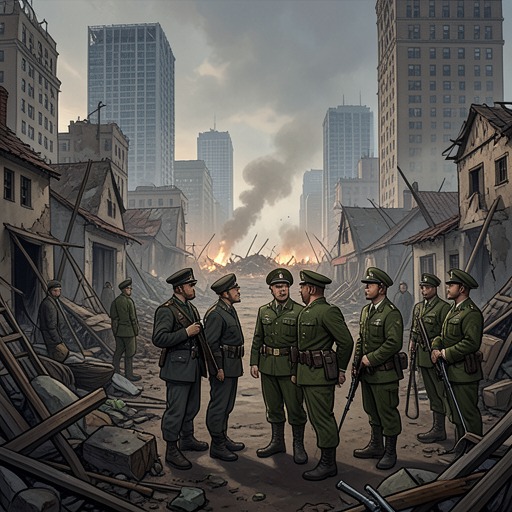
Utopian antiwar doctrine
UtopiaUtopian antiwar doctrine presents war as a brutal failure of human conduct, not an honorable arena for fame. The Utopians say they fight only to defend themselves or others from unjust aggression, or to help an oppressed people resist tyranny; even then, they prefer to force a settlement through strategy rather than battle. Their practices, however, include rewards for betrayal, efforts to provoke division among enemies, and extensive reliance on foreign mercenaries. The doctrine’s significance lies in this tension: its restraint is real, but it is pursued through methods that expose how far a society committed to avoiding slaughter will go to control the terms of conflict.
Principles and Grounds for War
The Utopians detest war as a brutal practice and reject the glory commonly attached to military success. They nonetheless train daily in military exercises, preparing both men and women so that neither would be wholly unprepared in a crisis. Preparation is therefore distinguished from eagerness: military readiness is a safeguard, while entry into war requires a stated cause. They identify defense against unjust aggressors and assistance to friends or oppressed peoples as legitimate grounds for fighting.
Their support for a friend’s offensive war is conditional rather than automatic. Before hostilities begin, the Utopians must be consulted; they examine the grounds for the dispute and require that demands for reparation have been refused, leaving war unavoidable. They regard injuries to merchants, including oppression under unjust laws or the perverse application of sound ones, as a particularly serious grievance. In their account, legal forms can disguise an injury instead of preventing it, so a wrong committed under color of law may provide an especially compelling cause for action.
The war fought alongside the Nephelogetes against the Aleopolitanes illustrates both the force and the danger of this principle. The dispute concerned what the Utopians considered injustices against Nephelogete merchants. The conflict drew in neighboring powers, damaged flourishing states, and ended in the Aleopolitanes’ conquest and enslavement. Although the Utopians had helped secure that outcome, they claimed no share of the spoil. The episode presents their doctrine as a response to perceived injury, but its consequences also show that a war undertaken for redress can expand far beyond the original commercial grievance.
Aims, Restraint, and the Meaning of Victory
The Utopians define the purpose of war narrowly: to obtain by force what, if granted in time, would have prevented war, or to impose such a deterrent consequence that an aggressor will not repeat the injury. They say that security, not public fame or vainglory, directs their plans. A victory won without bloodshed is therefore preferable to one secured through battle, and they honor success achieved by dexterity and sound conduct rather than by killing.
This preference shapes their response to injuries against their own merchants. If no violence has been done to their people, they may stop trading with the offending nation when satisfaction is refused, but they do not treat every commercial loss as grounds for war. The public bears such losses collectively, and the Utopians expect little from exported goods that they already possess in abundance. They judge the harm too limited to justify the deaths of many people. If one of their citizens is wrongfully killed or wounded, however, they demand that those responsible be surrendered. Refusal leads to war; compliance leads to punishment of the offenders, either by death or enslavement. The distinction makes bodily injury, rather than every material grievance, the threshold for a much more severe response.
Their conduct after fighting begins also gives practical form to the ideal of limiting harm. They observe truces despite provocations, avoid laying waste to enemy territory or trampling crops, and spare unarmed people unless they are spies. A surrendered town is placed under their protection; if it is taken by storm, they do not plunder it. Those who resist its surrender may be killed, and the remaining garrison may be enslaved, while other inhabitants are left unharmed. People who had advised surrender can receive rewards from the estates of those condemned, with the remainder distributed among auxiliary troops. The Utopians themselves take no share of the spoil. These rules restrain indiscriminate destruction, but they do not abolish coercion or punishment.
Subversion and the Cost of Strategy
When war is declared, the Utopians distribute sealed schedules in conspicuous places throughout the enemy’s country. The notices promise rewards for killing or capturing the prince and other leading figures, with a greater payment for delivering a target alive. They also offer indemnity and rewards to the named officials if they turn against their own country. Their intended effect is political as much as military: leaders become suspicious of one another and of those they trust, while fear and uncertainty weaken the opposing side. The promised rewards can be paid in gold and in revenues from lands among friendly nations, where recipients can live securely; the Utopians are said to honor these promises faithfully.
They defend the scheme as a means of ending a potentially prolonged war without risking a decisive battle. They also present it as a way to prevent the much greater loss of life that continued fighting would bring, reasoning that many ordinary soldiers are driven into war by their prince rather than choosing it freely. If inducements fail, they try to divide the enemy through internal disputes, encouraging a prince’s brother or a noble to seek the crown. If domestic conflict cannot be stirred up, they enlist neighboring powers by reviving old claims and supply them generously with money but sparingly with troops. In this account, avoidance of battlefield slaughter does not mean abstention from interference: the Utopians seek to break an enemy’s capacity to fight by manipulating its political relationships.
Mercenaries and the Limits of Restraint
The Utopians keep gold and silver for wartime use and draw on a large treasury held abroad, including debts owed by neighboring nations. They chiefly hire the Zapolets, a people described as living five hundred miles east of Utopia. The Zapolets readily offer military service for low pay, make no commitment to a fixed term, and may change sides when another employer offers more—even between successive days. Their loyalty is to the payment, not to a political cause; relatives and former companions may end up fighting for opposing princes. The account emphasizes that the money they value is quickly spent on a poor form of luxury.
The Utopians knowingly hire them at higher rates than other employers do, calling them the worst sort of men and reasoning that this spares better people at home from the dangers of war. They do not grieve when many Zapolets fail to return, and they honor the promised rewards for survivors, which encourages further enlistment. This arrangement starkly complicates their claim to compassion. They describe mercenary deaths as a service to humanity, yet their strategy depends on placing other people in the hazards they wish to avoid for their own citizens.
Their own troops are recruited differently. In foreign wars, volunteers are chosen from every city, and no one is compelled to go: the Utopians believe that a forced soldier without courage may act poorly and discourage others. In an invasion of Utopia, they may assign physically capable but less courageous men to ships or town walls, where their positions limit the possibility of retreat. Women may accompany willing husbands, and the army places relatives and allies near one another. These arrangements show a distinction between voluntary service abroad and the demands of defense at home, while underscoring that the doctrine regulates the deployment of force rather than rejecting military force itself.
Significance
The doctrine combines an unusually high threshold for war with a broad understanding of what may be done once war has been judged necessary. It condemns glory, values bloodless victory, protects crops and unarmed people, observes truces, and refuses to treat every commercial loss as a reason to kill. At the same time, its instruments include assassination rewards, betrayal, induced civil conflict, foreign intervention, and mercenaries whose deaths are accepted as useful. The contrast is not resolved by the text: Utopian restraint limits some forms of violence while authorizing severe pressure against leaders, armies, and political communities. Its antiwar ideal is therefore neither simple pacifism nor a clean separation between humane purposes and ruthless means; it is a system that tries to reduce the cost of war to the Utopians and to prevent larger slaughter, even as it makes strategic use of people and societies beyond their own.