Utopian devaluation of gold
UtopiaUtopian devaluation of gold is a social and material policy that breaks the customary link between precious metal, wealth, and honour. In Utopia, necessities are available through common provision rather than private purchase, while gold is reserved for uses that arise rarely and is deliberately assigned undignified forms. Its force lies not simply in owning little gold, but in changing what gold signifies: the metal that other societies treat as a measure of rank becomes, in Utopia, a badge of bondage or a toy for children.
Economic Foundations
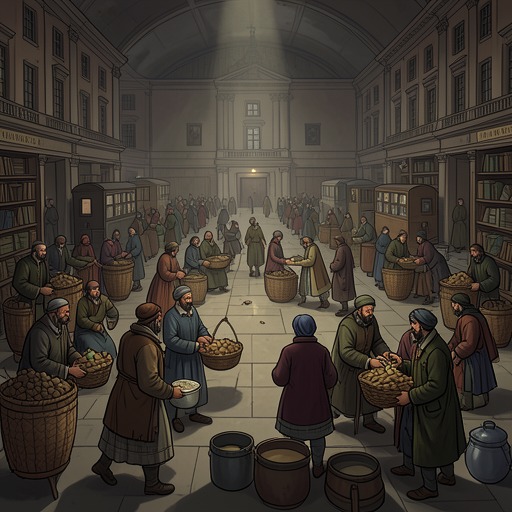
The practice depends on an economy organized around common access to goods. In each city, family production is brought to designated market houses, where goods of the same kind are stored together. A father takes what his household needs without payment or exchange. The account presents this abundance as removing the incentive to ask for more than necessary: people need not hoard against want, and the prestige attached to outdoing others in display has no proper place in the laws of the Utopians.
Provisioning also operates across the island. At the annual great council in Amaurot, three representatives from every town assess which places have surplus and which face scarcity, and supplies move freely between them. The towns maintain stores for two years against unfavourable seasons; only after the country’s needs and reserves have been addressed do they export the overplus. Grain, honey, wool, flax, wood, wax, tallow, leather, and cattle are among the goods sent abroad. A seventh of these exports is given to the poor in the receiving countries, while the remainder is sold at moderate prices.
Foreign trade brings back the few things Utopia needs, especially iron, as well as large quantities of gold and silver. The resulting wealth is held principally in public arrangements rather than as private riches: much of the treasure is represented by bonds in the name of towns, not individual citizens. Towns that owe money collect from those who owe them and keep the funds in public accounts or make use of them until repayment is requested. If a neighbour needs money more urgently, the Utopians may call in what is owed and lend it onward. Thus their rejection of money as a domestic measure of value does not mean that gold and silver disappear from their dealings with other nations.
Usefulness, Scarcity, and Public Reserve
The account explains the different valuation of metals by distinguishing actual usefulness from conventional price. Since money has no ordinary use among the Utopians, precious metals are kept as provision against uncommon events, with long intervals generally separating the emergencies for which they might be needed. Iron, by contrast, is indispensable to ordinary life, while gold and silver have no similarly essential use. Their high price elsewhere is attributed to human custom and their scarcity, not to a necessity inherent in the metals themselves. Nature is described as making useful things such as water and earth plentiful, while withholding or concealing things treated as vain or useless.
The public reserve nevertheless has a practical role in war. When the Utopians are engaged in conflict, they use their treasure to hire foreign troops, whom they are more willing to expose to danger than their own citizens. High pay is also intended to encourage enemy soldiers to betray their side or desert, and to foster distrust among opponents. Gold is therefore not simply discarded: it is held for contingencies and deployed instrumentally, while being denied the ordinary power to confer status at home.
The way the reserve is kept is designed to prevent precious metal from becoming an object of domestic reverence or suspicion. Storing it in a tower could provoke jealousy of the Prince and Senate, while turning it into fine vessels or plate might make the people reluctant to melt it down when war required funds. Instead, the Utopians eat and drink from earthenware or glass. In public halls and private houses alike, chamber-pots and closestools are made of gold and silver. Chains and fetters for enslaved people are fashioned from the same metals; some wear gold earrings, chains, or coronets as marks of disgrace. The contrast makes gold visible, but in forms that oppose its conventional dignity.
Adornment and the Anemolian Embassy
Pearls and precious stones found on the coasts and rocks are not sought out as objects of ambition. When Utopians come upon them by chance, they polish the finds and give them to children, who enjoy wearing them while young. As they grow older and learn that such ornaments are associated with childhood, they put them aside without needing parental instruction. The change in taste makes the social meaning of jewels appear learned rather than natural: adornment loses its attraction when it no longer signals adult distinction.
The arrival of the Anemolian ambassadors at Amaurot demonstrates how sharply custom can reverse an intended display. Delegations from several towns had gathered because the visitors were coming to discuss important affairs. The Anemolians, unfamiliar with Utopian conventions, mistook plain dress for evidence that the island lacked fine goods. Three ambassadors entered with a hundred attendants in varied clothing, much of it silk; the ambassadors themselves wore cloth of gold, heavy chains, earrings, rings, and caps covered with pearl bracelets and other gems.
The spectacle produced the opposite of the reverence they sought. Utopians associated the visitors’ finery with slavery, disgrace, or children’s playthings, and some mistook the most modestly dressed members of the party for the ambassadors. Children who had outgrown their own jewels pointed out the visitors’ ornaments, while adults questioned the usefulness of their loose, apparently ineffective chains. After a day in Utopia, the ambassadors saw gold used in household objects and in the fetters of enslaved people, and learned how little esteem the Utopians attached to it. They became ashamed of their display and put it aside. The episode turns precious dress into a failed act of communication: the same objects that promise rank in one society announce subjection or immaturity in another.
Critique of Wealth and Social Rank
The Utopians’ judgements extend beyond jewellery to the social authority wealth can purchase. They question why anyone should value a jewel’s uncertain gleam above the sun or stars, or esteem fine cloth when its thread begins as sheep’s fleece. They also object to a world in which a foolish or morally bad person may command the service of wise and good people simply because he possesses a large quantity of gold. If wealth changes hands through accident or legal trickery, the former master may become dependent on the person who acquires it, as though his own standing followed the metal’s fortune.
They regard the deference shown to rich people as especially revealing when those who honour them neither owe them anything nor depend on their generosity. Wealth can attract near-divine respect even when its possessor is miserly and base-minded. Against this arrangement, Utopian education and law cultivate a different judgement: most people, men and women, are taught to spend their free hours reading, and learning continues through life. The rejection of gold’s prestige is thus reinforced by habits that direct attention away from display and toward acquired understanding.
The wider political argument connects money’s value to the preservation of inequality and to harms that law punishes without preventing. Raphael describes other governments as serving the rich, who secure their possessions and make the poor labour cheaply under the appearance of public authority. In contrast, he argues that extinguishing both the use and desire of money would remove many occasions for fraud, theft, robbery, quarrels, sedition, and violence, along with the anxieties and watchfulness associated with maintaining wealth. His example is a year of famine: the granaries of the rich might still contain enough corn to prevent thousands from starving, if it were distributed. The passage therefore presents Utopian devaluation not as an isolated eccentricity about decoration, but as one part of a larger challenge to hoarding and unequal access.
Significance and Limits
The system’s central reversal is concrete: gold remains physically abundant and internationally useful, yet it is made socially poor. Public distribution limits the ordinary need for money; public reserves preserve a strategic use for it; household objects and slave fetters attack its glamour; and children’s changing relation to jewels makes status appear contingent. The embassy scene gives these arrangements a visible test, as foreign magnificence becomes an embarrassment when judged by Utopian standards.
At the same time, the account distinguishes Utopia’s internal order from its dealings beyond the island. The Utopians export goods, accumulate claims and precious metals, lend to neighbours, and spend treasure on foreign soldiers in wartime. The policy is therefore a reordering of value rather than an assertion that metals have no possible use. Its critical edge comes from asking why a resource with limited everyday utility should rule social esteem, shape political dependence, and coexist with preventable deprivation.