Communal ownership
UtopiaCommunal ownership is the foundation of Utopia’s social order and the premise behind Raphael Hythloday’s most sweeping criticism of other governments. In his account, shared property removes the fear of want that encourages acquisitiveness, while common stores and distribution allow people to live in plenty without private fortunes. The dialogue gives this ideal concrete institutional form, but leaves its evaluation unsettled: Raphael defends it as the basis of justice, whereas Thomas More’s narrator closes with reservations about living without private property or money.
The principle and its argument
Raphael argues that a country cannot be governed justly or happily so long as property remains and money measures the worth of other things. Where goods are divided among private owners, he says, the best things tend to fall to the worst people, wealth gathers in the hands of a few, and the rest are left in misery. New laws cannot reliably secure ownership or establish what belongs to whom; the frequent, unresolved lawsuits of property-owning societies are, in his view, evidence that legal regulation does not cure the underlying problem.
For Raphael, communal ownership changes the structure of distribution rather than merely softening its worst outcomes. He allows that limits on land and money, restrictions on princely power, and safeguards against offices being sold or made too costly could mitigate hardship. But he compares such reforms to care for a desperately ill patient: they may relieve symptoms without curing the disease. While people can accumulate what they can obtain, he contends, a small group will divide the nation’s wealth and the majority will bear cares and anxieties. His argument thus links property not only to poverty, but also to unequal power and the instability produced by attempts to regulate inequality piecemeal.
Distribution as a daily institution
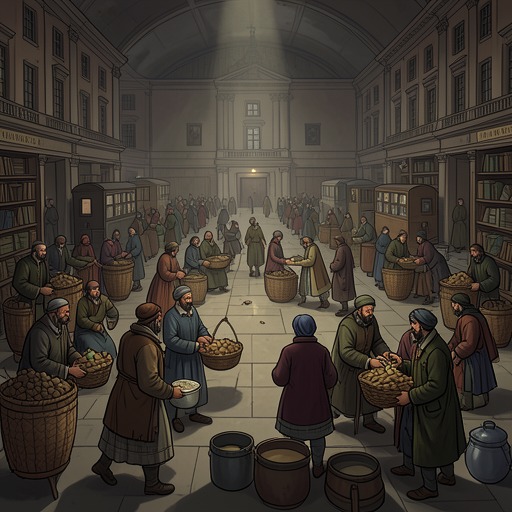
The account describes shared ownership through ordinary access to goods. Each city is divided into four parts, with a marketplace in the middle of each. Families bring what they produce to designated storehouses, where goods of the same kind are gathered together. A father then takes what his household needs without payment or exchange. The system does not depend on bargaining over each item: Raphael says that abundance removes the reason to refuse anyone, while reliable provision leaves people no incentive to take more than they need.
This arrangement is also a contrast between two motives. Raphael attributes greed partly to fear of scarcity, but says that human pride turns superiority in pomp and excess into a source of distinction. In Utopia, the laws leave little room for such display. The claim is not simply that people share goods; it is that secure access and the absence of private accumulation weaken the incentives that make possession a contest. The household’s place in the system is visible in its regular use of the common store, while provisioning is organized around need rather than an individual’s ability to pay.
Island-wide coordination and external trade
Communal distribution extends beyond individual cities. At the annual council in Amaurot, three senators from each of the island’s fifty-four cities examine which places have provisions in excess and which face scarcity. They supply one another without exchange, so Raphael describes the island as one family. The council also ensures that stores sufficient for two years are set aside against an unfavourable season. Only after the island’s needs and reserve have been accounted for does it order the export of surplus goods, including food, wool, wood, leather, and cattle.
The arrangement does not mean that Utopia has no dealings in money beyond its own society. It gives a seventh of exported goods to poor people in the countries receiving them, and sells the remainder at moderate rates. The island brings back goods it needs, especially iron, and accumulates gold and silver through trade. Contracts are made in the name of a town rather than an individual: towns that owe money collect from their own debtors and retain or use the funds until the Utopians call them in. They may also lend money to neighbours in need. Raphael therefore distinguishes the absence of money in domestic distribution from the use of a public financial reserve in relations with other nations.
Gold, security, and the uses of wealth
The treatment of precious metals makes the difference between Utopia’s internal order and other nations especially pointed. Since gold and silver have little use in ordinary life on the island, the Utopians value them according to their practical usefulness, not their scarcity. Raphael contrasts them with iron, which is essential, and presents the high value attached to gold and silver elsewhere as a human convention rather than a measure of genuine need.
The island’s gold is nevertheless kept for contingencies, particularly war, when it can be used to hire foreign troops. The Utopians do not treat it as a treasure to display or guard in a royal storehouse: they fear that either practice could provoke distrust or attachment to the metal and make people reluctant to spend it when necessary. Instead, they deliberately make precious metal socially undignified. Their chamber pots and close stools are made of gold and silver; the same metals are fashioned into slave chains and other badges of infamy. Children wear pearls and gems, then discard them as they grow older and recognize them as childish ornaments. These details turn devaluation into a public practice: wealth remains available for external emergencies while losing its power to command admiration at home.
The dialogue’s unresolved judgment
Raphael’s defence culminates in a broader indictment of governments that preserve the interests of the rich under the appearance of public authority. He argues that if money lost its value, many crimes and conflicts punished by law would also lose their causes, and that poverty itself could be relieved: even in a year of famine, he observes, hoarded grain might have prevented deaths if it had been distributed. Pride, which measures its own standing against the misfortune of others, is the obstacle he identifies to adopting the Utopian order. Communal ownership thus appears as both an economic arrangement and a challenge to the social prestige built on unequal possession.
The framing of the argument prevents Raphael’s vision from becoming an uncontested conclusion. The book moves from an account grounded in Thomas More’s journey to Flanders into the fictional report of Raphael, whose travels and observations lead Peter Giles to ask why he does not serve a king. The resulting debate places practical political counsel beside an imagined society whose institutions can expose the assumptions of existing governments. At the end, More’s narrator acknowledges that he finds aspects of Utopian life, especially common living without money, difficult to accept because they would remove what many people regard as a nation’s ornaments: nobility, magnificence, splendour, and majesty. He commends the constitution in general but says he cannot agree with everything Raphael has related, while wishing that many Utopian practices could be followed by other governments. Communal ownership remains, accordingly, both the principle that makes Raphael’s ideal society coherent and the question the dialogue deliberately leaves open.